It’s that time of year. Amazon is cutting a million-dollar check to Seattle’s chamber of commerce political action committee. Their candidates are talking about accountability and responsibility, and we still don’t know what that means–but it seems to pay well. Milquetoast Moderates insist it’s their time. To do what? It’s unclear. Keep a low profile? Shy away from taxes? Hold business roundtables? Valet park their wealthiest constituents?
Luckily, candidates with stronger aspirations than being Jeff Bezos’s lapdogs are out there. We have before us an inspired pack of urbanist progressives that generally care about making it safer for people walking, rolling, and biking to get around. They’re willing to raise progressive revenue to fund affordable housing and transit upgrades. We sought candidates that had an equity lens and used it to construct policies rather than only to destruct them.
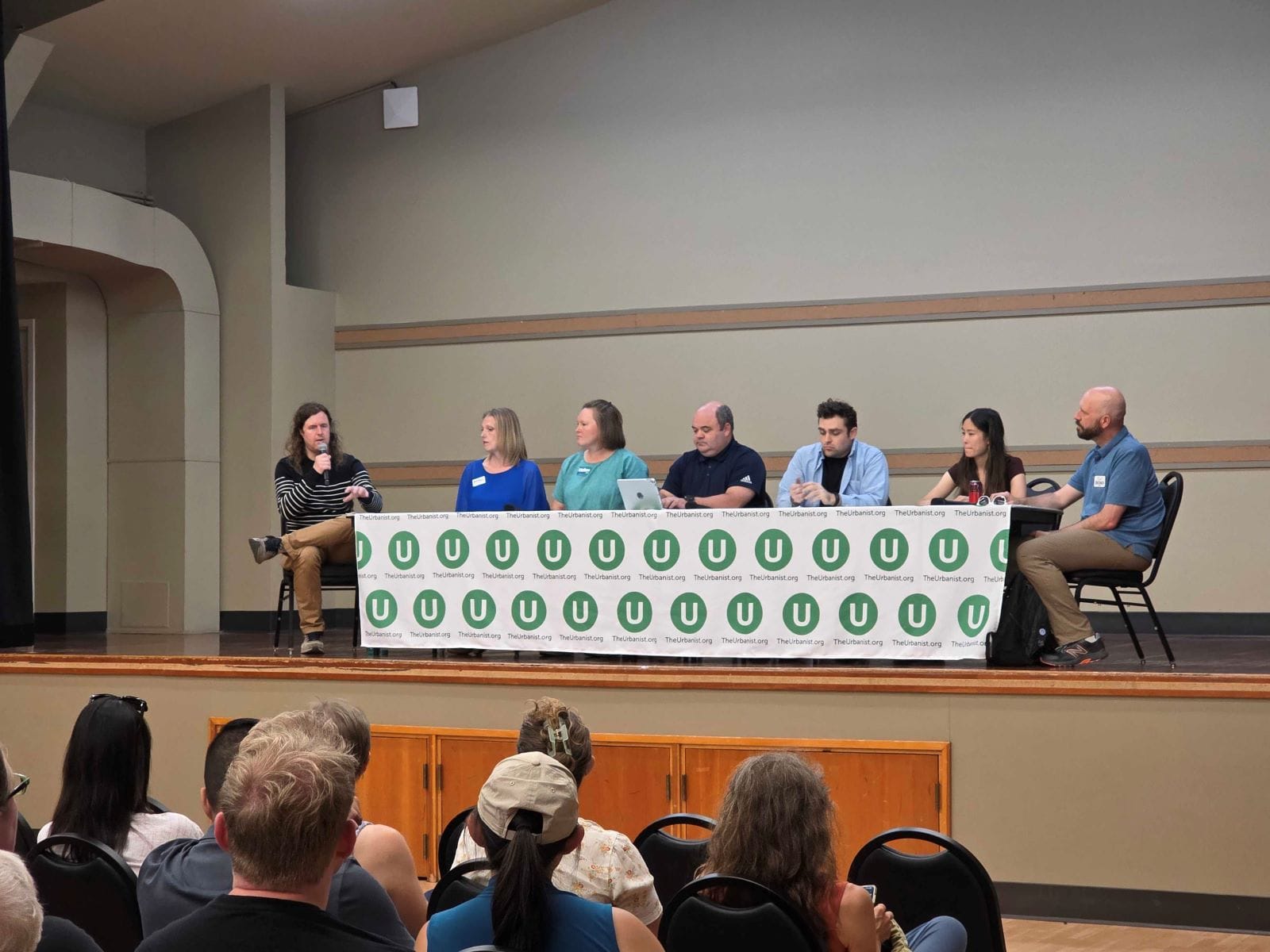
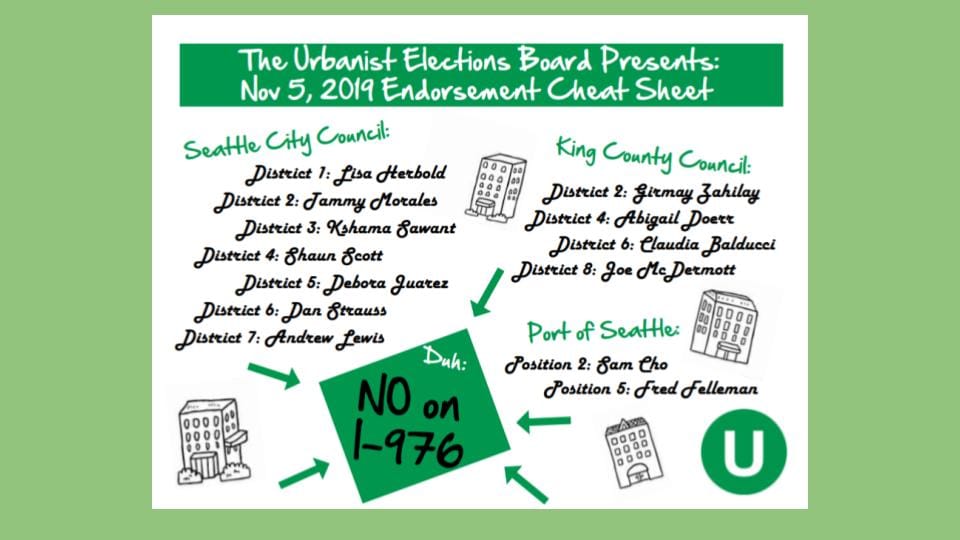
The Urbanist Election Board crafted a questionnaire zeroed in on these issues, and we published highlighted candidate responses on issues like congestion pricing, affordable housing strategies, the streetcar, Vision Zero, and evictions/displacement. Additionally, we hosted candidates for in-person interviews and finally arrived at our endorsements.
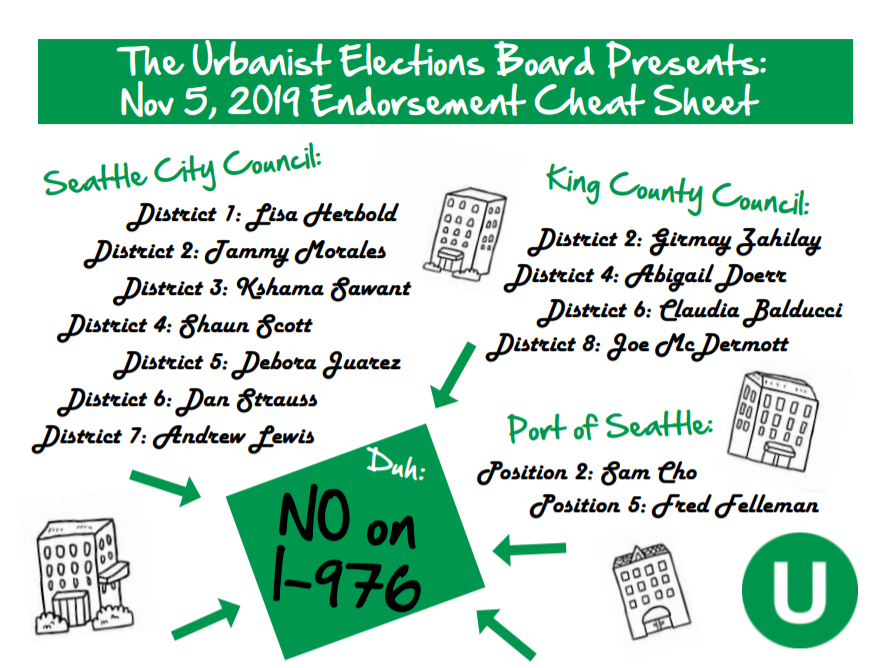
No On Tim Eyman’s I-976
Tim Eyman isn’t just after our office chairs, he’s trying to gut our transportation system.
Tim Eyman has dedicated his life to cutting taxes in Washington State and his latest terrible initiative, I-976, would put over $25 billion (yes, BILLION!) at risk for critical state transportation projects. I-976 would impact every community throughout Washington State, taking away precious funding for transit service and expansion, ferries, Amtrak, Washington State Patrol, and road and bridge maintenance.
I-976 would limit all car tab fees in Washington State to $30, and reduce other vehicle licensing and weight fees. It would take away 61 cities’ authority to use Transportation Benefit Districts for car tabs, cutting $60 million for local municipalities to pay for road improvements and transit service in their community. For example, the car tab portion of the Seattle Transportation Benefit District would disappear, cutting $36 million that funds hundreds of thousands of bus service hours and Seattle’s youth ORCA program.
It also would severely delay or potentially cut Sound Transit light rail projects, and puts close to 40% of the entire ST3 package at risk. This initiative also cuts transit access services for people with disabilities, seniors, students, and Northwest Tribes, and could shut down rural transit agencies like Mason Transit and Garfield Transit that depend on state funding to run its transit service.
The bottom line is I-976 would increase congestion and leave people with fewer transportation options. Spread the word and vote No on I-976.
Seattle City Council
D1: Lisa Herbold
Councilmember Lisa Herbold is a hardworking legislator. She takes bold progressive stands, but she also often defends the status quo when it comes to parking, single-family zoning, and sabotaging the streetcar. She can talk about equity while trying to sink an extra billion dollars building a light rail tunnel to West Seattle whose primary function appears aesthetic–and which will almost surely delay light rail reaching High Point, Westwood Village, and White Center. Despite some suburban proclivities, Herbold is a net positive on the city council, willing to stand up to big corporations.
Her opponent Phil Tavel is a chamber darling who ironically has a dozen failed business ventures to his name and thousands of dollars in unpaid traffic tickets. Accountability and fiscal responsibility starts at home, dude. While Herbold got most of her irresponsible driving behavior out of her system in the 1990’s, Tavel apparently is still driving like a jerk to this day. He goes further than Herbold in opposing upzones and pandering to and embodying car culture.
We hope to see more of the Herbold that voted for the head tax and championed affordable housing funding–and less of the Herbold that launched into soliloquies railing against the streetcar and new parking reforms at every opportunity. Vote Herbold.
Read Lisa Herbold’s questionnaire responses here.
D2: Tammy Morales
Tammy Morales earned our endorsement in the primary and cruised to a first place win with more than 50% of the vote. She’s a strong supporter of transit and affordable housing, and she’s backed by a wide progressive coalition. Morales has a vision for incorporating race and social justice into the City’s work, and she has experience implementing that vision as an organizer for the Rainier Beach Action Coalition and a legislative director in the Texas Legislature.
That said, Morales’ proposal to make each development project go through a displacement analysis seems like a recipe for a logjam. Displacement analysis should happen at a higher level. She’s also been skeptical of congestion pricing. While she has signaled some flexibility here, we worry when an equity lens is lavished on motorists while ignoring people stuck in buses clogged in congestion. Challenging car culture is good for equity given the very high cost of car ownership and our coming climate reckoning.
Her opponent Mark Solomon is running a centrist pro-business campaign. Mayor Jenny Durkan endorsed him and tried to smear Morales as a socialist in order to support his primary chances. Solomon eked through the primary, but, as a yes man for the chamber and the mayor, it’s not clear what he has to offer the working class. Vote Morales.
Read Tammy Morales’ questionnaire responses here.
D3: Kshama Sawant
Councilmember Kshama Sawant is a controversial figure, but it’s clear she’s fighting for the least among us. Sawant pushed the city to raise the minimum wage to $15, which has been a big success, and she has continued to fight for rent control. She’s a reliable vote for safe streets infrastructure like protected bike lanes, and she didn’t just vote for Mandatory Housing Affordability (MHA) upzones, but also sponsored amendments bumping up capacity in her district.
Egan Orion, on the other hand, doesn’t seem ready for the tough calls a city councilmember has to make. Backed by copious spending from the Amazon-backed Civic Alliance for Sound Economy (CASE) political action committee (PAC), Orion has pleaded ignorance. “I didn’t realize CASE had political positions.” he said. We have news for you, Egan. They do. One example, CASE opposes the head tax on larger employers. Big surprise: Orion does too.
While Orion has staked out some urbanist positions and has tried to run to the left to siphon progressive votes from Sawant, it’s clear when the rubber meets the road, he’s got the back of Big Business well before he has our backs. Sawant, on the other hand, will lead the charge to find progressive tax revenue and stick it out when the fighting gets tough. Vote Sawant.
Read Kshama Sawant’s questionnaire responses here.
D4: Shaun Scott
It’s a tale of two starkly different candidates. One is a social justice urbanist. One is not (and got a pathetic 1.25 stars from CAPE). Vote for the urbanist: Shaun Scott.