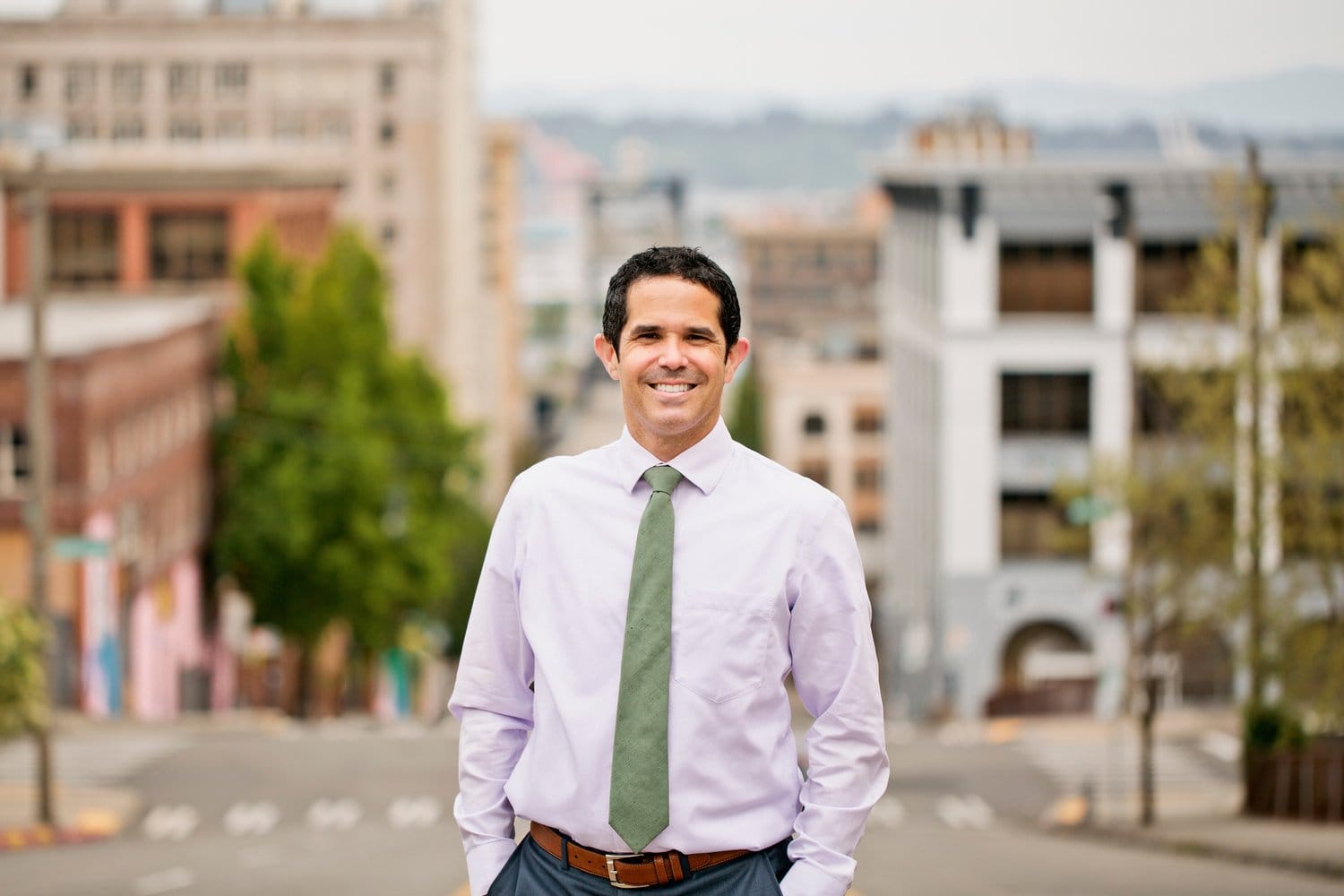
The Urbanist Elections Committee expanded our scope in Pierce County this year, just in time for an exciting race for Pierce County Executive featuring urbanist Ryan Mello. Spoiler: We endorsed Mello. His leadership on a whole host of issues that touch not just Pierce County, but the whole region is truly exciting.
County executives in Pierce, King, and Snohomish counties are guaranteed a seat on the Sound Transit Board of Directors and get to appoint replacements to their respective county delegations on the board. All indications are Mello would be a great leader on the Sound Transit board, focused on transit outcomes and willing to creatively problem solve to overcome the inevitable hurdles that crop up when dealing with massive infrastructure projects. Mello has pushed the agency to invest in and accelerate bus rapid transit plans while Pierce County waits on a delayed Tacoma Dome Link light rail extension.
We’ve also endorsed a slate of leaders that can support Mello’s vision at the Pierce County Council. After a long run of Republican and Republican-lite leadership that has meant unchecked sprawl, divestment from transit, and cutting social services, Pierce County sorely needs an era of progress and investing in the future. The Urbanist’s 2024 slate offers that.
We have endorsements across the Puget Sound Region and in statewide races. It’s a politically fraught and anxious time, but we have singled out leaders that you can rely on to carry forward real solutions on housing, climate, transit, and economic justice. We can forge a better future by growing together and taking care of one another — not by burying our heads in the sand to ignore real problems and ripping each other apart over invented ones.
Return ballots to drop boxes or get them postmarked by 8pm August 6 to ensure your vote is counted. Register to vote or update your address here.
The Urbanist’s 2024 Primary Slate Cheat Sheet
| Governor: No Endorsement | Seattle City Council 8: Alexis Mercedes Rinck |
| Attorney General: Nick Brown | LD01-1: Davina Duerr |
| Lands Commissioner: Patrick DePoe | LD05-1: Kristiana de Leon |
| 2nd Congressional District: No Endorsement | LD22 Senate: Jessica Bateman |
| 8th Congressional District: Imraan Siddiqi | LD34-1: Emily Alvarado |
| Pierce County Executive: Ryan Mello | LD34-2: Joe Fitzgibbon |
| Pierce County Council D2: Davida Haygood | LD36-1: Julia Reed |
| Pierce County Council D3: John Linboe | LD36-2: Liz Berry |
| Pierce County Council D6: Jani Hitchen | LD37-2: Chipalo Street |
| LD-27-2: Devin Rydel Kelly | LD38-1: Julio Cortez |
| LD27 Senate: Yasmin Trudeau | LD41-2: My-Linh Thai |
| LD28 Senate: T’wina Nobles | LD43-1: Nicole Macri |
| LD29, Position 1: No Endorsement | LD43-2: Shaun Scott |
| LD29-2: Sharlett Mena | LD45-2: Melissa Demyan |
| LD33-2: Mia Su-Ling Gregerson | LD46-2: Darya Farivar |
Governor: No endorsement
Attorney General Bob Ferguson, the most substantial Democrat running for Governor, declined to participate in our endorsement process during the primary. We would have loved to talk to him, because we have concerns about his record on transit and urbanism, and perhaps he could put them to bed.
Ferguson launched his political career in 2003 by taking down King County Councilmember Cynthia Sullivan, a pioneering urbanist and Sound Transit supporter. Ferguson argued Sound Transit was out of control and mismanaged during his campaign, but hardly took a leadership role in addressing those issues in his three subsequent terms on county council.
As Attorney General, Ferguson defended Tim Eyman’s 2019 ballot initiative, which gutted transit funding, more vigorously than warranted. State law obligates attorney generals to defend citizen initiatives once they’ve passed, but they have discretion in the vigor and resources they pour into that defense. Ferguson boasted at the time that he was making his staff work over Thanksgiving to file an injunction seeking to ensure Eyman’s measure went into effect, despite a challenge that ultimately proved its unconstitutionality (due to the multiple subjects and misleading ballot title, which Attorney General Ferguson had approved). Eyman’s car tab measure would have put transportation budgets across the state into chaos, imperiling progress on transit and road safety.
Given the opportunity to speak with Ferguson about concerns like these prior to the general election endorsements, we might be able to get our endorsement pens out. But by skipping our process, all we can do is shrug, continue to have reservations about his transit stances, and comment on his opponents. Lucky for Ferguson, we were not impressed by the competition.
Mark Mullet made his name as a roadblock to progressive legislation in the state senate, and has big business support to animate an otherwise listless corpse of a campaign, which is polling in the low single digits. Mullet fought to expand highways (including a costly SR 18 expansion pet project), water down climate legislation, kill rent stabilization, and obstruct a capital gains tax while in office. That’s not a train we’re trying to board. His platform is short on viable solutions, with his homelessness policy centers around hiring more cops and criminalizing homeless people, which has not worked, even if you can get past the moral qualms. Mullet told us that he agreed with the recent Grants Pass Supreme Court ruling, permitting cities to sweep people sleeping outside without first offering shelter and services.
We do have to hand it to Mullet for talking to us, despite the criticism this publication leveled at him in the past. He was not afraid to speak his mind and tried to identify places where we do agree, albeit not with much success. For us, being the owner of the first Tesla in Washington state is not the flex he thinks it is. We’re looking for leaders who understand the importance of transit and breaking free of car dependency, but we’re struggling to find them in this race.
Andre Stackhouse is a young, idealistic Green party candidate, and much of his platform sounds promising. Universal health care, a housing guarantee, tuition-free college, and fare-free transit sound great in theory, but difficult to implement in practice. Stackhouse was not pleased with our initial writeup, arguing his extensive list of policy ideas deserved more attention, and clarifying he does not propose Cascadia secession, but more incremental political “sovereignty” steps, like a state public bank and increasing voter rights. Overall, we were looking for more than a laundry list of ideas and the swagger to trumpet them (and berate any election committees that may stand in the way). We were hoping to be inspired with faith in the candidate’s ability to effectuate his ideas — to no avail.
Fred Grant has volunteered at homeless shelters, but unfortunately this has not left him with a grasp of the issue, or apparently much compassion for people who are experiencing homelessness. Grant not only agreed with the Supreme Court on ramping up homeless sweeps (even without offering shelter first) but also provided muddled thoughts about drug use and forced treatment. He told us that he believes drug users should not go to jail, but something like a jail where they can’t leave and are forced into treatment. We’ll spend the rest of the election trying to figure that one out. Yikes.
- Bob Ferguson didn’t return a questionnaire.
- Mark Mullet Questionnaire
- Andre Stackhouse Questionnaire
- Fred Grant Questionnaire
Attorney General: Nick Brown
The role of Attorney General is a complicated one. The office oversees an array of civil litigation across a number of divisions, with mandates as wide-ranging (and sometimes seemingly contradictory) as defending the state prison system from Washingtonians with civil rights complaints and advancing affirmative civil rights litigation on behalf of Washingtonians. The right person for the role needs a variety of experience to grapple with this wide-ranging work. This is ultimately why The Urbanist chose to endorse Nick Brown.
While both candidates we considered for this role, Manka Dhingra and Nick Brown, have experience as prosecutors, Brown brings additional experience as a civil litigator with a variety of roles and perspectives, including recently serving as the U.S. Attorney for the Western District of Washington and as general counsel for Governor Jay Inslee. (Also, notably, a Survivor alum, which might not qualify one for office but is a fun fact.)
Both candidates had strong interviews. Dhingra had a particularly strong answer to how she would hold client agencies accountable, including the Department of Children, Youth, and Families. Similarly, she explained that she would use her discretion so as to not defend a misleading Tim Eyman-style initiative that would kneecap Sound Transit as vigorously as Bob Ferguson did. (Dhingra later clarified that “as the people’s attorney, I will always ensure the integrity of the initiative process and the voice of the people are heard and defended.”) Meanwhile, Brown touted his plan to consolidate the workers’ rights work at the office into a Labor & Worker Rights Division. Both of their plans would contribute to building stronger, safer, healthier communities.
In the end, we determined that Brown’s breadth of experience, including executive branch background, made him the survivor. Vote Nick Brown.
Lands Commissioner: Patrick DePoe
The open lands commissioner seat drew a surprisingly broad field this year, with some big names, from Democratic King County Councilmember Dave Upthegrove of Des Moines to Republican former US Representative Jaime Herrera Beutler of Clark County. Patrick DePoe stood out in our interviews as the most prepared leader with the clearest vision for managing state-owned lands, which at nearly 6 million acres account for about 13% of all land in Washington. Those state holdings include extensive forests and watersheds supporting threatened salmon runs.
DePoe, who is former vice chair of the Makah Tribe and the Department of Natural Resources’ current tribal relations director, had the clearest answers for how state land management could further forest health and salmon recovery, while also providing needed resources for local communities. DePoe’s run was inspired in part by a desire to carry the torch after the passing of Indigenous rights legend Billie Frank Jr., an activist and Nisqually Tribe leader who helped Pacific Northwest tribes secure fishing rights guaranteed in their treaties, but blatantly ignored by state officials for much of the 20th century.
Activism by Frank and others helped secure the 1974 Boldt decision from a federal judge, providing the tribes the right to co-manage fisheries and take 50% of the annual fish harvest. With the ruling, the state DNR went from a key actor in abusing tribal fishing rights and impoverishing Indigenous communities, to (eventually) a key actor in protecting those rights and co-managing fish runs. This history, recently recounted in the SIFF-screened 2024 documentary Fish Wars, should be required reading for Washingtonians, taught in school curriculum.