National politics are abysmal right now, as this administration tramples on civil rights, shreds the constitution, poisons diplomatic relationships, and eviscerates basic social programs to line the pockets of the rich. By controlling what we can control, we can begin to turn it around, preparing for the challenges ahead and greener pastures beyond. We must elect good people who are ready to fight for our values to local office, and luckily we have just such people to recommend.
It’s very tempting to give in to hopelessness and cynicism, given decades of federal gridlock on key issues and Trump’s blowing up institutions and norms before our eyes with little immediate resistance. Despite the direness of the hour and the increasing vitriol and violence accompanying our discourse, capable leaders have stepped up. Some are running for office for the first time, and others are seeking greater responsibility — even with the scarcity of tools before them as the federal government adjudicates its duty and moves to implode itself.
This is precisely when good leaders are needed, and we are glad good people continue to put themselves forward. We’ve sought to select people with the conviction and skills to meet the moment. In some races we were blessed with multiple seasoned urbanist leaders or credible “baby” urbanists quickly growing into their own, which made our selections difficult. We’re thankful to all who ran and to everyone who continues to fight for this democracy. Even an act is small as casting a ballot and believing change is possible and brighter days are ahead is an act of resistance. Don’t sit this one out.
Ballots will soon be arriving in your mail boxes. Washington voters have until 8pm Tuesday, August 5 to return a ballot at a drop box or get it postmarked. Visit the Vote WA portal to register or check your voter information.
Note: Some races have great urbanists running, but if they only face one opponent they do not have a primary and automatically advance to the General Election in November. Other races had solid candidates, but if they do not return our questionnaire, they are ineligible for endorsement based on our rules.
The Urbanist Elections Committee consists of Forest Baum, Emma Biscocho Pelletier, Angela Compton, Caitlin Hepworth, Kacie Masten, Jason Merges, Oliver Moffat, Ryan Packer, Aparna Rae, Maya Ramakrishnan, Hannah Sabio-Howell, Jazmine Smith, Doug Trumm, and Kelsey Vanhee.
***
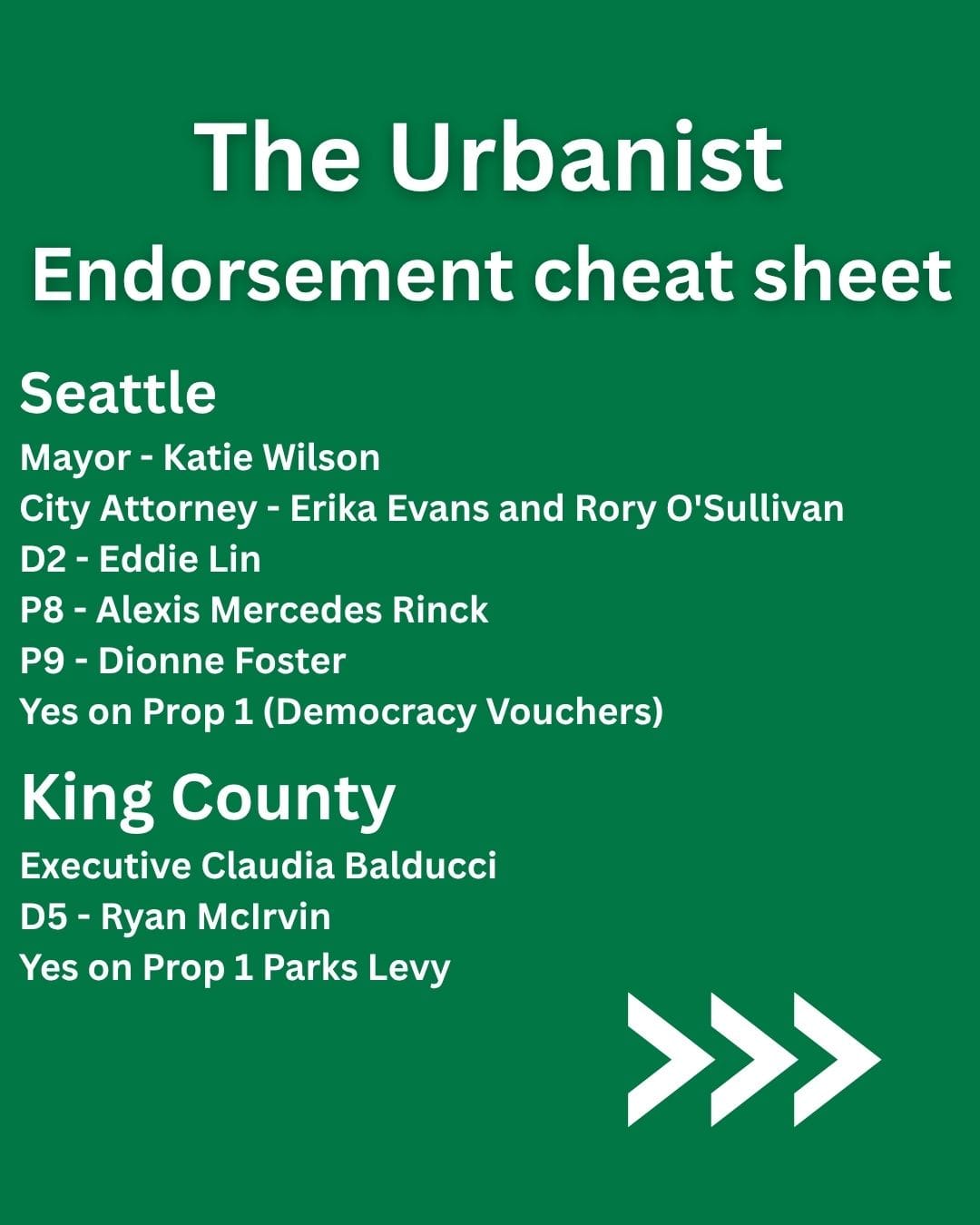
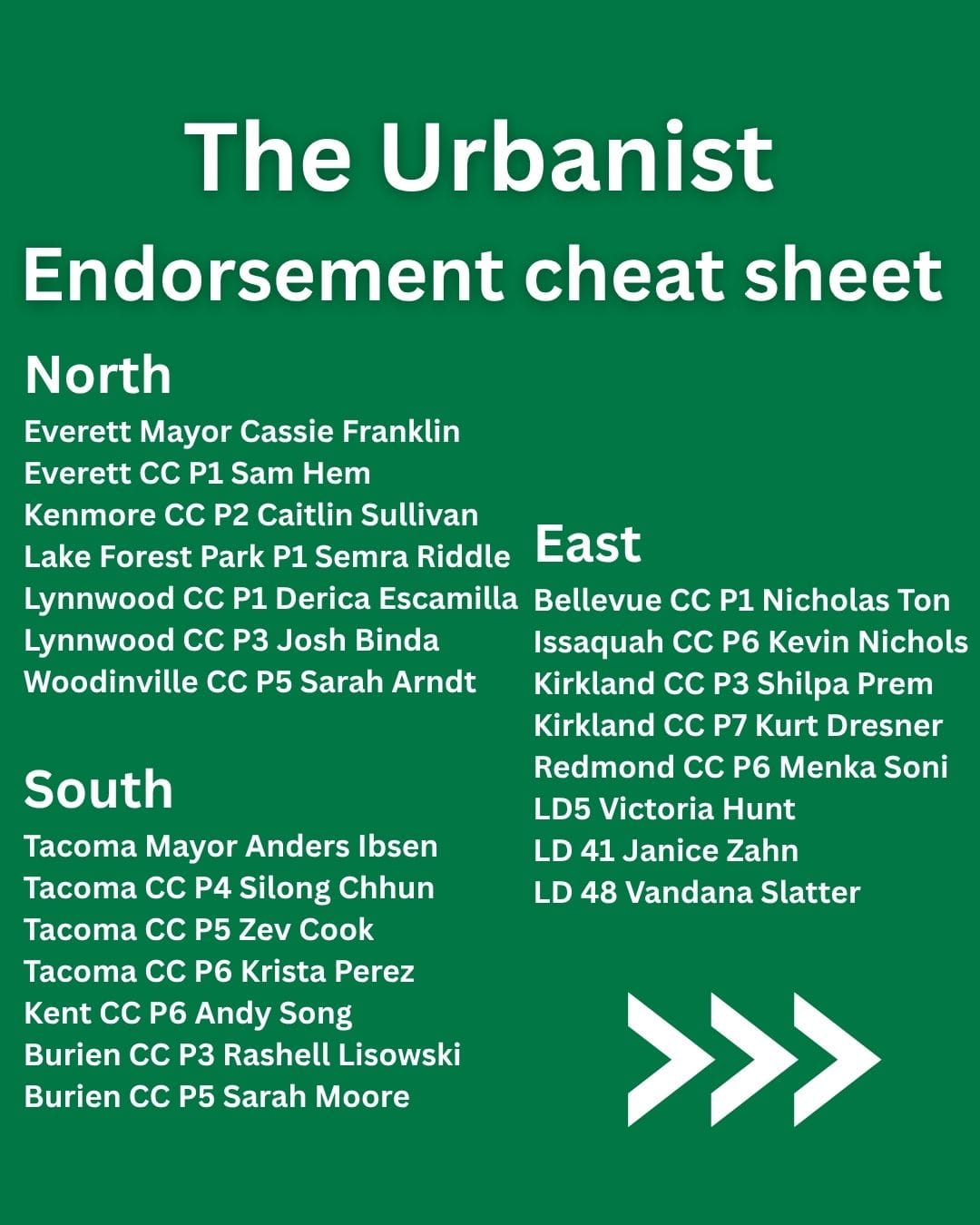
King County Executive: Claudia Balducci
Help Wanted: Adept leader with the ability to manage Washington’s largest county. Must bring experience to handle structural budget issues, deal with impending federal cuts to public health, handle a countywide housing crisis, and avert a looming fiscal cliff at King County Metro. Another prerequisite: the ability to accelerate King County’s work to stand up and operate voter-approved crisis care centers in the face of community opposition. And then there’s a full-time side hustle: steering the entire Sound Transit board toward a stable ST3 delivery plan.
More than just about every other local elected official we can name, Claudia Balducci has been in the policy trenches, playing a long game and pushing for reforms that often don’t bear fruit until years down the line. Balducci has helped lead a wave of progressive urbanist leaders on the Eastside, helping the region break out of a suburban mindset and embrace rapid transit and urbanization.
When she was Bellevue’s Mayor, she committed to bringing more homelessness services to an area of the county that only had one single men’s shelter. She was able to fulfill that promise on the County Council, leading on a property sale that paved the way for the Porchlight shelter – a significant achievement on its own, but one that opened the door to more tools to help people exit homelessness on the Eastside.
From bringing the K Line back from the dead, to bringing regional attention to the issue of traffic safety as president of the Puget Sound Regional Council, to championing arts funding via the Doors Open levy and ensuring those dollars actually reach arts organizations, Balducci has had a hand in so many regional wins over the past decade.
Of course, we’re also impressed with Balducci’s work on the Sound Transit board. She’s one of the main reasons that the agency is still considering ways to make a promised Jackson Street transit hub work as a part of Ballard Link right now. We’d love to see what Baducci can do with more staff and the ability to directly pick who she serves with on the board.
Baldduci has pledged to make housing her top priority as County Executive and setting a tangible but ambitious goal of delivering 44,000 affordable homes in her first five years is refreshing and much needed to galvanize action.
We’ve been impressed with what Girmay Zahilay, Balducci’s primary challenger, has done during his time on the County Council. His proposal to use county bonding capacity to fund badly needed workforce housing is still in its inception, but it shows promise. Zahilay is charismatic, and elevating the needs of disadvantaged, often overlooked residents of South King County has in turn elevated the political debate. He’s brought renewed focus to improving road safety in the Rainier Valley by fixing the most dangerous set of light rail tracks in the region.
On the other hand, Zahilay plans for the office have remained high-level. A pledge to use performance metrics and ratchet up government efficiency doesn’t tell us much on its own, without more concretely defining the goals toward which they’d serve. Zahilay is clearly a rising star in local politics, but it’s crucial the next County Executive hits the ground running and tackles big problems, rather than using the office as a stepping stone or a testing ground.
Both candidates are inspiring leaders we are very thankful to have in public service. When it comes down to it, we have more confidence in Balducci’s ability to execute ambitious plans and navigate choppy waters on the horizon due to federal chaos that is sure to strain budgets and put many people at risk. Vote Balducci.
King County Proposition 1
The King County Parks Levy is a funding source that’s benefited King County’s park system since it was initially approved by voters in 2003, and makes up about 80% of the King County Parks Department’s budget. Renewed by voters every six years since, the levy has paid for maintenance and repairs to existing parks, trails, fields, and play areas, as well as the creation of new ones through grant programs designed to expand park access to under-resourced communities.
King County’s parks and trail systems are some of the best in the country, largely due to the resources from this levy. The 2025 renewal would help fund the completion of the 42-mile Eastrail trail as well as complete and improve other regional trail connections, getting us closer to a truly interconnected trail system for bikes and pedestrians to move through all of King County.
The property tax’s renewed rate would cost property owners 23.29 cents per $1,000 of assessed value, totaling less than the cost of some streaming services per month for most homeowners. It’s only a slight increase over the current levy, which charges about 19 cents per $1,000 assessed property value. The renewed rate would cost the owner of a median-valued home about $17.18 per month, about $3.44 more per month than they currently pay, according to the County.
Add to the benefits increased accessibility at urban and rural parks, continued investments in habitat and waterways, and resources for educational programs for kids, the choice couldn’t be clearer. Ensure King County’s public spaces remain beautiful, safe, and accessible by voting YES to renew the parks levy.
Seattle Mayor: Katie Wilson
Katie Wilson is the clear choice to push Seattle forward and make this a city where everyone can thrive. Wilson had been in the middle of progressive victories over the last decade as head of the Transit Riders Union, but she has done about as much as possible from the outside. It’s time to send her to the top floor of city hall to navigate the city through a very challenging period when big ideas are needed — rather than four more years of vacillating, foot-dragging, and leading from behind.
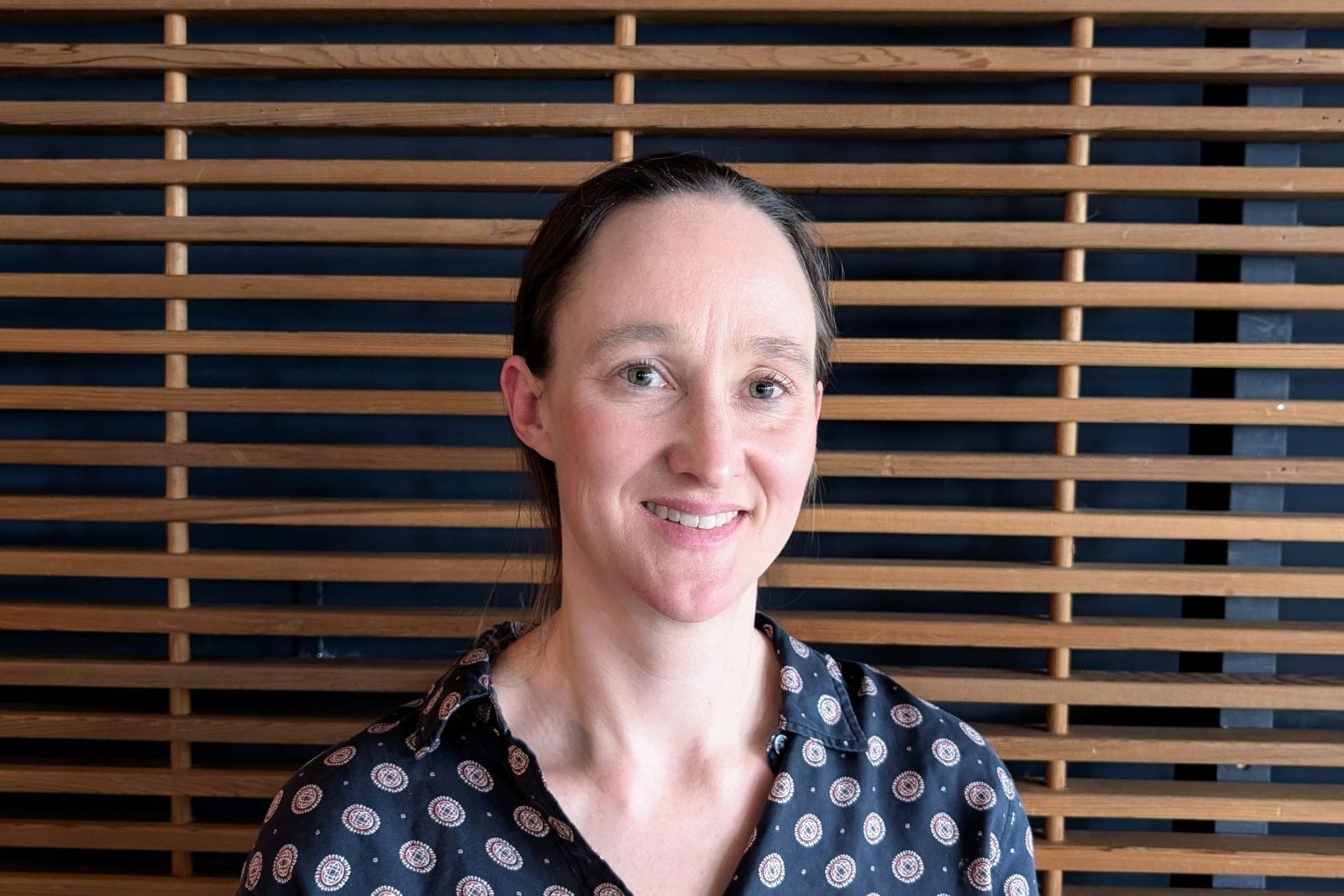
Seattle’s sitting mayor, Bruce Harrell, marks a sharp contrast with Wilson. He’s a slick politician, always ready with the ceremonial shears to cut a ribbon on a project — many initiated by predecessors. But Harrell is rarely eager to do the heavy lifting to advance a new initiative. Harrell has spent more time riffing on his “One Seattle” slogan than backing it up with the policy wins to turn the lofty rhetoric into real results on the ground.
Despite ample opportunity to work with centrist allies on Council, Harrell did not deliver on his big campaign promises from four years ago, which swept him into office. For example, Harrell promised 2,000 additional units of emergency housing for homeless people in his first year, but fell well short. Instead, the number of shelter beds have shrunk under his watch, even as destabilizing sweeps of homeless people have reached a new record high. Without beds for unhoused people to go, sweeps are largely spreading the problem around, rather than providing a durable solution, as Wilson has underscored.
Harrell pledged to speed up light rail delivery, but instead has helped delay it with his indecisiveness about route decisions. His move to abandon a hub station in the Chinatown-International District planned as part of Ballard Link could be a generational mistake. We have much more faith in Wilson’s ability to improve outcomes for transit riders and communities as a Sound Transit board member.
Wilson’s top two campaign priorities are “affordable and abundant housing” and “a real reduction in homelessness.” Unlike Harrell, we would expect Wilson to make real headway in her first term, rather than waiting around and blaming others for not clearing hurdles, as Harrell has done.
For example, Harrell campaigned to block a grassroots social housing initiative, rather than simply endorsing it or getting out of the way. Showing how out of touch and little regarded the mayor was, Seattle voters passed the social housing measure by a 26-point margin anyway, despite the mayor’s face being plastered on opposition mailers. In contrast, Wilson and the Transit Riders Union threw their weight behind the initiative.
Time and again Wilson has done the heavy lifting to get ideas that seemed impossible passed into law. As Urbanist board member Rian Watt put it: “You’ve already felt Wilson’s impact if you or your kid have zipped around the city with a subsidized Orca card. Her organizing with the Transit Riders Union made that happen. If you’ve had your move-in or late fees capped for your rental apartment, you’ve also benefited from her work. And if you’re working a minimum wage job that actually pays you what you need to survive, you can thank her too. Those aren’t empty promises from a do-little Mayor, those are actual results from a private citizen without even a fraction of his power. Imagine her in his office.”
While Harrell was part of a City Council that abandoned a corporate head tax before it ever went into effect out of fear of backlash from business leaders, Wilson shepherded a much larger “JumpStart” payroll tax into law. The payroll tax has survived numerous legal challenges and political assaults and become an indispensable part of the City budget, saving the city from massive cuts and providing a durable source of revenue to invest in Seattle’s future. Most payroll tax revenue was set aside to fund affordable housing before Harrell overrode the spending plan to fund his own budget priorities. In other words, without Wilson, Harrell’s mayoral term would have been even more lackluster — it may have crashed and burned from sheer lack of resources and ideas.
Wilson has led successful campaigns to win reduced-fare programs for transit riders and expand services and protections for tenants. She’s proposed additional ideas to protect tenants, including the recently passed ban on rent-setting software that have allowed corporate landlords to collude to drive up rent.
Wilson is stridently pro-housing and has pledged to cut red tape and barriers to homebuilding. She told us Harrell should have gone farther in his One Seattle housing plan. While Harrell watered down the growth plan that his city planners developed, Wilson has vowed to zone for more housing citywide and streamline permitting to help theoretical housing capacity to become reality. Harrell also pledged big permitting reforms but dragged his feet throughout his first term and ended up needing to use a temporary ordinance to meet the state deadline to curb design review process delays.
Several of Harrell’s personnel decisions leave much to be desired. Late in 2024 he belatedly ousted the police chief he selected amid multiple scandals, perhaps most damaging is what appears to be a pervasive pattern of sexual harassment and covering for abusers. Failing to take on the cultural problem at the Seattle Police Department (SPD) like Harrell promised in 2021 has kept the department far away from its stated “30 by 30” (30% by 2030) goal of recruiting more women and meeting recruitment and efficiency goals in general. So while Harrell is eager to throw money at SPD, police accountability has continued to suffer.
The career paths of the two leading mayoral candidates couldn’t be more different. Harrell earned millions in corporate law before serving 12 years on City Council and now another four years as mayor. Meanwhile, Wilson spent 15 years as an organizer fighting to improve transit service and tax the region’s wealthiest companies. Wilson rents her home and rides the bus to get around with her young daughter. Harrell owns a mansion just off Lake Washington and sees Seattle through a windshield perspective.
Actor and nonprofit leader Ry Armstrong is also mounting a progressive campaign against Harrell and was first in the race. We admired their passion for tackling big problems like homelessness and their attention on supporting the arts sector. Ultimately, we found Wilson to be the more battle-tested leader with the acumen to forge alliances to turn big ideas into actionable initiatives.
Seattle deserves an urbanist mayor ready to deliver real progress and take on an increasingly belligerent Trump Administration, which is unmoored from the strictures of the constitution and the rule of law — not to mention human decency. Wilson would do that without hesitation or reservation. We cannot say the same about Backroom Bruce. Vote Wilson.
- Katie Wilson questionnaire responses
- Bruce Harrell questionnaire responses
- Ry Armstrong questionnaire responses
- Clinton Bliss questionnaire responses
Disclosure: Katie Wilson was a freelance writer for The Urbanist in 2024, contributing a dozen paid articles and earning $4,050 in total. All articles contributed after she launched her mayoral campaign have been on a volunteer basis.
Seattle City Attorney: Erika Evans and Rory O’Sullivan
When it comes to the City Attorney race we are thrilled to have three wonderful contenders that will be a marked upgrade from the incumbent city attorney, who we have no confidence will stand up to protect Seattle from the federal chaos and harm ensuing nor prioritize truly important public safety issues like drunk driving and domestic violence. Any of the three challengers would be a massive improvement over Ann Davison. We’ve narrowed it down to two for you: Erika Evans and Rory O’Sullivan.
Evans brings forth experience prosecuting cops to hold them accountable and is making the switch from federal to local after the civil rights work started falling apart under the Trump Administration. She appears laser-focused on bringing evidence-based public safety and harm reduction strategies in the City Attorney’s Office, which has drifted from those moorings under Davison. As a former assistant US Attorney, she has a wide body of experience taking on big cases, ranging from prosecuting January 6 usurpers to wage-thieving companies.
However, Evans has also spent most of her career as a prosecutor, which gives her a narrower legal vantage than her opponents, whose experience is more varied. In contrast, Nathan Rouse’s most recent experience is as a public defender, and has the backing of the public defenders union.
Rory O’Sullivan, meanwhile, has served in a variety of roles, including at the Housing Justice Project of the King County Bar Association, defending tenants. O’Sullivan has led advocacy work as well, pushing to end the state ban on publicly funding political campaigns and then launched Seattle’s democracy voucher program. Most recently, he also launched his own firm specialized in helping people secure the unemployment insurance benefits they have earned.
The three challengers agree about most issues. All want to take a tougher line with the Trump Administration than Davison, herself a Republican convert during Trump’s first term. All three want a more holistic approach to justice than Davison and pledge to bring back the community court that Davison unilaterally killed — Rouse pushed to go farther and emphasized pre-filing diversion. All are skeptical of Davison’s move to bring back banishment zones in a blunt and futile effort to target sex work and public drug use. They appear to agree that Seattle should end cash bail for non-violent offenses since it makes it harder for folks to avoid a cycle of poverty and recidivism.
We like what Evans brings in terms of experience and tenacity. O’Sullivan impressed us with his democracy reform chops and history of standing up for the little guy. Ultimately we endorsed both and look forward to somebody beating Davison to restore some sanity and compassion to the City Attorney’s Office.
- Erika Evans questionnaire
- Rory O’Sullivan questionnaire
- Nathan Rouse questionnaire
- Ann Davison did not return a questionnaire.
Seattle City Council, District 2: Eddie Lin
Eddie Lin stands out in an interesting field of candidates for District 2. Each candidate brought unique and valuable attributes to the table, but Lin seemed most ready to dive into the role.
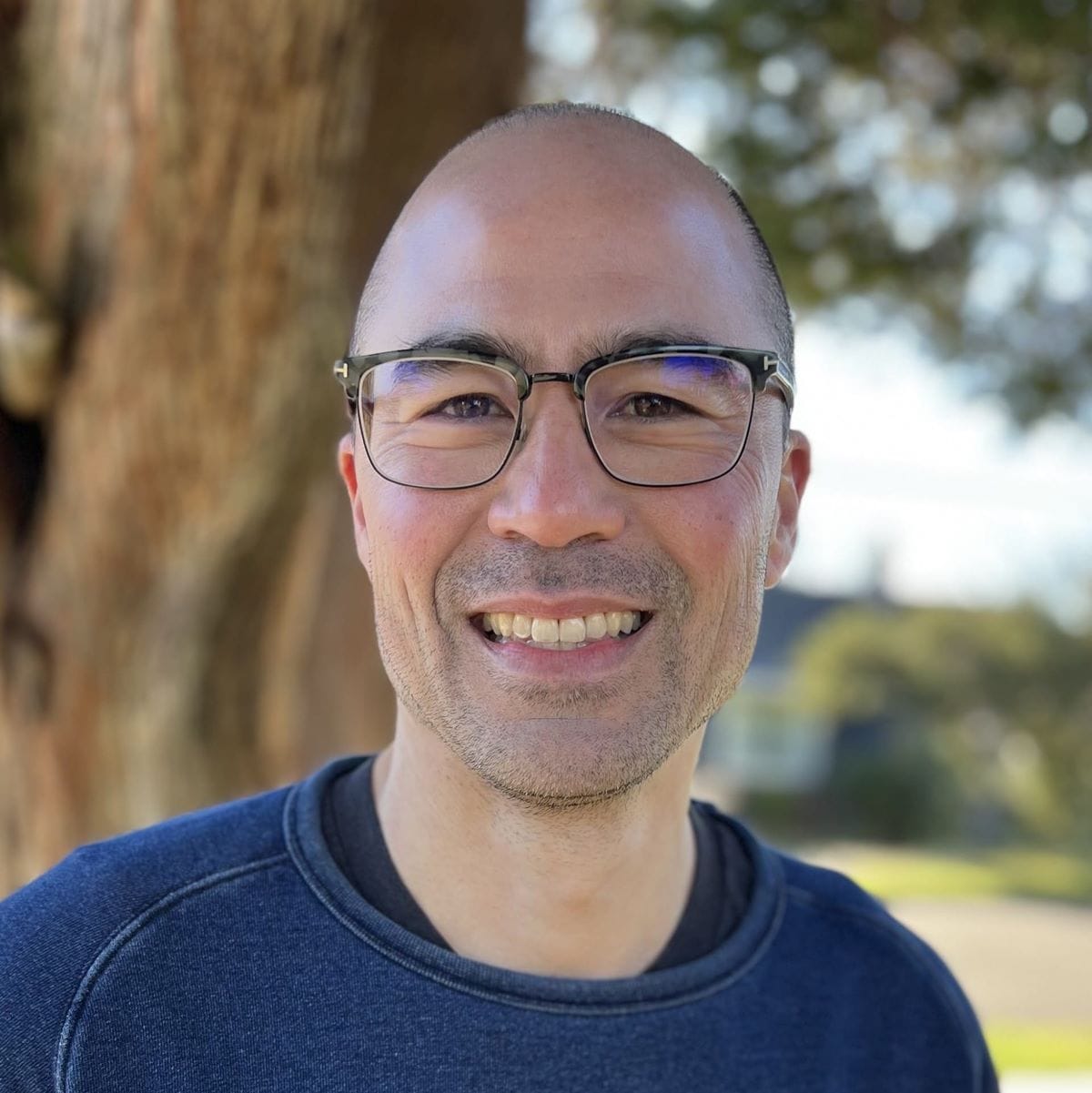
With the D2 position up for grabs after Tammy Morales’ resignation in early 2025, the race has become crowded with challengers looking to carry the progressive baton forward to represent one of Seattle’s most diverse — and under-resourced — districts. Eddie Lin’s candidacy has risen above the rest, with priorities around housing, transit, and public safety aligning nearly lock step with The Urbanist’s own views.
Lin enters the race with experience in Seattle’s housing sector, having worked in real estate law and, more recently, with nonprofit homebuilders as a city attorney supporting the City’s Office of Housing. He’s also been careful to lobby against provisions that would kneecap homebuilders.
Like most of his opponents, Lin is calling for a growth plan that goes far beyond the Mayor’s One Seattle plan, pushing to maximize housing density through zoning code updates, and reducing barriers like design review, parking requirements, and other restrictions. On homelessness, he supports housing first approaches and increasing services to unsheltered Seattleites.
On transit, Lin advocates for safety improvements by working in coalition with Amalgamated Transit Union 587 and the Transit Riders Union to make public transit safer for passengers and operators.
He supports defending and expanding progressive revenue sources like JumpStart to ease burdens on the working class. He’s also called out the need for safety improvements along MLK Jr. Way S and Rainier Avenue S, proposing road diets to calm traffic and create safer space for pedestrians, cyclists, and transit.
Lin is not without his missteps. He voted for Proposition 1B in the February 2025 special election to fund Seattle’s new Social Housing Developer. Proposition 1A, which ultimately won with 63% of the vote, proposed a new “excess compensation” tax on payroll expenses for employees paid over $1 million. 1B, backed by centrist councilmembers and Mayor Bruce Harrell, would have reallocated existing JumpStart funds and ultimately left the developer underfunded. Lin said as a future councilmember he would use his position to support the work of the Seattle Social Housing Developer.
We admire that Jamie Fackler and Jeanie Chunn backed Prop 1A from the get go, rather than needing a mulligan. However, we appreciate that Lin was upfront and honest about his thought process, rather than obfuscating. And overall, Lin’s grasp of housing issues was strong, even as a more recent convert to the concept of quickly scaling up the Seattle Social Housing Developer. A labor organizer, Fackler impressed us on economic justice issues. His willingness to critique the excesses of capitalism while still supporting housing abundance policies was a nice pairing. Chunn brings a refreshing commitment to the community and bold progressive values, and we’re excited to see her run again with a firmer policy platform.
The Elections Committee was also impressed by Adonis Ducksworth, who is Mayor Harrell’s transportation policy manager. With his unique background as a skateboarder and outreach specialist at the Seattle Department of Transportation, Ducksworth brings depth on mobility issues and road safety interventions. He was born and raised in Seattle’s South End and exhibited a passion for gun violence prevention and youth services.
In the end, we determined Lin was the stronger candidate across a broader set of issues, especially housing and homelessness. Eddie Lin is invested in the health, safety, and quality of life of South Seattle communities and will not shy away from ambitious goals and real plans to address the issues Seattle faces. Vote Eddie Lin.
- Eddie Lin questionnaire
- Adonis Ducksworth questionnaire
- Jamie Fackler questionnaire
- Jeanie Chunn questionnaire
Seattle City Council, Citywide Position 8: Alexis Mercedes Rinck
We’ve liked the leadership we’ve seen from Alexis Mercedes Rinck in her first year so much that we endorsed her early — a honor we bestow very seldom. She certainly deserves a full term after winning resoundingly last year to serve out the remainder of Tersea Mosqueda’s term. Here’s what we wrote in March:
Alexis Mercedes Rinck resoundingly won election to the Seattle City Council with 58% of the vote last November. Already in her first four months in office, she’s proven herself, and we want to see more. We endorsed Rinck last year, and we took the rare step (for us) of endorsing early this year to underscore the value of her leadership on Council and our alignment in both values and approach.
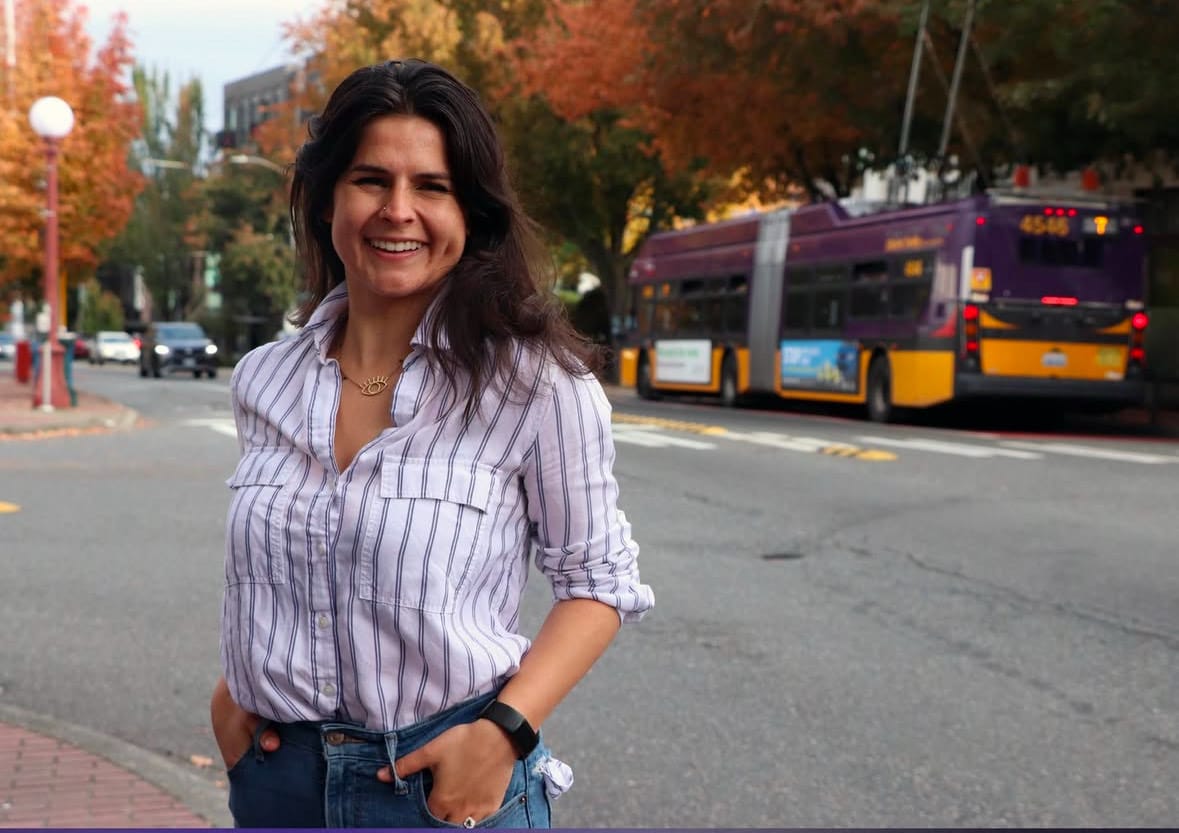
Rinck is clearly an urbanist. She bikes and rides transit to get around Seattle. She knows our biggest issues — housing, transportation, and safe streets — both at first-hand visceral level and an academic level. She doesn’t even own a car. And perhaps most notably, considering the challenges that lie ahead for our city, her questionnaire responses pledged work ahead to fight for housing abundance, safe streets, and high quality green spaces and public third places.
In fact, Rinck said her top priority for the next four years would be “reinvigorating our housing development pipeline to accelerate the creation of desperately needed housing.” This is a housing abundance candidate. She is a strong backer of social housing and, unlike most of her colleagues, endorsed Proposition 1A to fund the new Seattle Social Housing Developer, rather than the unsuccessful big-business-backed effort to derail it.
While the centrist wave of councilmembers elected in 2023 needed months to get up speed, delaying council meetings and major legislation, Rinck hit the ground running after winning a one-year term in a special election to fill out the remainder of Teresa Mosqueda’s term. Mosqueda left early after winning a seat on the King County Council.
From her inauguration, Rinck has stressed the need to fight the rise of authoritarianism and Trump’s attacks on civil rights and social investments. She didn’t just do this from behind a desk; Rinck showed up and gave an impassioned speech at the President’s Day protests in Seattle.