Drop boxes and post offices stopped taking ballots by 8pm last Tuesday but votes are still trickling in–even as outcomes are decided. Cary Moon’s share has been ticking up but she’s far from pulling off the upset, as she sits 43.57% of the vote. It looks like the race will shake out with Jenny Durkan at about 56% and Moon at 44%.
1. Durkan was able to peel some support off the urbanist coalition.
The Urbanist endorsed Moon, as did Seattle Subway, Seattle Transit Blog, and Seattle Bike Blog. While editorial endorsements are nice, the urban-focused group with some real money, T4WA (the political action committee offshot of Transportation Choices Coalition) endorsed Jenny Durkan. Former TCC Executive Director Jessyn Farrell and fourth place finisher in the mayoral primary didn’t endorse but said she voted Durkan when KIRO7 asked on election night.
On the other hand, the splitting of the transit advocate vote isn’t all bad. Mayor-Elect Durkan announced this week that TCC’s Executive Director Shefali Ranganathan would be one of her two deputy mayors. It’s reassuring to have a transit advocate at a top Durkan administration position where she presumably can fight for transit priority and investments. Arguably investing in transit isn’t controversial. The Sound Transit 3 ballot measure passed in Seattle with more than 69% of the vote in 2016. So it’s safe to say Seattleites want to see big transit upgrades and are willing to pay for it.
2. NIMBYs lose again. Pat Murakami failed to hit 30% of the vote.
After running on an anti-tenant, protectionist platform, Murakami got absolutely crushed by Councilmember Lorena González. While Murakami did a little bit better than Bill Bradburd (who managed only 21.4% against González in 2015) all indications are housing concern trolls (who oppose the city’s housing affordability agenda) have very little base of support in the electorate. Let’s start acting like it as we plan our land use policy.
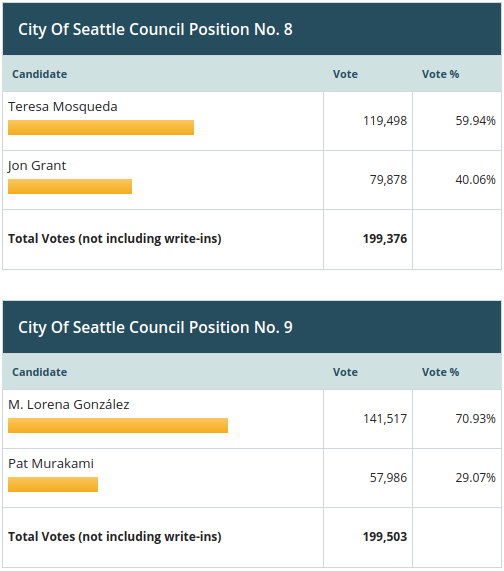
3. Jon Grant tacked to single-family home votes and lost big.
Grant sought to follow Kshama Sawant’s path to the council, but ultimately his opponent, Teresa Mosqueda, was a more captivating candidate. To me anyway, Grant’s signature campaign plank of 25% inclusionary zoning–likely counterproductive–ended up sounding hollow next to Mosqueda’s more nuanced housing policies. Where Grant shook his fists at developers, Mosqueda championed ways to constructively harness Seattle’s boom for good and expand housing options in every neighborhood.
4. Class divisions: Durkan dominated along Puget Sound and Lake Washington shorelines.
How did Durkan jump out to a big lead? Precinct results map showing Durkan ahead in virtually every waterfront precinct on election night. These view homes tend towards some of Seattle’s spendiest, suggesting this election broke along class lines. See also Durkan’s 90% plus finish in Broadmoor.
MAP: See where Durkan dominated Moon on election night as she won race for mayor (w/ @JustinAMayo @Emily_M_Eng) https://t.co/dUeNw1xZiM pic.twitter.com/mKbFAR8aoH
— Daniel Beekman #timeforchange (@DBeekman) November 11, 2017