Here’s the problem. Sitting through a presentation about the Ballard Interbay Regional Transportation (BIRT) Study, one finds themselves cheering for terrible options.
The issues are implacably difficult and balancing interests is complex beyond imagining. Interbay has a dozen bridges that are not earthquake or climate change ready sitting at the intersection of rail and water. Three very powerful and wealthy communities overlook the neighborhood. Every level of government has a finger in the pie, often crossing political boundaries. Cutting-edge industries share space with the legacy companies that built this city. Everything must keep moving at the same time all of it needs replacement and upgrading.
Seattle Department of Transportation (SDOT) and their consultants at Nelson Nygaard have culled a list of transportation improvements from two decades of Interbay planning studies. The projects range from painted pavement to half-billion dollar bridges. Together, these options are being wound into blueprints for the next two decades of development.
And we are still left asking “is this it?”
Yeah, That’s It.
On Wednesday over Zoom, the BIRT project team presented a handful of slides about potential projects in four categories: Pedestrian, Bicycle, Transit and Freight, and Corridor-Wide. Under each category, there was a breakdown of examples, like the Emerson Street Pedestrian Bridge and Freight and Transit Lanes between Denny and Market.
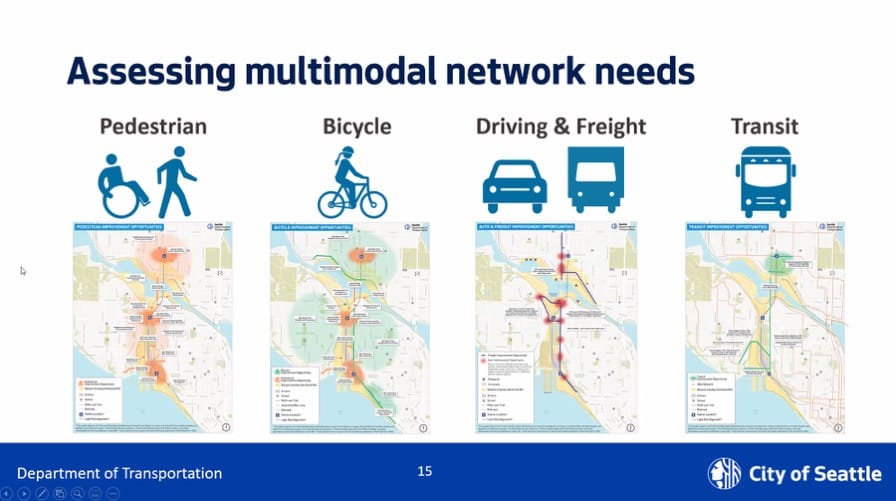
The Multimodal Needs Report has a more thorough breakdown of the proposed projects. (Nowhere are the projects combined into a single table.) Pedestrian projects focus on access around the new light rail stations, trail connections, shared use paths along the bridges, and sidewalk improvements throughout the area. These are echoed in the bike improvements with the additions of completing neighborhood connections and the Missing Link of the Burke-Gilman Trail in Ballard.
The report punts on the transit network connections. There are the future light rail stations as a backbone, with a handful of bus-only lanes supporting them. Busses ride on the same routes as cars and trucks, so the attention goes to roads.
And that puts the most money and effort on the freight and automobile improvements. This is where the two bridges come up. The study includes two of three scenarios for the Ballard Bridge: the low span that simply replaces the bridge at its existing height; and a mid-height span that is still a drawbridge but needs fewer openings. The mid-height bridge lands further north in Ballard and requires extra off-ramps. Off the table for this analysis is a high fixed bridge.
Of interest to most respondents on the call and source of the most questions and comments, the Draft Plan considers two options for the Magnolia Bridge replacement. There is the $400 million 1:1 replacement of the bridge in its existing location. The second scenario is a less extravagant Armory Way bridge that likely would serve people walking, rolling, biking and riding transit better. The scenarios will not examine the Dravus-Only or Low Bridge options from the Magnolia Bridge report.
Other transportation projects include intersection turning radius changes at some locations, joint bus and freight lanes, and access improvements between the Ballard Bridge and Leary, Emerson, and Nickerson.
Next steps for BIRT include testing these proposed projects against four project goals:
- Improve mobility for people and freight
- Provide a system that safely accommodates all travelers
- Advance projects that meet the needs of communities of color and those of all incomes, abilities, and ages
- Support timely and coordinated implementation
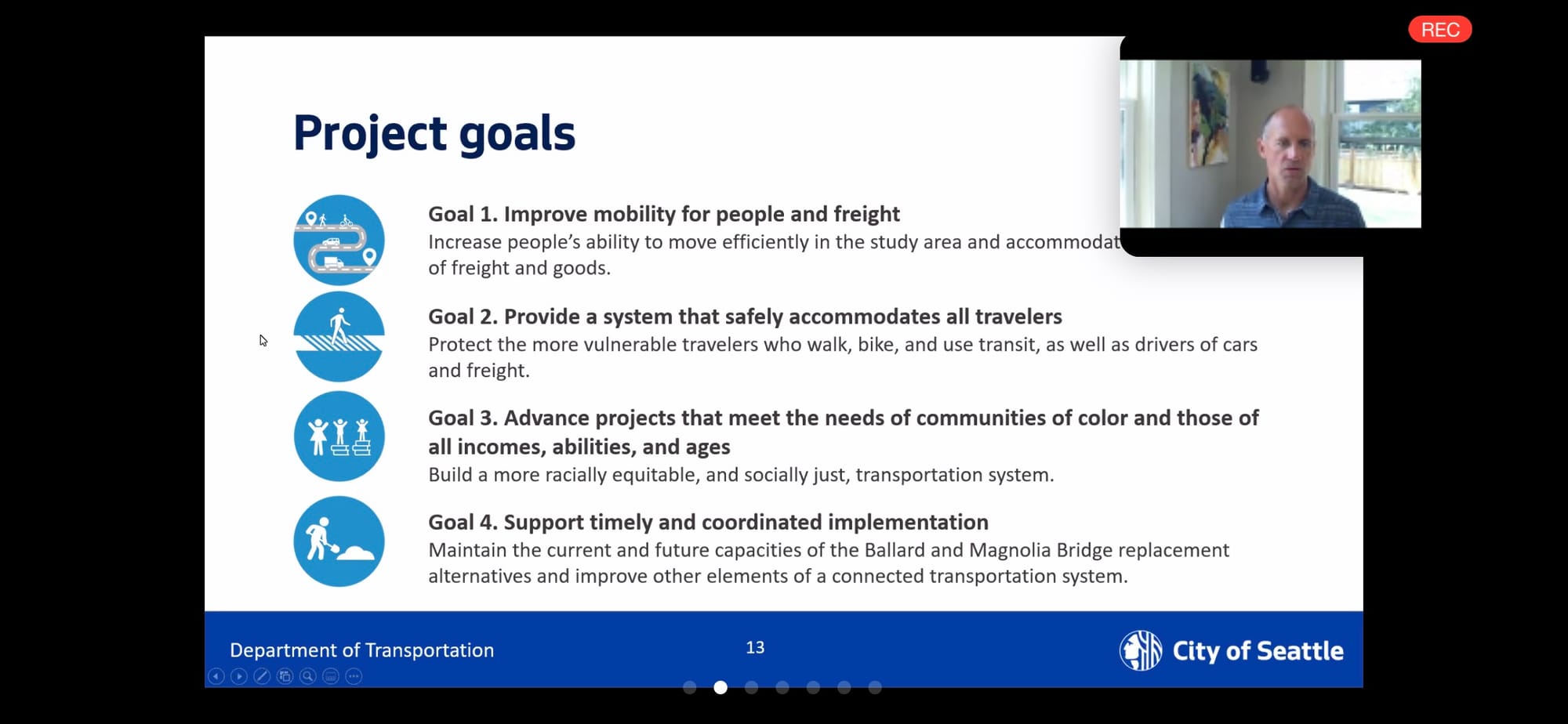
It’s here where the fine print starts screaming. Under “timely and coordinated implementation” is “maintain the current and future capacities of the Ballard and Magnolia Bridge replacement alternatives.” The only appendix for the report is the discredited intersection Level of Service analysis that supports automobile dependence. All this bike and pedestrian stuff, and this is a report about cars.
When we start seeing that weird tailoring of the question, we also start to see glaring omissions. Many of the feeder reports dealt with land use, which is one of the most important determinants of traffic generation. But nothing in this report does. The report omits mention of baseline plans like the 1998 Ballard Interbay Northend Manufacturing Industrial Centers (BINMIC). When asked, the consultants said that was outside of their timeframe of 2000-2019. However, the BINMIC zombie plan is on every map in the report and referenced in each of the documents that the team reviewed. The freight and corridor-wide projects rehash many of the BINMIC’s incomplete transportation improvements.