Whether pushing for a car-centric waterfront or failing to deliver on electric shore power, the Port of Seattle’s commitment to sustainability is an open question
It’s impossible to ignore a cruise ship docked on Seattle’s waterfront.
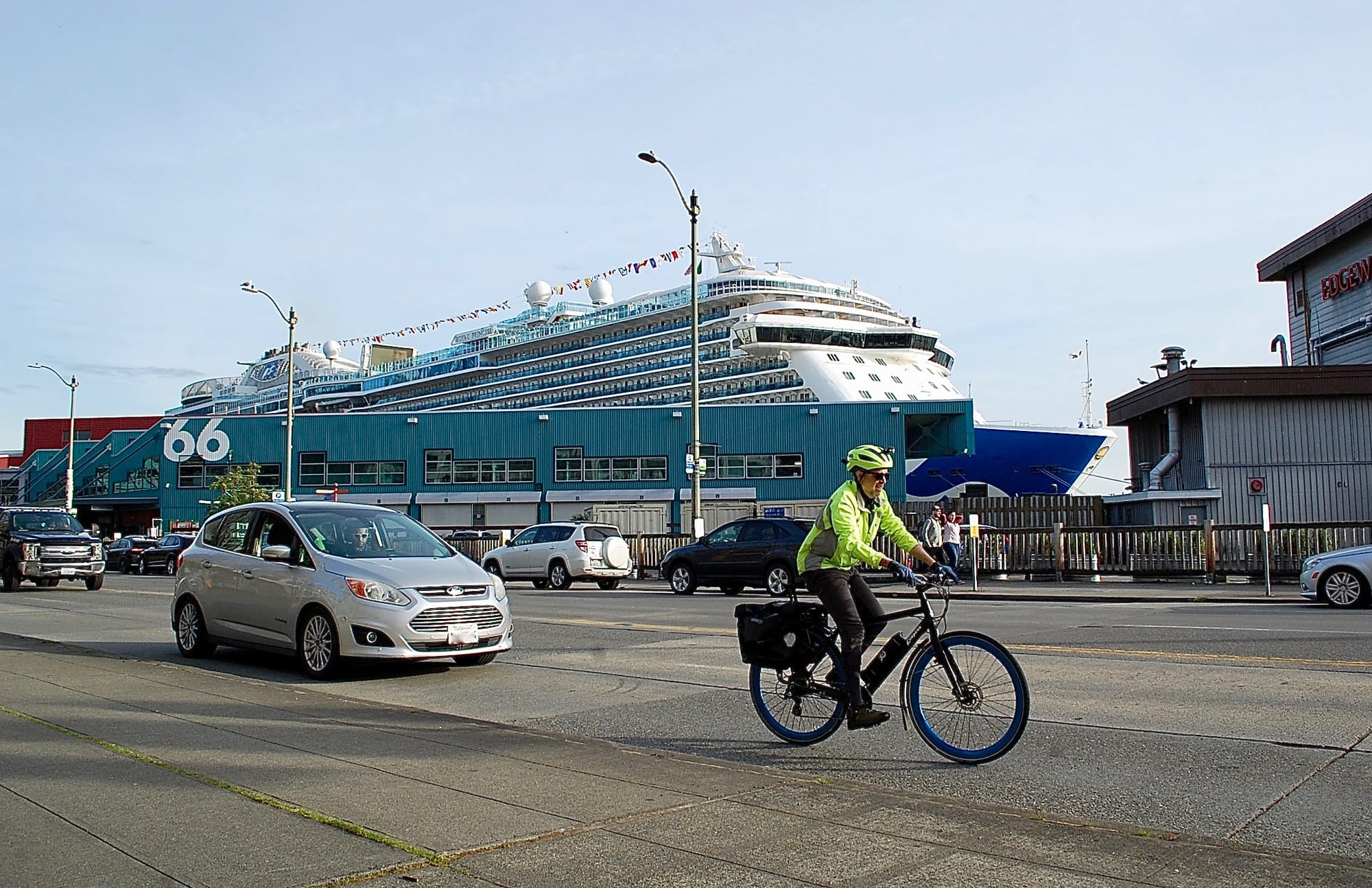
Recently, a behemoth Princess Cruise ship bound for Alaska – the Ruby Princess – towered over Terminal 66, reaching heights equivalent to a 15-story building. If the Columbia Tower, Seattle’s tallest building, was laid on its side, it wouldn’t measure up to the length of the Ruby Princess, which takes up 1,083 feet of the city’s seafront.
It is not just their size that is imposing. Cruise ship visits create both positive and negative impacts that can’t be ignored. On the plus side, the 289 sailings that 13 ships will make out of Seattle in the 2023 season between April and October are estimated to bring in $900 million worth of tourist revenue and support 5,500 local jobs.
Even though the Port of Seattle aspires to be the greenest cruise port in North America, these ships also bring a host of negative impacts to the city: pollution and carbon emissions, crowding at popular tourist sites, and pressure to build Seattle’s transportation infrastructure focused on automobiles and freight rather than transit and pedestrians.
In addition, the Port is behind schedule on promised plans to expand shore power, which allows these diesel-burning ships to turn off their engines while docked.
As I reported in a detailed multimedia feature published earlier this year at Hakai Magazine, Alaska cruises based in Seattle leave many harmful impacts in their wake. These include carbon emissions, sewage and scrubber discharge, noise impacts to Orca and gray whales, and overcrowding as the massive ships disgorge thousands of tourists into tiny Alaskan towns.
Seattle isn’t tiny, but it too feels the impact of this industry.
The Wide Stroad to Alaska
As new wide arterials recently opened at Alaskan Way and the new “not a highway” known as Elliott Way, the Port of Seattle and the cruise industry it supports have contributed to Seattle falling behind on its sustainability goals.
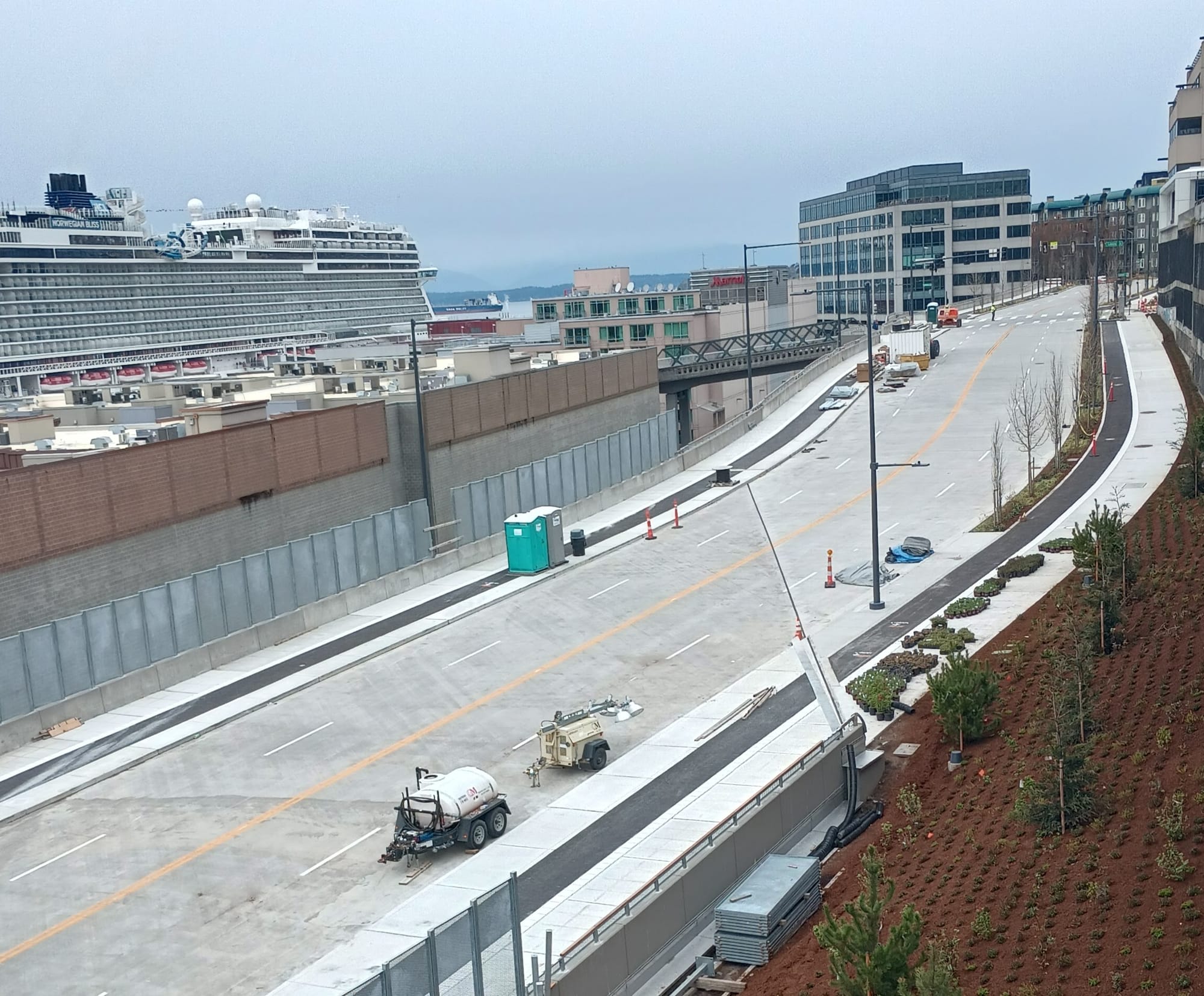
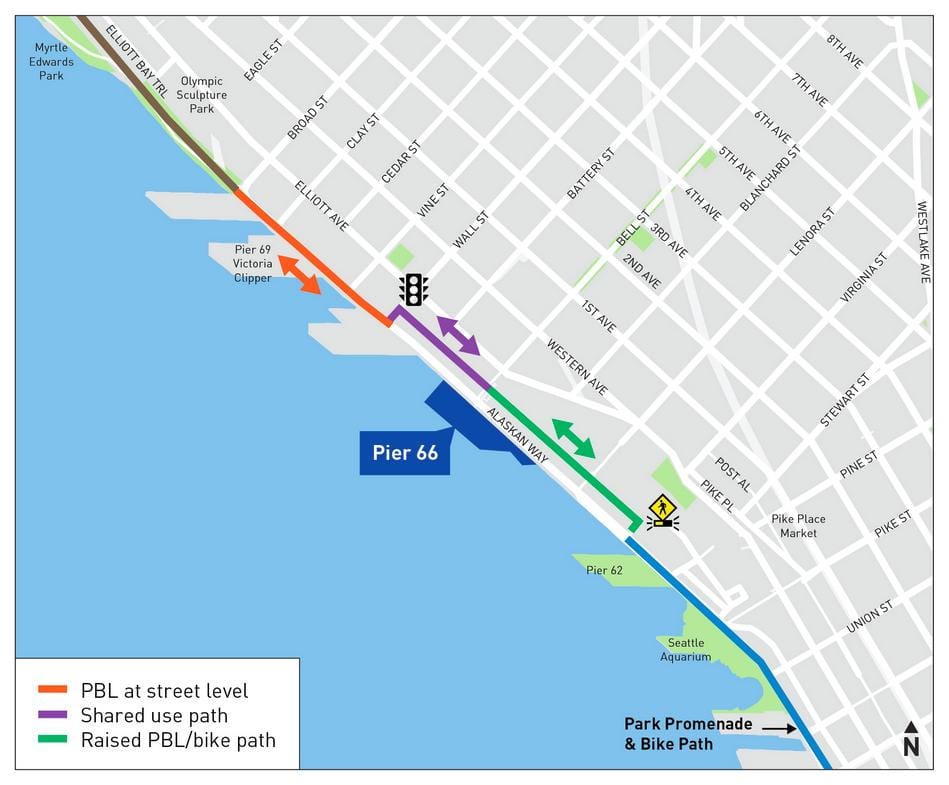
Gordon Padelford, of Seattle Neighborhood Greenways, is disappointed that the Port of Seattle has been reluctant to support a continuous, protected bicycle and pedestrian path alongside the newly reconstructed Alaskan Way. “If the Port really wants to demonstrate its sustainability bonafides, it needs to fully support a continuous waterfront trail for Seattle,” noting that a completed waterfront trail connecting to the Elliott Bay Trail would rival the Burke-Gilman Trail as the city’s most popular trail.
In an interview with The Urbanist, Stephanie Jones Stebbins, the Port’s managing director of maritime, said, “We are actually very supportive of a separated bike pathway as long as that can be dual use for operations when it’s not being used as a bike path.”
“When there’s a cruise ship in town, it does not make sense to have a bike lane in front of the cruise terminal. It makes sense to have a bike lane on the side of the road where there’s already a bike path right now.”
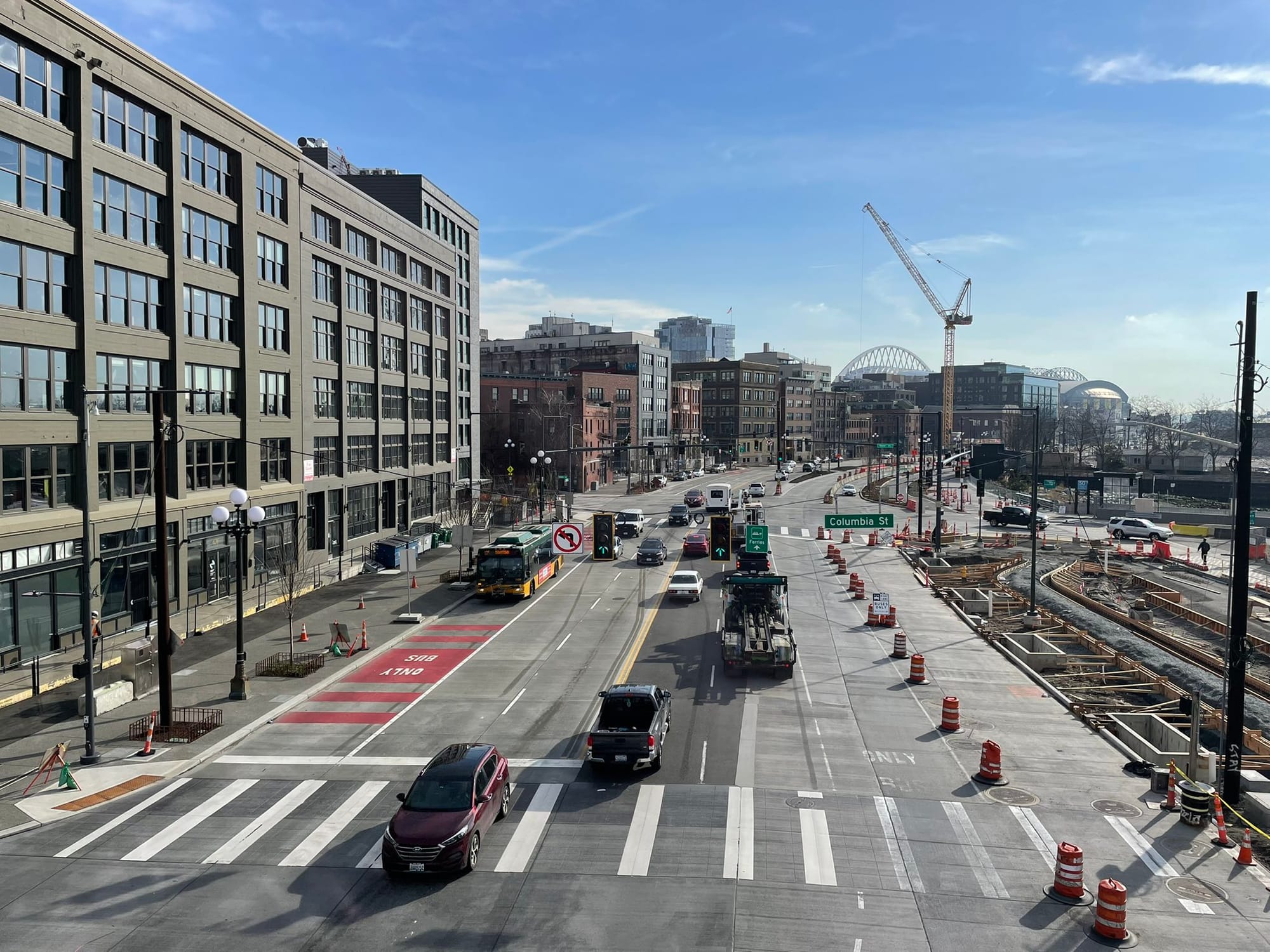
That “bike path” is currently a raised sidewalk. Padelford says making cyclists and pedestrians cross busy Alaskan Way twice, which is still SDOT’s preferred solution, isn’t tenable.
“Requiring people to go across the street on the east side sidewalk and then go back across the street again – which was the original proposal – is a non-starter,” he said. Padelford is optimistic, however, that a compromise solution involving flaggers temporarily directing bike traffic away from the cruise terminal during busy boarding hours can solve the problem.
Angela Brady, director of the City of Seattle’s Office of the Waterfront, defends the newly opened four-lane roads and says the second phase of the project will include much more landscaping and will be more pedestrian-friendly than it currently is. “This really allows us now to focus on construction of the new park, which is the long linear park on the water’s edge that will be more focused on pedestrians and bicycles,” she said.
Responding to viral online criticism of the newly opened project, Brady said, “The viaduct carried 110,000 vehicles a day. We’re now only carrying about 18,000. So, that’s a significant reduction in the volume of vehicles as compared to the Alaskan Way Viaduct. And you know, our speed limits are 25 miles an hour and not 50. It’s not a freeway.”