In a meeting that will likely be remembered for antivax firefighters and some… interesting… public comment, Bellevue City Council actually discussed some important urbanist topics. The body advanced further study into a parks levy that would go onto the November ballot, and staff provided an update on upcoming actions to implement the City’s Vision Zero plan.
Widespread Council Support for a New Parks Levy
Following Council’s direction at their March 7th meeting, staff returned last night with more details on the levy options that the body could send to Bellevue voters in November for approval. The current parks levy, passed with 67% support in 2008, is slated to only provide approximately $20 million over the next eight years and fund just two additional projects. However, the recent update to the City’s Parks and Open Spaces Plan identifies capital and maintenance projects that will total $880 million over the next 20 years. With only $300 million in revenue expected to go to parks during that same time frame, the city would be left with a half-billion dollar funding gap if no action is taken.
By staff’s estimates, a new 20-year parks levy could provide up to $15.4 million annually ($308 million over the life of the levy) by assessing a 0.02% property tax rate ($200 on an assessed value of $1,000,000). For comparison, Bellevue’s 2008 levy assessed a 0.012% tax ($120 per $1,000,000 in assessed value).
A “Pay as you go” levy with changing interest rates or a regular levy bond would only require a simple majority from voters, but an excess levy bond would require a supermajority (i.e. 60% approval). Decisions on which levy to bring to voters, what its tax rate would be, and how long it would last are still to come from Council and will need to balance revenue concerns with the political calculus of what’s palatable to Bellevue voters. However, given the 2:1 support for the previous levy and residents’ continued prioritization of parks and green spaces, Council has an opportunity to go bold to fund the City’s public spaces.
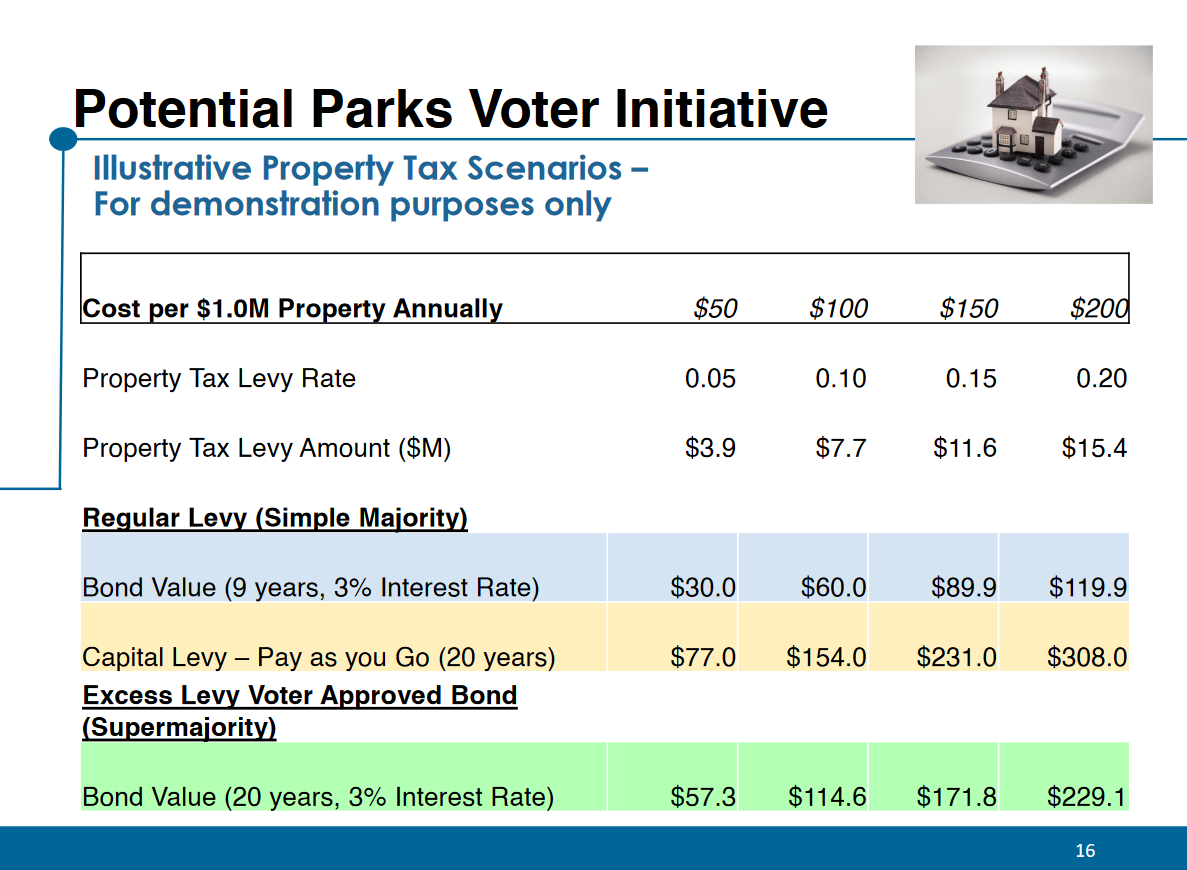
A decision on these issues is not due until before an August 2nd filing deadline, but Council directed staff to continue work exploring the different levy options while weighing the tradeoffs of different tax rates and levy lengths. To further plug the parks revenue gap, staff have also been researching impact fees on new residential and commercial development. In neighboring Eastside cities, these fees help bring in thousands of dollars for each new unit of housing, with some providing exemptions for affordable housing developments.
Council as a whole seemed open to impact fees, though Mayor Lynne Robinson shared her reticence to support fees on anything other than commercial development. Since more work is needed and the timeline is not as pressing as it is for the levy, staff noted that the issue won’t be brought to Council for a decision until budget season comes around, either during this fall’s discussions or during next year’s mid-biennium update.