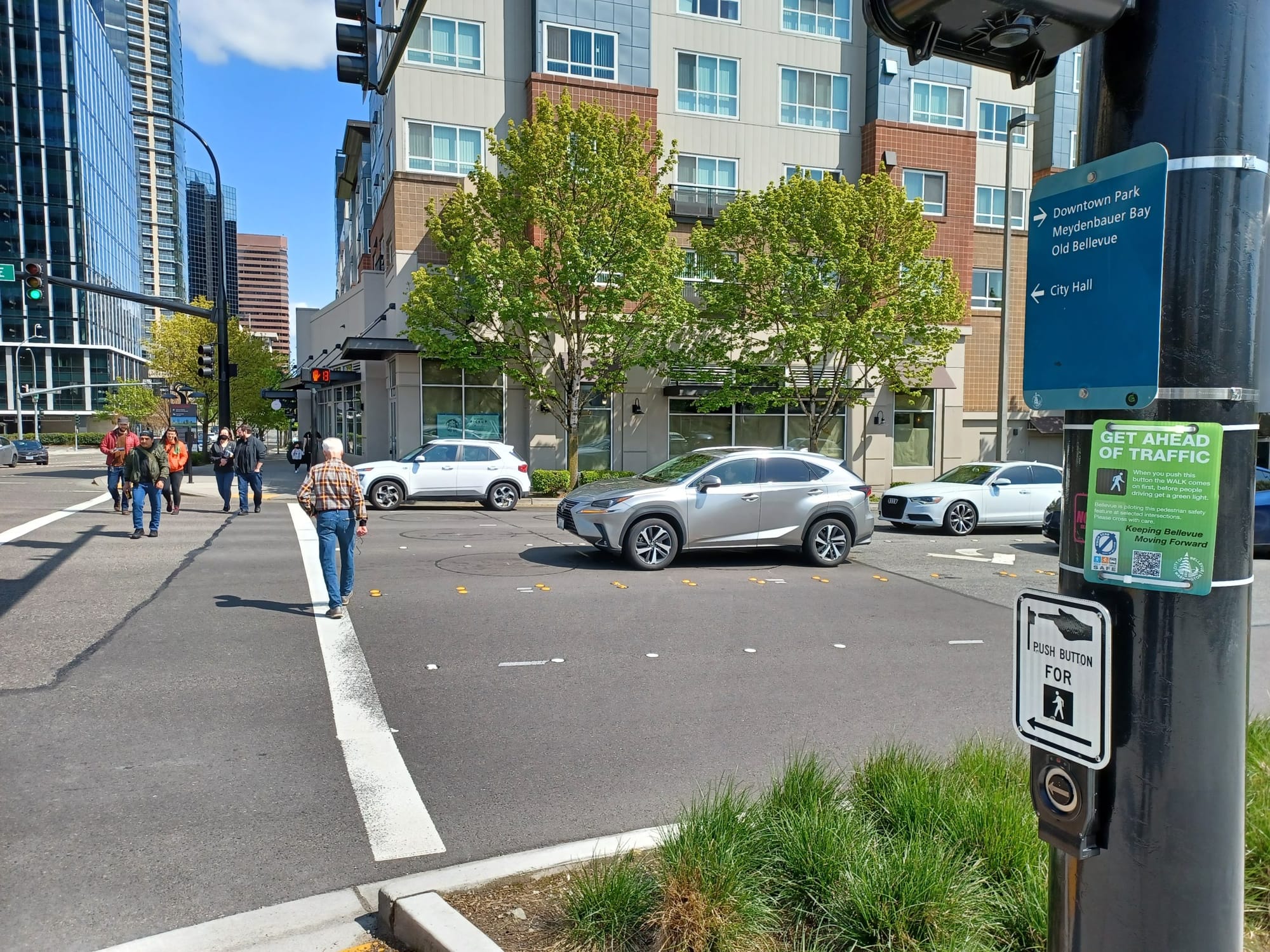
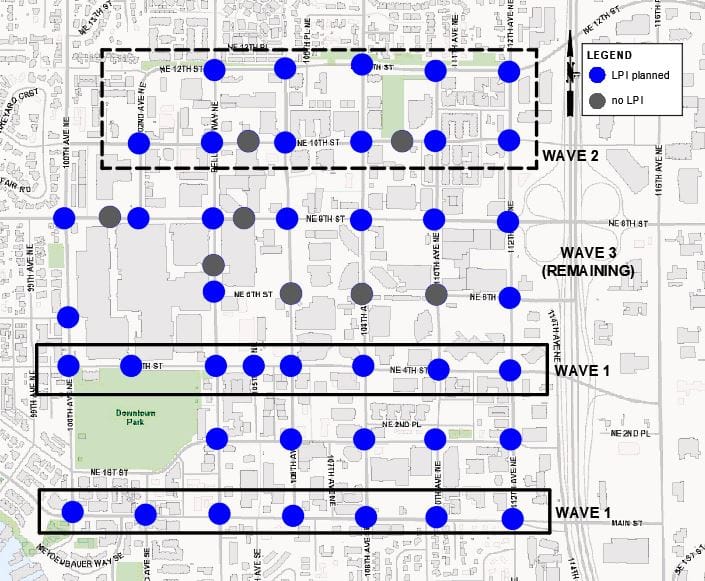
People who spend time walking or rolling around Downtown Bellevue might have noticed a slight change to their experience over the last couple of weeks. Beginning in early April, intersections along Main Street and NE 4th Street give crossing pedestrians about five seconds to enter the crosswalk before cars going in the same direction are given a green light. This change, known as Leading Pedestrian Interval (LPI), helps to reduce collisions between pedestrians and drivers by making people walking in the crosswalk more visible to drivers before they turn.
Although the change is subtle and simple — in an interview, city staff describe the implementation of LPI “like a flip of a switch” — the safety impacts for people walking and rolling are anything but. Analysis from a 2020 pilot program across 20 intersections Downtown and in Crossroads revealed that LPI helped reduce near-misses between people driving and walking by 42%.
A parallel analysis by Seattle’s Department of Transportation across 300 LPI intersections in that city showed a 48% reduction in turning collisions between drivers and pedestrians. And because implementation only requires minor edits to the city’s signal timing, LPI improvements cost significantly less than other traffic safety measures. For just the cost of staff time to code and monitor the rollout, Bellevue Transportation expect to implement the LPI program across 41 Downtown intersections by September.
At two intersections (Bellevue Way & NE 8th Street and 108th Avenue NE & NE 4th Street), Bellevue has deployed additional technology meant to increase safety. Enhanced cameras, LiDAR (Light Detection and Ranging), and artificial intelligence will identify road users by mode and interface with the city’s adaptive traffic signals to more accurately adjust timing.
Franz Loewenherz, Mobility Planning and Solutions Manager with Bellevue Transportation, explained a use case for the software for people walking at these intersections. If a person crossing the street is detected by the software to still be in the crosswalk even after the timer has expired, traffic in the cross-direction could be paused until the person has left the intersection. The program, which Loewenherz describes as “just getting going,” is using equipment loaned to the City of Bellevue by Ouster, Outsight, and Sighthound, Inc. at no cost.
Room for Further Improvement
The implementation of these low-cost programs represents a subtle shift away from Bellevue’s automobile-centric history. However, both these measures can still be seen as emblematic of Bellevue’s gradual, data-driven, and technology-focused implementation of Vision Zero. These qualities, while not inherently bad, may leave safe streets advocates wanting more improvements to be implemented more rapidly. For example, with the clear benefits of LPI — not just from data within Bellevue or Seattle, but from around the country — vulnerable road users may wonder why the program’s rollout is phased over the next five months, instead of all the changes happening at once.
David Grant, Bellevue’s Public Information Officer for Transportation, explains: “The widespread application of LPI is still pretty new for [Bellevue] so we’re rolling it out in phases to allow staff time to observe and adjust traffic signal operations, if needed. It breaks the projects into manageable numbers of intersections and also allows staff to apply any lessons learned to the next phase of implementation.”
This approach would be more understandable if signal phasing order had been changed dramatically (e.g. if an intersection’s traffic cycle had been changed to allow pedestrians to cross before left-turning vehicles), but this does not appear to be the case at intersections where LPI has thus far been implemented.
As seen in the video below, left-turning vehicles at many intersections are still allowed to proceed before people walking in the corresponding crosswalk. The Urbanist’s Anton Babadjanov has observed how intersections along NE 4th Street have historically given priority to drivers turning left before pedestrians, and it does not appear that LPI implementation has changed this paradigm.