Stakeholders are demanding more information from Sound Transit, as is the Harrell Administration, as it unveils its alignment preferences.
Sound Transit is planning Seattle’s light rail future and many are worried about the direction the train is headed. This ranges from grassroots transit advocacy organizations like Seattle Subway and us at The Urbanist to very powerful business stakeholders. Sentiment seems to be widespread that Sound Transit isn’t really showing its work or leveling with riders and other stakeholders about the key decision points that will actually determine the fate of West Seattle Link and Ballard Link, which will bring 13 new or expanded light rail stations to Seattle in the 2030s.
Including all the addenda, the Draft Environmental Impact Statement (DEIS) for those two projects was more than 8,000 pages long but on some key issues it addressed very few questions.
Kylie Rolf, who is vice president of advocacy at the Downtown Seattle Association (and formerly Director of Major Initiatives and Legislative Affairs in the Durkan administration) expressed her organization’s frustration with the murkiness still in the agency’s plan on a recent meeting of the Downtown Community Advisory Group (CAG) — of which she is a member.
“This has been a little bit of difficult exercise for me and for others. Because if you’re coming at from the lens of economic development impacts, impacts to downtown residents, impacts to downtown businesses, arts and cultural organizations, in order to formulate meaningful opinions and comments, it’s pretty impossible to do with this level of information that’s contained in this DEIS,” Rolf said. “Things like construction timing and phasing throughout the segment, street closure phasing and duration, plans for pedestrian traffic and transit detours.”
John Marchione, the former Redmond Mayor who now represents the Public Stadium Authority, also complained about the low level of detail. Marchione said his organization would like to see more details about detours and small business impact mitigation before they determine a preferred alternative at the Chinatown-International District Station. Sound Transit did sketch out some rough concepts for detours in the DEIS, but Marchione said more structure and details for the plan would be needed beyond simply indicating alternate routes.
Other Downtown CAG members largely echoed those sentiments. Sabrina Villanueva, who is senior director of property management with mega-landlord Clise Properties, said the two-year closure of 4th Avenue would be unacceptable and hurt commercial activity. Amy Worthington, a commercial real estate advisor, agreed and argued the negative impacts to the street could linger long after construction. She contended that 3rd Avenue is still suffering from degraded urban design and commercial environment because of the construction of the original Downtown Transit Tunnel in the 1980s.
Complaining about construction impacts can lurch into the absurd. Did stakeholders think that a subway would instantly materialize as if by magical spell with no impact to cars and businesses on the surface? Impacts and detours are the inevitable toll of any major construction project. In Seattle, it appears some are not even willing to build a transformational 100-year rapid transit line without letting temporary impacts to car traffic to be the driving factor in our decisions.
Still, the consensus that Sound Transit hadn’t communicated its plan well or effectively honed in on a mitigation strategy was fairly resounding. Nonetheless, the process presses forward and Sound Transit still hopes to finalize the EIS on schedule despite the pushback and lack of consensus on some of the more controversial decisions.
Harrell backs Mercer Street Station in Uptown
Mayor Bruce Harrell has unveiled the City’s proposed official preferences on the light rail alignment and transmitted them to Alex Pedersen, who chairs the Seattle City Council’s transportation committee and is sponsoring the resolution that would make them the City’s official stance. The alignment preferences are still awaiting a vote from the rest of the council, but they may not prove an area where councilmembers want to expend political capital by bucking the mayor and wading into murky waters where most decisions come with controversy and powerful detractors.
In a recent Sound Transit Board meeting, Mayor Harrell revealed his administration’s preference for Mercer Street location in Uptown to avoid impacts to KEXP, other arts organizations, and performance venues in the Seattle Center. The resolution also backs Terry Avenue in Denny to avoid traffic impacts to Westlake Avenue, deviating from the agency’s preferred alternative. A four- to six-year-long closure of Westlake Avenue, which cuts through Amazon’s campus and is a major transportation artery for major employers and residents throughout North Downtown, has proven to be too tough a pill to swallow.
The Seattle Center Foundation submitted a letter opposing the Republican Street option and backing Mercer Street in hopes noise and construction disruptions would be less. Some arts organizations worried impacts from a Republican siting could put them out of business and also expressed worry about losing “legacy trees” on the Seattle Center campus, which the City’s presentation flagged as well, in addition to arguing the transit-oriented development (TOD) potential would be greater with Mercer.
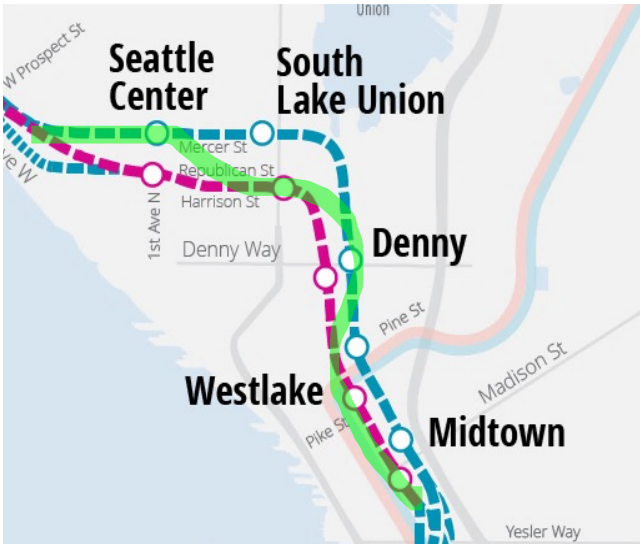
The Urbanist backed the Republican Street alternative because riders would be able to get the surface quicker since the station depth is shallower and its location is on the on the doorstep of the pedestrianized Seattle Center complex rather than under a busy Mercer Street. “From a rider perspective, the Republican Street station is clearly superior,” I wrote in our DEIS rundown. Situated about 85 feet deep below a pedestrianized street, a Republican station should be able to provide elevators headed direct to the surface, although for some reason the agency says that is not in the plan yet.