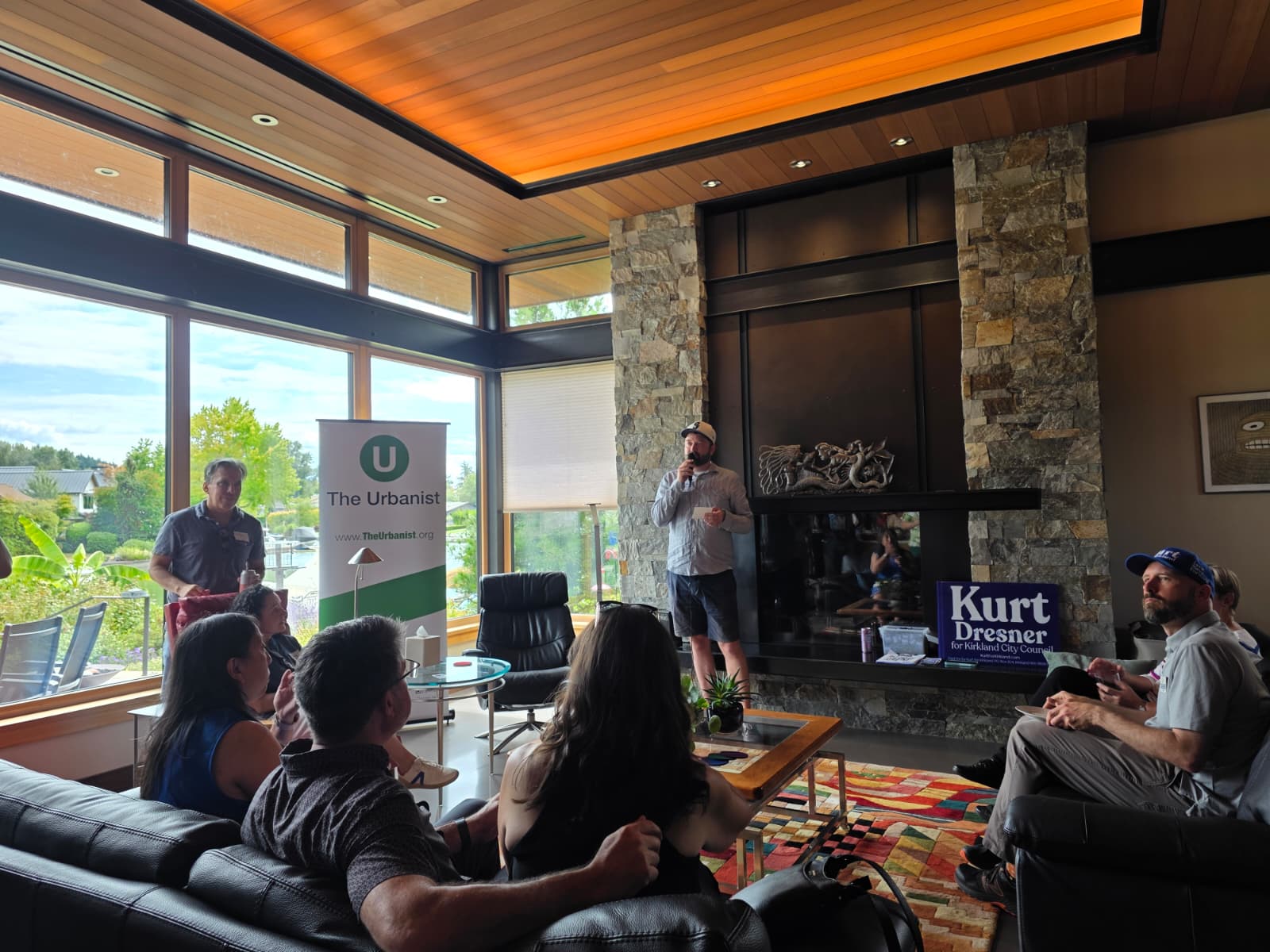
Social housing is going to the ballot in February, and if you want to learn more about the initiative, The Urbanist has you covered. At our monthly virtual meetup on January 10, we’re hosting Tiffani McCoy, co-chair of the House Our Neighbors campaign behind the measure, to break it down and answer any lingering questions our readers have. We’ll post the video to our website and YouTube page for those who can’t make it.
Initiative 135 would establish a public developer of social housing in Seattle. The campaign met the signature-gathering threshold in August, which sent I-135 to a special election ballot. The last day to vote is February 14. The Urbanist Elections Committee endorsed I-135 this summer, noting how effective the model had been elsewhere.
“Cities like Vienna and Singapore have shown the power a well-funded social housing system has to dramatically reduce housing costs for all residents while also producing beautiful, high-quality, environmentally-sustainable homes that build strong communities in highly desirable neighborhoods,” the committee wrote. “For these standout cities, socializing housing production has meant working class families have been able to find stable housing that meet their needs in high-demand urban cores closer to jobs and amenities. In Seattle, it basically takes winning a lottery for this to happen, but I-135 is an important first step toward changing that.”
McCoy is advocacy director at Real Change, a nonprofit that advocates for economic, social, and racial justice. With its street vendor program and advocacy, Real Change is dedicated to empowering people who have experienced homelessness. Runaway housing prices across the Seattle region have created an affordability crisis that is driving the homelessness crisis. Social housing could help ease the crisis.
McCoy will lay out the benefits of social housing and a public developer to build it, as well as lessons learned in the campaign. We’ll discuss the homelessness crisis and the best ways to address it.
Social housing is sometimes used as a catchall term for below market housing, but House Our Neighbors has used it to refer specifically to permanently affordable mixed-income housing managed under democratic tenant control, which is what I-135 stipulates the public developer will work to create.

This mixed-income aspect differs from the predominant nonprofit model already at work in Seattle, where most buildings are geared entirely toward low-income households — usually at below 60% area median income (AMI). By opening up buildings to a cross section of tenants up to 120% of AMI, House Our Neighbors hopes to generate a cross-subsidy effect, wherein higher income households help cover expenses to lower the cost of providing housing well below market rate to low income households. Mixed-income buildings also promote cross-class communities, which is a sociological good in its own right, backers argue, pointing to research showing the harm of economic segregation.
McCoy gave a primer on social housing during an appear on Converge Media’s Morning Show, which is embedded below.