On Thursday, the Puget Sound Regional Council’s general assembly, which consists of representatives of nearly every county, city, town, and tribal government in the entire four-county central Puget Sound region, unanimously voted to adopt the latest version of a regional transportation plan. The horizon of the plan extends to 2050, but in adopting the plan, regional leaders have also voted to undertake the long overdue work of looking at how current and planned investments in transportation align with the adopted and urgent goals around greenhouse gas reduction by 2030.
The original version of the plan, released back in January, mostly geared its analysis on climate just to 2050. This timeframe would have likely set the region up to do very little to significantly change the way the regional governments are currently operating around emissions reductions, placing most of the onus to meet our long-range target on vehicle electrification or a future road usage fee that’s mostly outside the political reality of the current moment.
The plan as adopted now acknowledges that things are not currently on track to meet the goal of a 50% reduction in greenhouse gases (compared to 1990 levels) by 2030. “PSRC will continue to work with partner agencies including the Puget Sound Clean Air Agency on developing a climate implementation strategy for achieving the climate goals and to monitor progress. However, based on initial analysis of the steps needed to meet the region’s greenhouse gas reduction goals, if implementation of a road usage charge and significant decarbonization of the transportation fleet do not occur until the 2030s, it seems unlikely that the strategies outlined in this plan would enable the region to meet the adopted VISION 2050 greenhouse gas reduction goal for 2030,” language added to the plan says.
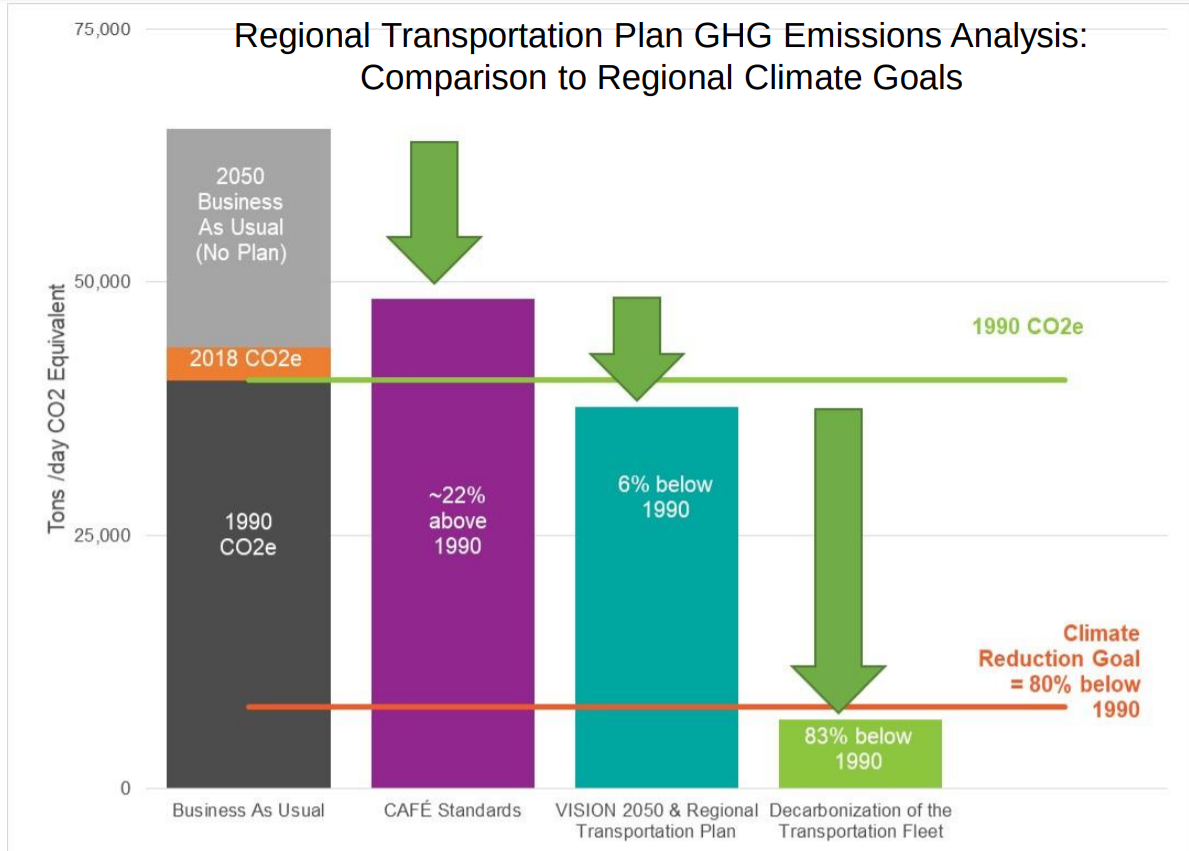
This victory on climate will likely require additional heavy lifting in the coming months. “Following plan adoption PSRC will work with its partners to develop a 2030 transportation network and inputs corresponding to the Four-Part Greenhouse Gas Strategy and conduct a 2030 analysis in alignment with the region’s 2030 and 2050 climate goals,” the plan states. Then the real work will begin to align the planned investments contained in the plan with that target: the plan calls for utilizing $300 billion in transportation spending through 2050, with a majority of that money earmarked to maintain already existing infrastructure. It’s easy to adopt a target but harder to have conversations about reallocating resources. However, just getting that into the plan was a huge step.
The fact that the plan was steered to focus on the near-term goal of 2030 is largely attributable to the work of several key regional elected officials serving on PSRC’s boards. PSRC’s current President, King County Councilmember Claudia Balducci, raised the alarm about how climate was treated in the plan back in December, and doggedly pursued amendments around the issue through to the adoption of the plan. It’s easy to imagine a different PSRC president not going that extra mile.
“We also included greater transparency around how much GHGs our transpo system can afford to emit in the next decade, [and] a process for learning how much each of our implementation actions (like new transpo funding) will contribute toward that limit before we make decisions,” Balducci wrote on Twitter after the plan’s adoption. Elected officials agreed to look at the climate impact of future projects when making decisions but backed away from amendments that would have committed PSRC to take any specific actions.