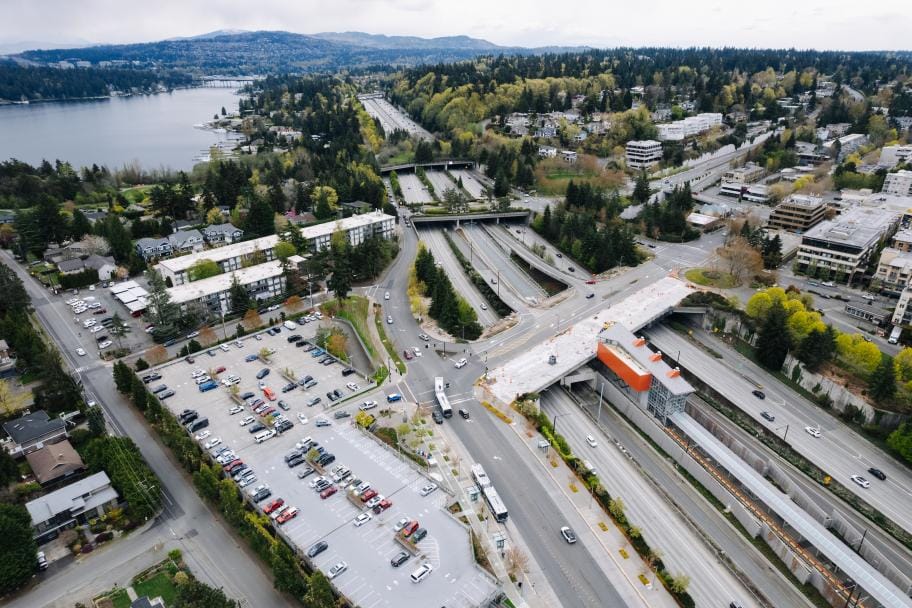
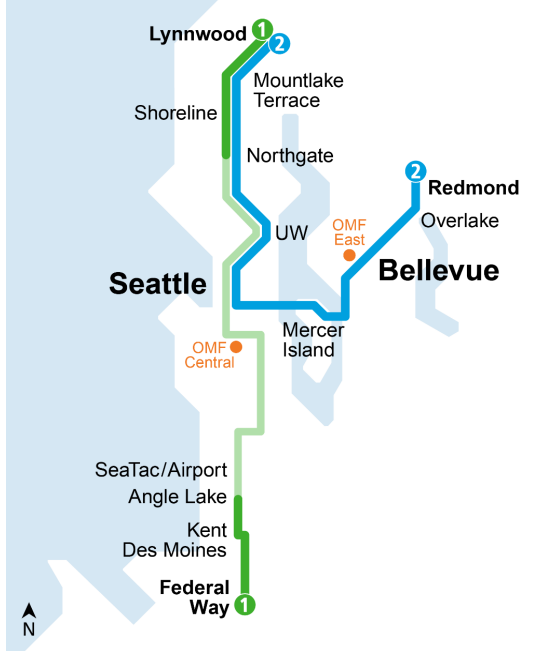
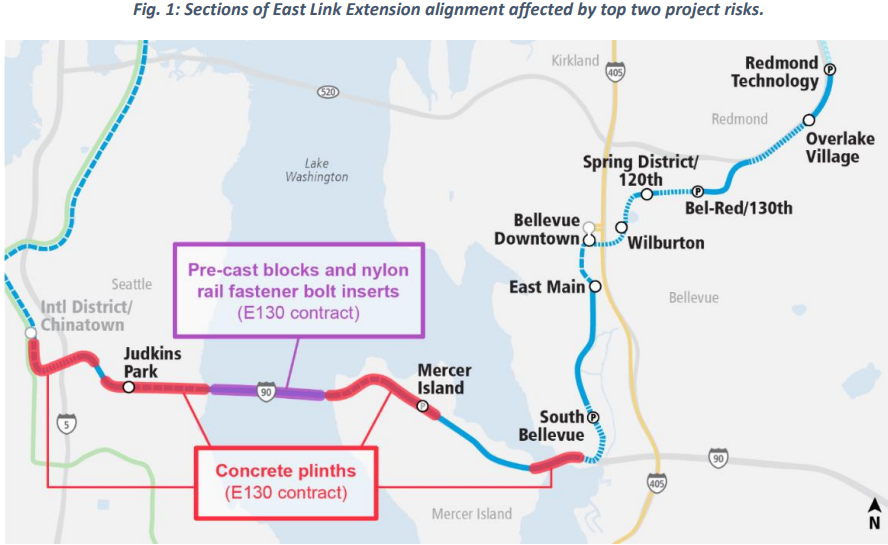
Sound Transit revealed delayed timelines for its next four light rail extensions Thursday. Defects in concrete plinths in a four-mile section of East Link through Mercer Island and Seattle have caused a delay of at least a year, pushing the expected opening from July 2023 to late 2024. The Federal Way light rail extension, meanwhile, has been delay by about one year to 2025 by unexpectedly problematic soil conditions near the McSorely Creek Wetland in Kent.
The Downtown Redmond Link extension is pushed back to 2025, which the agency primarily attributes to the four-month concrete delivery strike earlier this year. The agency expects to miss its December 2024 target for Downtown Redmond Link by four to five months.
Lynnwood Link is expected to see a four- to six-month delay beyond its July 2024 target, Sound Transit said, which still leaves some hope of a late 2024 opening. Beyond the now accounted for concrete strike and pandemic impact delays, Lynnwood Link project risks are low, which indicates further delays are unlikely, the agency said.
“Within about the next four years, our carbon- and congestion-free light rail system will more than double from 26 to 62 miles and from 25 to 50 stations,” Sound Transit Interim CEO Brooke Belman said in a statement. “While we are on a path to fully resolve impacts of Covid-19, the concrete delivery strike, and our construction challenges, we have more work to do before we can reliably establish opening dates. We will work tirelessly with our contractors to complete these extensions as rapidly as possible without compromising on safety or quality.”
While possibly just poorly chosen words, Belman’s pledge of within “about” four years hints Sound Transit isn’t even guaranteeing to open all four lines by 2026 which it had previously pledged by 2024. With the defects with the East Link plinths still not fully assessed, further delays could be in store, but it’s hard to see any projects slipping past 2026 based on what Sound Transit has revealed thus far. And for now, all seem to be pledged for 2025, if not sooner on Lynnwood Link’s part. The light rail delays also likely entail delays for the associated bus network restructures, with King County Metro planning a major Eastside bus restructure and Metro and Community Transit also planning to overhaul bus routes north of Northgate. Both had been timed to and designed around the opening of light rail.
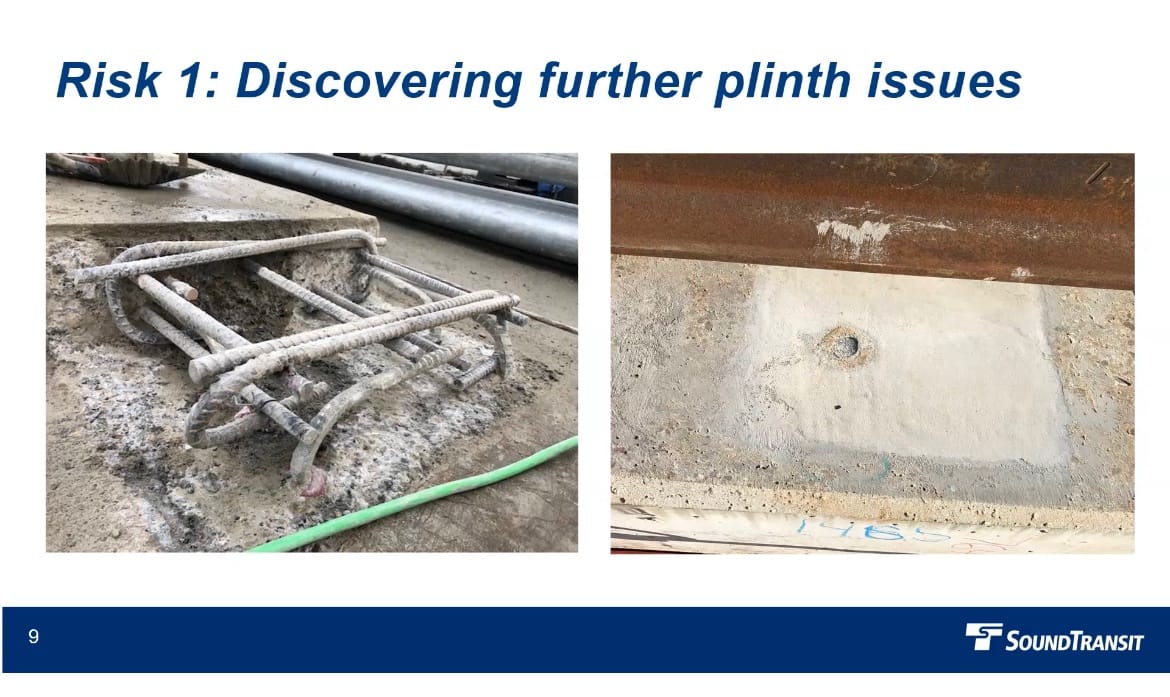
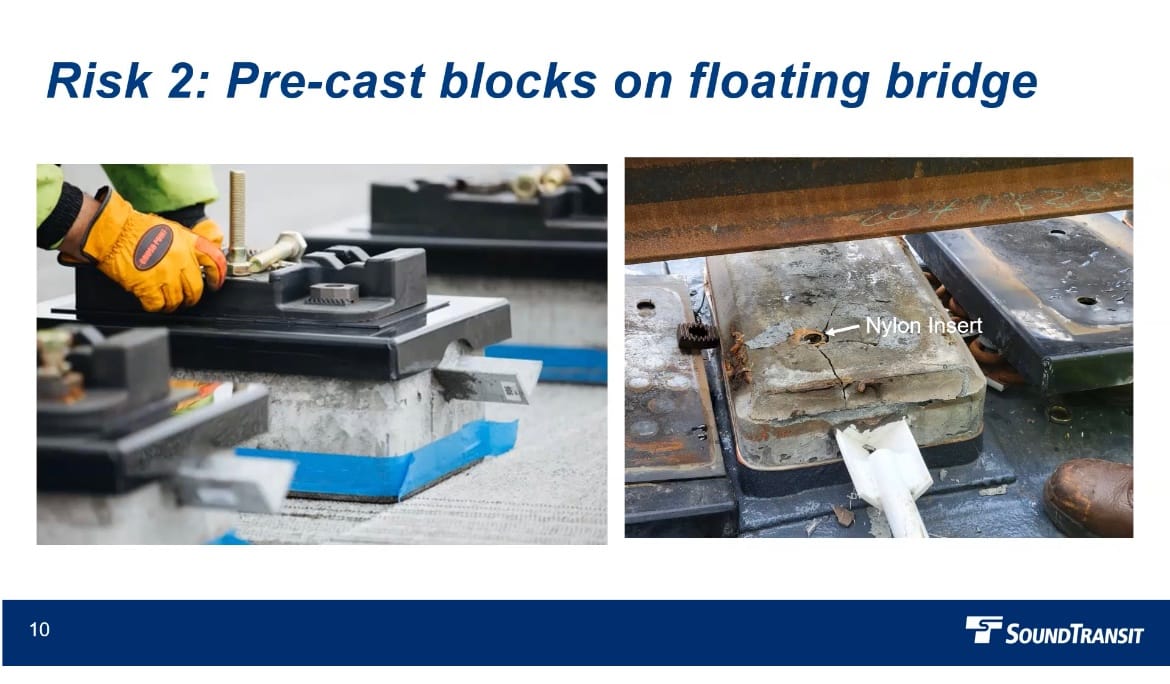
Construction issues have piled up on the projects, but the agency has reassured the Sound Transit Board’s Systems Expansion Committee that it has a plan to correct them and avoid similar problems in the future. Deputy CEO Kimberly Farley laid out these steps in a memo shared with the board. The first step was a thorough analysis of the risks facing each projects, Farley explained.
“The second step, now underway, is to analyze the implications of projects’ current status at a programmatic level,” the Farley memo states. “A programmatic risk analysis will evaluate shared resources (such as staff and capacity for conducting safety certifications) needed across the projects opening in similar timeframes. It will also look at project sequencing.”
Sequencing will be particularly tricky since some projects may leapfrog others. Lynnwood Link may open before the entirety of East Link, for example, and a late East Link opening would rob the system of operational capacity of an added base. This could cut into light rail frequencies possible until East Link does open.
“Without mainline access to the OMF East, service on the 1 Line will be limited by OMF Central capacity and more dependent on reliable performance of the new light rail vehicle fleet operated out of the base in Seattle,” the memo notes. “We are analyzing operating strategies to mitigate impacts and to determine what service levels can be provided if the 1 Line expands to Lynnwood and/or Federal Way before East Link crosses Lake Washington.”
Just as opening four lines in the space of a year was sure to be a challenge for the agency from mid-2023 to mid-2024, the same could be even more true if all the timelines are pushed back a year but remain jumbled together. One added complication is that concrete companies still haven’t signed their mixer truck drivers to a long-term contract, instead operating on a short-term truce. The owners continue to refuse to meet the demands that the union is making around retirement benefits, and another concrete stoppage may be imminent.
“Our intent is to continue intensive focus on eliminating or reducing risks and to open the projects as rapidly as possible without compromising their safety and quality — including providing positive passenger experiences from the first day of service through many decades to come,” the memo continued.
During the meeting, Expansion Committee Chair Claudia Balducci pressed the agency heads to consider opening the eastern half of East Link sooner while the plinth issues are addressed in the pinchpoint at the floating bridge over Lake Washington. Since East Link included a new Operations and Maintenance Facility (OMF East) in Bellevue’s Spring District, the line theoretically could operate independently until the Mercer Island and Seattle tracks are fixed and it interlines with the whole system.