On Monday, the Seattle City Council met for their regular legislative agenda meeting. Key decisions were made on short-term vacation rental regulations, conditional right-of-way vacation and future surplus of property in South Lake Union, and agreements with Sound Transit to facilitate development of light rail projects.
Short-Term Vacation Rental Legislation
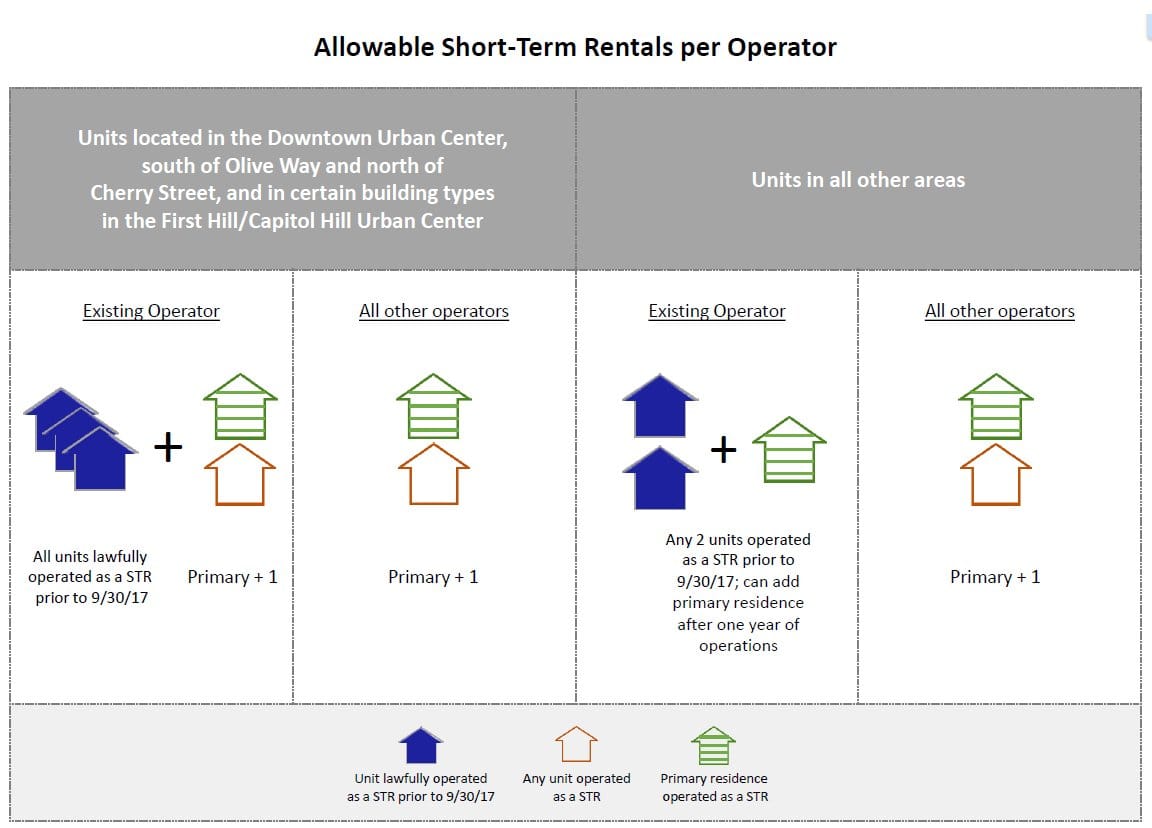
The city council has settled policy on short-term vacation rental regulations, ending a nearly two year process. Under a complex regulatory scheme, operators of short-term vacation rentals may be able to own and operator two or more units in Seattle depending upon where units are located and when they began operating:
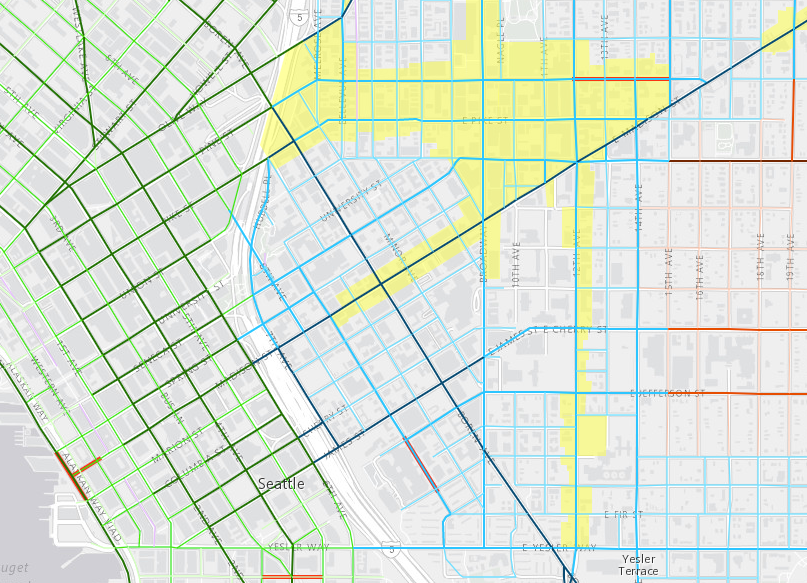
- Existing operators in Downtown Urban Center south of Olive Way and north of Cherry Street will be allowed to grandfather-in all units lawfully operated as of September 30, 2017 in addition to two further units, including one in their primary residence;
- Existing operators in multifamily buildings constructed after 2012 and containing no more than five dwelling units in the First Hill / Capitol Urban Urban Center will be allowed to grandfather-in all units lawfully operated as of September 30, 2017 in addition to two further units, including one in their primary residence;
- Existing operators in all other areas will be allowed to grandfather-in up to two units lawfully operated as of September 30, 2017 and within one year also operator their primary residence as a unit; and
- New operators in all other areas will be allowed up to two units, including one in their primary residence.
Two last-minute amendments were adopted to the legislation that:
- Shrunk the area where grandfathering-in provisions for larger operators would apply; and
- Established a fee schedule structure to recover regulatory costs with regulating online platforms likes Airbnb.
Councilmember Sally Bagshaw sponsored the first amendment in an effort to constrain the number of short-term vacation rentals in more residential areas of Downtown, such as Belltown, Pioneer Square, and Chinatown-International District. The amendment also removed South Lake Union and Uptown from the large operator grandfathering-in provision.
Councilmembers Mike O’Brien and Lisa Herbold sponsored a separate amendment to specify recovery costs associated with implementation and regulation of short-term vacation rental platforms like Airbnb. The director of the Department Finance and Administrative Services will be required to adjust fees accordingly to ensure that the full regulatory costs are recouped by the city. The fee structure will be mixed with a per night fee (nights a rental occurs) and graduated annual fee based upon number of listings by an operator on a specific platform.
For small operators of one or two units, the limitations will have little or no affect on their ability to rent out their spaces. Larger operators, however, may face a more difficult choice: selling their extra units or renting them out to long-term tenants. The practical effect could be an overall increase of long-term housing or at least stemming the tide of long-term housing conversion to short-term vacation rentals. A very real pitfall though could be jobs associated with large operators that may have to downsize or dissolve.
The regulations will go into effect on January 1, 2019, in addition to health and safety standards, land use regulations, and special taxes.
Transit Way Amendment and Sound Transit 3 Partnering Agreements
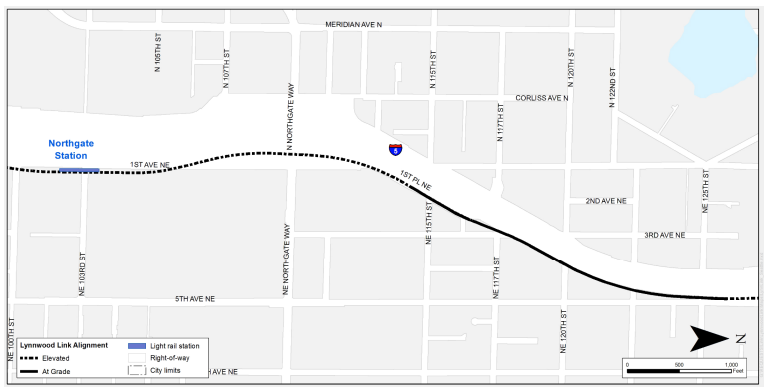
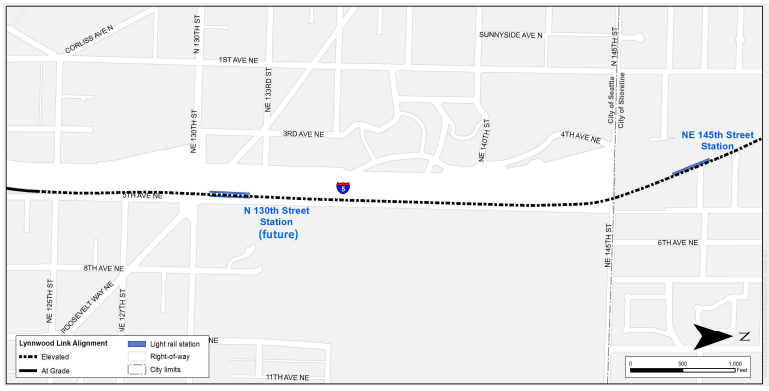
The city council signed off on a revised Transit Way Agreement with Sound Transit. The revised Transit Way Agreement formally adds the approximate location of stations, light rail facilities, and right-of-way for the Lynnwood Link Extension north of Northgate. This will allow Sound Transit to construct and operate light rail along that segment in Seattle. The existing Transit Way Agreement already identifies existing and planned facilitates and operations for the Central Link, University Link, Northgate Link, and East Link segments. The Lynnwood Link Extension will primarily be located within right-of-way owned by the state (I-5) with few exceptions. A future station on the segment will be added in Seattle at N 130th St and second one just beyond the city limits at NE 145th St.
Separately, the city council approved a partnering agreement with Sound Transit. The partnering agreement creates a formal relationship between Sound Transit and the city in planning and implementing Sound Transit 3 projects. Both agencies will make internal changes to processes to more seamlessly collaborate on projects and issues. For instance, the partnering agreement specifically lays out a formal schedule of key milestone deliverables, primary project specialists and contact at Sound Transit and Seattle, overall development approach, and means to resolve disputes.