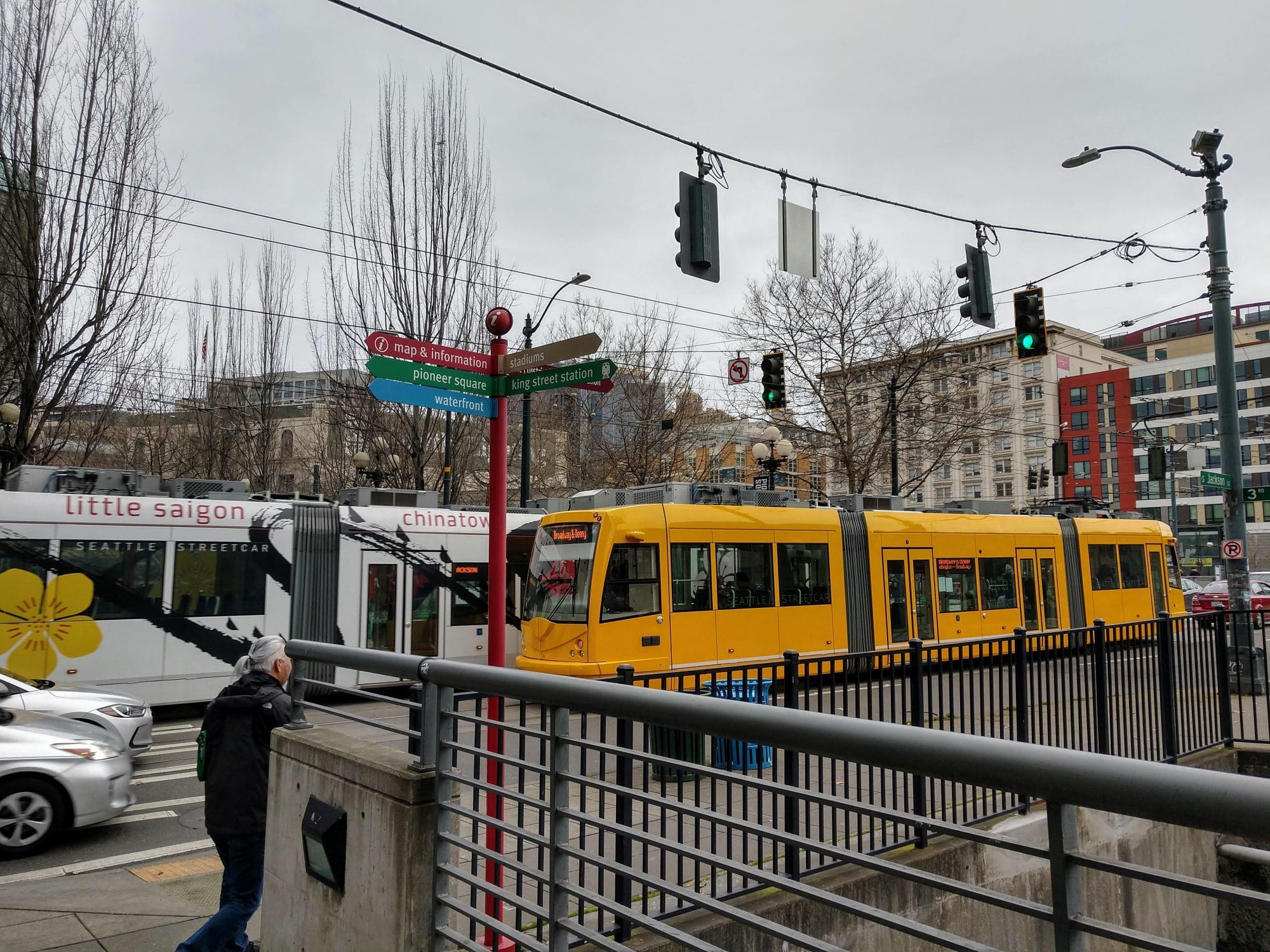
On Tuesday, the Seattle City Council was briefed on the Center City Connector project, which was recently backed by Mayor Jenny Durkan. The project was put on hold after modest project cost increases and dispute over future operating costs with King County Metro came to light in early 2018.
Over the summer, a consultant hired to evaluate the cost and benefits for the project affirmed that costs did go up but that projected ridership could also rise, making the financial issue somewhat of a wash. Then in January, Mayor Durkan finally released an updated engineering report that suggested additional design changes could be useful, though some were not an operational necessity.
During the meeting, Councilmember Lisa Herbold asked if the city would pursue cost recovery from the vendor of the new CAF Urbos streetcars that city would be purchasing. Her line of questioning really got at the issue that the streetcars have created some system engineering challenges that may not have been fully vetted by the vendor in developing their proposal, leaving the city otherwise on the hook to pay more to resolve the challenges. “It’s something that we’ll work with the [vendor] to negotiate as we move forward with the project,” said Karen Melanson, Deputy Director of Policy, Programs, and Finance for the Seattle Department of Transportation (SDOT).
When Mayor Durkan declared her support for the project, additional cost increases, above those identified by consultant KPMG in the summer, were disclosed: $285.8 million versus the earlier $252.2 million. “The current city estimate builds on the KPMG work and adds in the additional engineering analysis as well as escalation for construction with revenue estimated to be in 2026,” Melanson said.
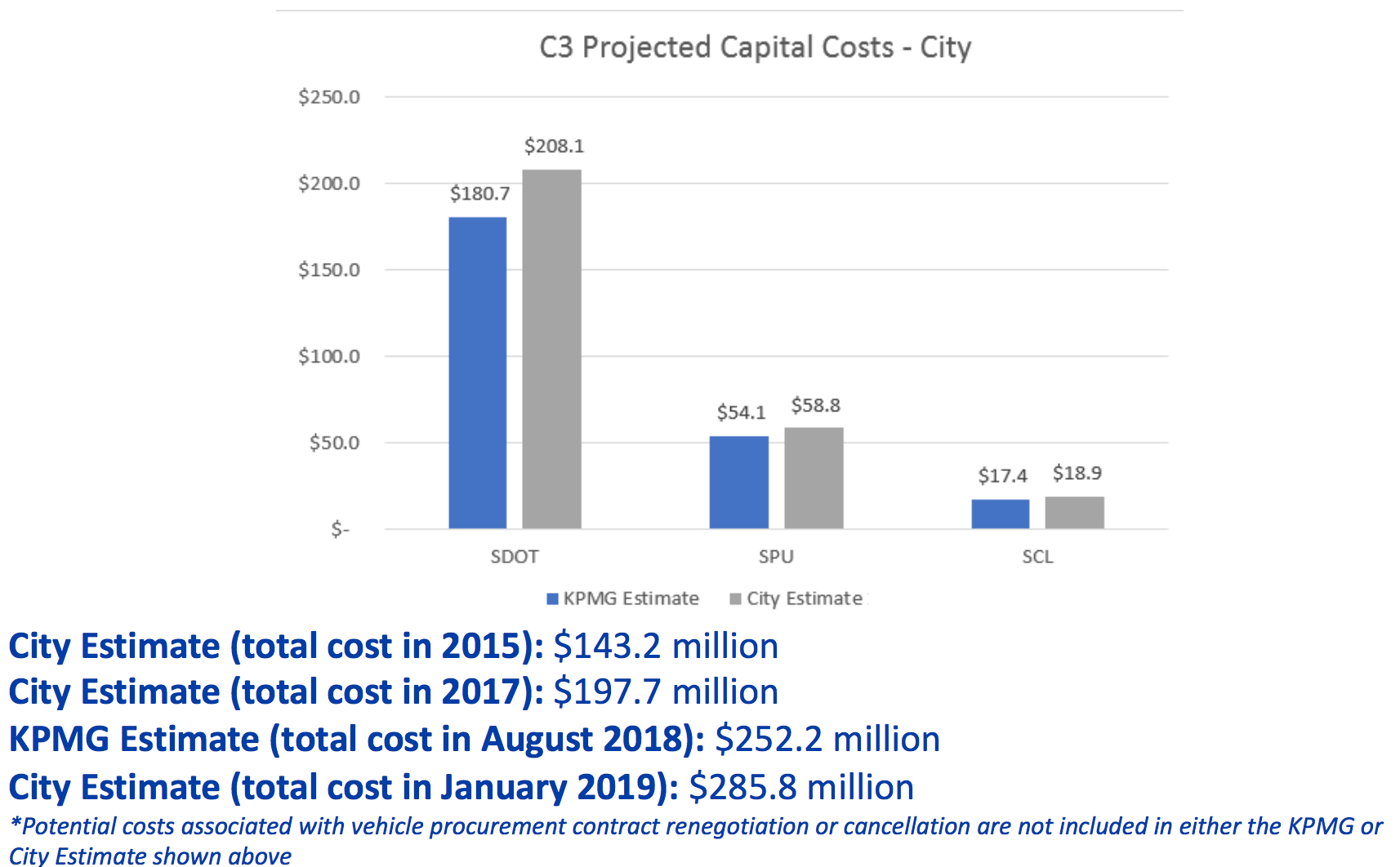
The KPMG analysis differed in that it neither included additional engineering analysis costs nor went beyond 2022, when construction was assumed to wrap up. City Budget Director, Ben Noble, said that at the time of the KPMG report the city did not know that 2026 would be the actual year of completion due to the engineering issues. Most of the cost increase therefore is escalation due to added time and inflation, not because the KPMG estimate was inherently wrong.
Noble also confirmed, in response to a question from Councilmember Johnson, that most of the $6.2 million cost increases for Seattle Public Utilities and Seattle City Light capital projects were cost escalations.
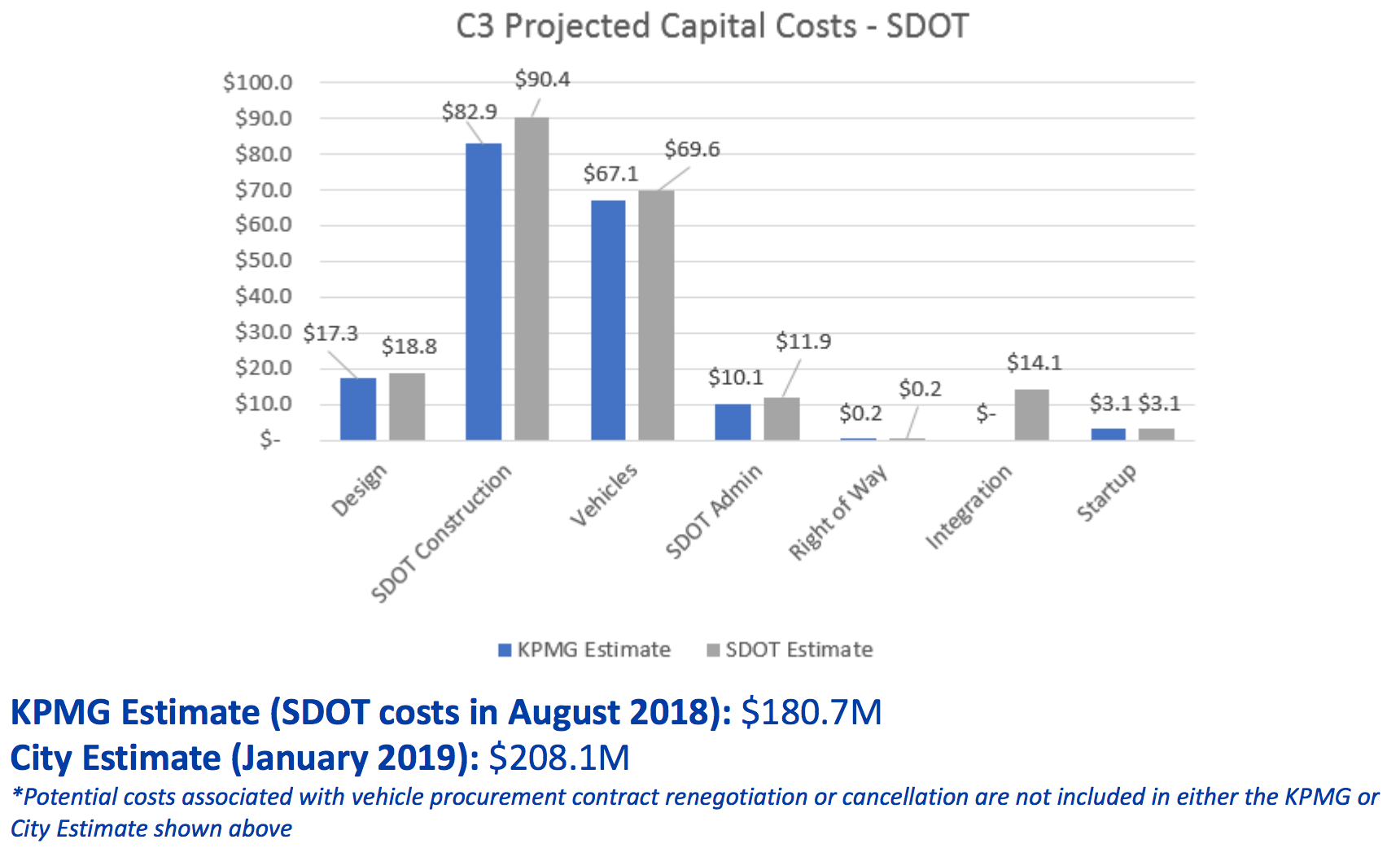
In terms of the streetcar cost increases, the January estimate was $27.4 million more. The lion’s share of the cost increases were escalation costs, SDOT said. The exceptions were design ($1.5 million), administration ($1.8 million), and integration ($14.1 million) costs. Councilmember Johnson speculated that these might be the costs that could be partially if not fully passed back to the streetcar vendor.
Excluding the capital expenditures for utilities work, most funding that has been set aside for the Center City Connector streetcar project has not been spent, even though most of the funding has been identified:
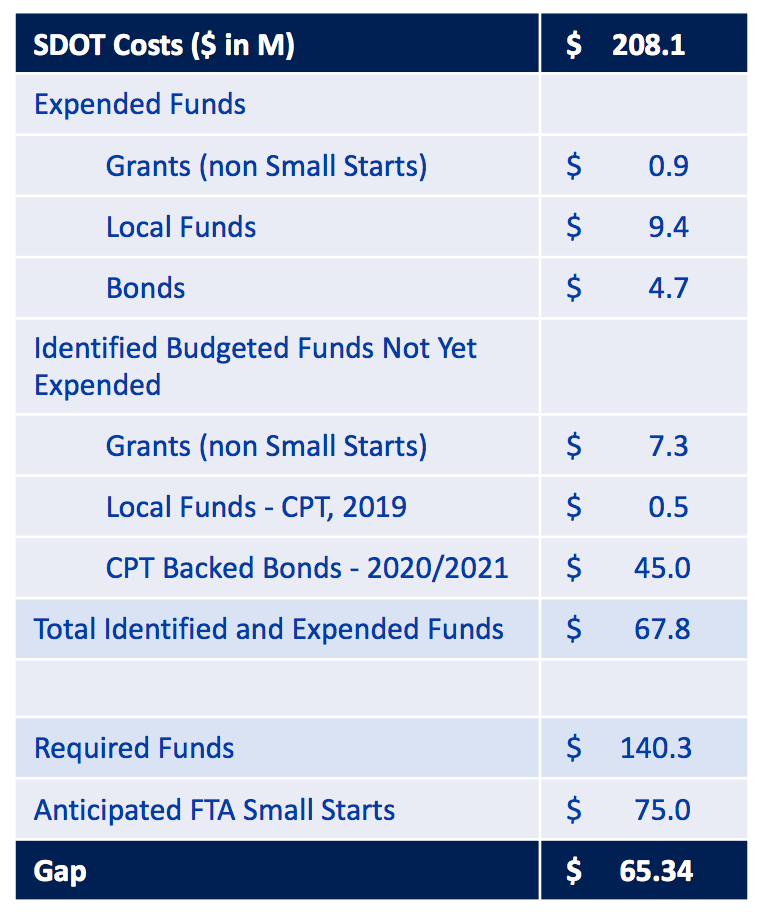
SDOT expected to receive a $7.3 million Congestion Mitigation and Air Quality grant from the Puget Sound Regional Council to purchase the streetcar vehicles and has $500,000 from the Commercial Parking Tax approved for continued work to plan and coordinate the project this year. Another $45 million will come from Commercial Parking Tax-backed bonds in 2020 and 2021. Assuming that the other $65.34 million in unidentified funding sources are secured, the Federal Transit Administration (FTA) should come through with a $75 million grant for the project ($50 million is guaranteed and another $25 million is expected after additional review).
“One of the things that we know and we don’t think has changed is the project…again for now a higher cost, in some sense a relatively smaller cost compared to many transit projects by connecting two existing systems that are sort of struggling in operations and isolation in drawing that connection,” Noble said. “You get a very significant ridership and a very significant benefit. Bottomline, the FTA will do their own analysis, but we expect the project will compete well on the Small Starts criteria.”
The Value of Redundancy
Councilmember Herbold asked if the streetcar corridor (partially) overlapping with other rail lines might affect the equation. Melanson responded that the FTA will look at the ridership projections and models of the streetcar project itself, which demonstrates on its accord the project value.
Councilmember Mike O’Brien also pointed out that partial overlap could have positive impacts, not negative ones to system use, similar to increasing transit frequencies and building upon networks in general, inducing more ridership overall. “With a network effect, now there’s potentially tens of thousands of riders every day the could get off at a certain location with a connection to the streetcar, too,” he said. “But you would hope that one would at least attempt to model that, whether it’s a positive or negative.”
Eric Tweit, Project Manager for SDOT, said the ridership numbers were derived from modeling conducted in 2014 using the FTA’s “STOPS Model“. He said that the model accounted for “conditions expected to be in the transit system as a whole by 2035.” That included known light rail extensions at that time. The ridership numbers were then updated this past fall “with a recalibrated version of the STOPS Model,” accounting for things like recent ridership on the South Lake Union streetcar line, which has seen a 2% ridership decline. Ultimately, that modeling scenario determined that ridership would be in line with what KPMG projected last summer.
Councilmember O’Brien made another observation about how alternative options can be a good thing for a transit system and riders, offering “multiple different connections” and choices. “Maybe on some days you decide that [you] want to take the two escalator rides downstairs to get on something and then reverse it at the other end,” he said. “Or [you’ll] just hop on something on the street, it might be slower that way but not a longer walk. But we do know that when people have lot of different options, that’s a benefit.”