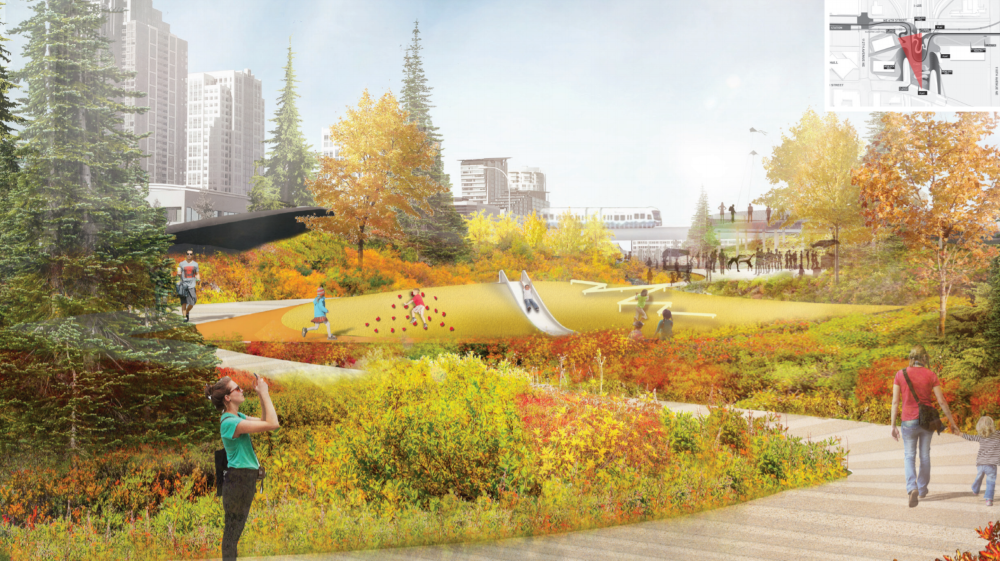
Removing I-405’s NE 8th Street cloverleaf interchange would free up space to extend the planned “Grand Connection” lid northward.
A dozen cars idle before a stoplight; a dozen others rush through the intersection in front of them. The sidewalks are empty today like usual; cars are the only populace on the streets. The light turns green and the cars rush forward in different directions.
I’m standing at the intersection of NE 8th Street and 11th Avenue NE in Downtown Bellevue. To my left and right are brand-new skyscrapers—the gleaming manifestation of Bellevue’s immense growth over the last twenty years—and before me is a freeway interchange connecting 8th Street with I-405. Nowhere else is the stark contrast between the 20th and 21st centuries more apparent: floors of dense development and acres of empty, car-centric land smacked right next to each other.
It’s quite a scary experience to walk (or bike) across I-405 on NE 8th Street. Traffic speeds by at highway speeds on the street’s six wide lanes while pedestrians are confined to a narrow sidewalk. Cars taking the freeway entrance seem to have no regard for any speed limit whatsoever. I’ve often found myself trekking across I-405 on other streets since 8th Street is really that daunting—pedestrians and bicyclists need to traverse no less than six treacherous crosswalks just to get from one side of the freeway to the other.
The fact that the interchange still exists is a testament to Bellevue’s unequivocal love for autopia. Downtown streets are huge—twice as wide as their Seattle counterparts—blocks are long, and sidewalks are afterthoughts. No matter what the tall buildings may entail, Bellevue is still a car-dependent suburb at heart.
Picking up the pieces
Bellevue blossomed at a time when criss-crossing cities with highways was the hallmark of urban planning. Six-lane avenues, ten-lane freeways—the more lanes the better. It was a time when automobile ownership was booming and when global warming wasn’t really a thing.
But those dreamy days of Pax Americana remain only a distant memory of our turbulent present day. Global warming is now threatening the basis of our very livelihoods, not least because of the unsustainable lifestyles of days gone by. We’re starting to feel the squeeze of those car-oriented policies in other places too: driving is deepening structural inequalities, many cities are seldom walkable, and public transit is lacking. The dangerous health effects of driving puts communities within one-thousand feet of freeways at high risk for fatal diseases like asthma and respiratory illness.
As we build our cities for tomorrow, we must not surrender ourselves to the playbooks of yesteryear. Do we really need to preserve the 15 lanes of freeway rammed through Downtown Bellevue? Can we do without the enormous interchanges that prevent our cities from developing sustainably?
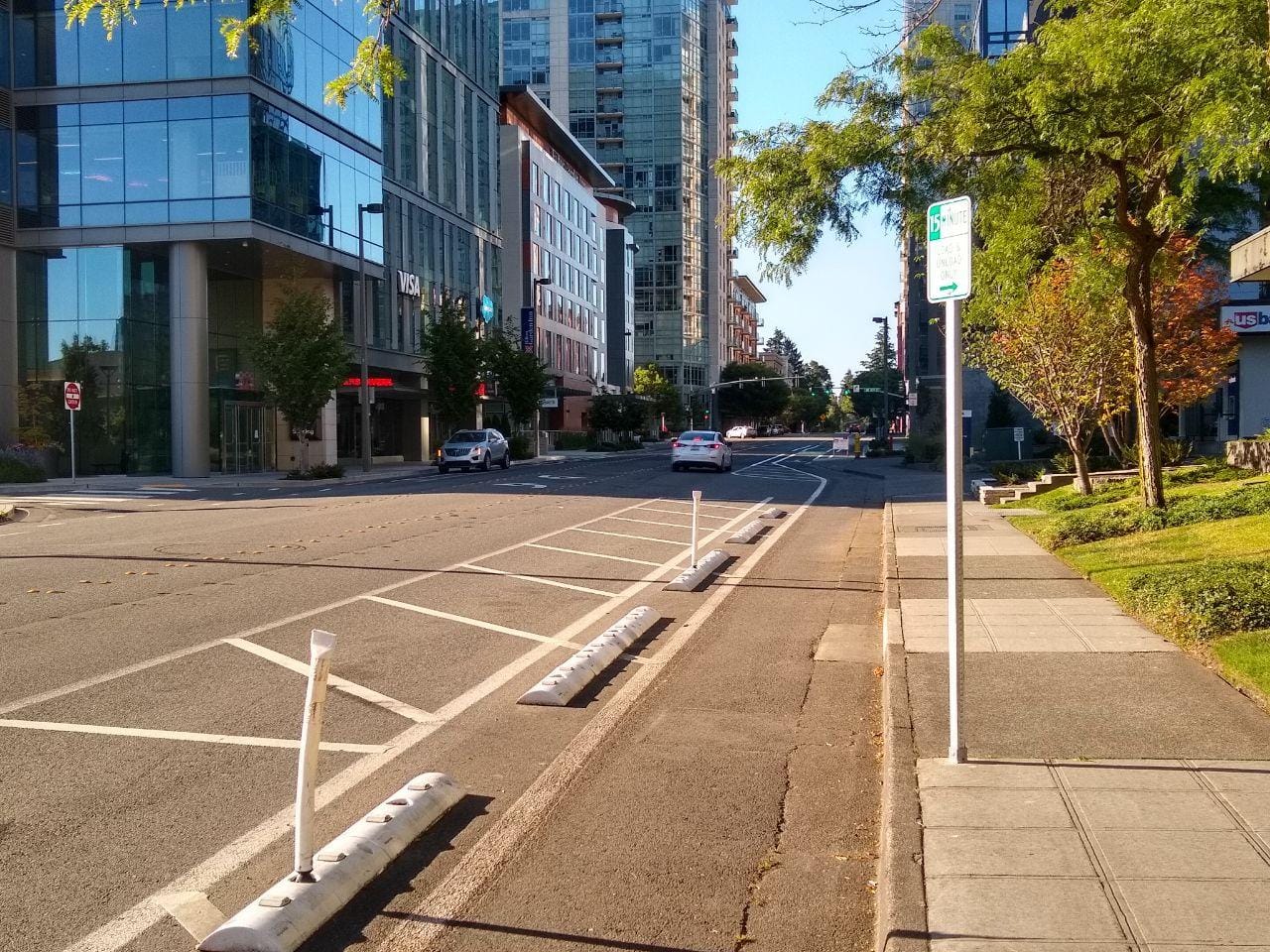
Bellevue is taking steps to become more friendly to our friends on foot, such as building pedestrian malls, widening sidewalks, and even lidding a portion of I-405. But these efforts are still pretty car-oriented, to say the least. A larger freeway lid, as I’ll describe later in this piece, would take a bigger step in the right direction.
Induced Demand: More Lanes, More Traffic
Rather than attacking the root cause of the issue—freeways themselves—many urban planning projects try to work around them without really questioning whether they need to be there in the first place. Projects shouldn’t be dinged for reducing traffic speeds or capacity, since in many cases such reductions are beneficial.
More lanes doesn’t equate to less traffic, in fact just the opposite. Induced demand dictates that while road widening will decrease congestion in the short-term (since there’s more lanes handling the same number of cars), it won’t speed up travel times in the long-term. That’s because as traffic thins, people will take notice and use the road more and more until it becomes just as congested as before. Think of it this way: you wouldn’t drive from Seattle to the Seattle Premium Outlets in Tulalip after work—the mall would be closed before you even arrived! But if the traffic wasn’t as bad, you might have made the journey. Commuters might also stop taking the bus or carpooling when they see that the HOV lanes aren’t much faster than the regular ones.
Texas learned this the hard way after spending $2.8 billion to expand its Katy Freeway to a whopping 26 lanes in Houston. After the expansion, rush hour travel times increased by 51%. More cars simply filled the extra capacity the road provided. With this in mind, it’s important to be open to change when discussing how we shape our roads and cities. Downsizing roadways isn’t always a bad thing.
Though this isn’t to say that we should just get rid of all roads—there needs to be a balance. I-405, being an important regional connection without nearby alternatives, should definitely exist so Eastside residents can still get around. That being said, there are certainly parts of the freeway that can be slimmed down, particularly the 8th Street interchange.
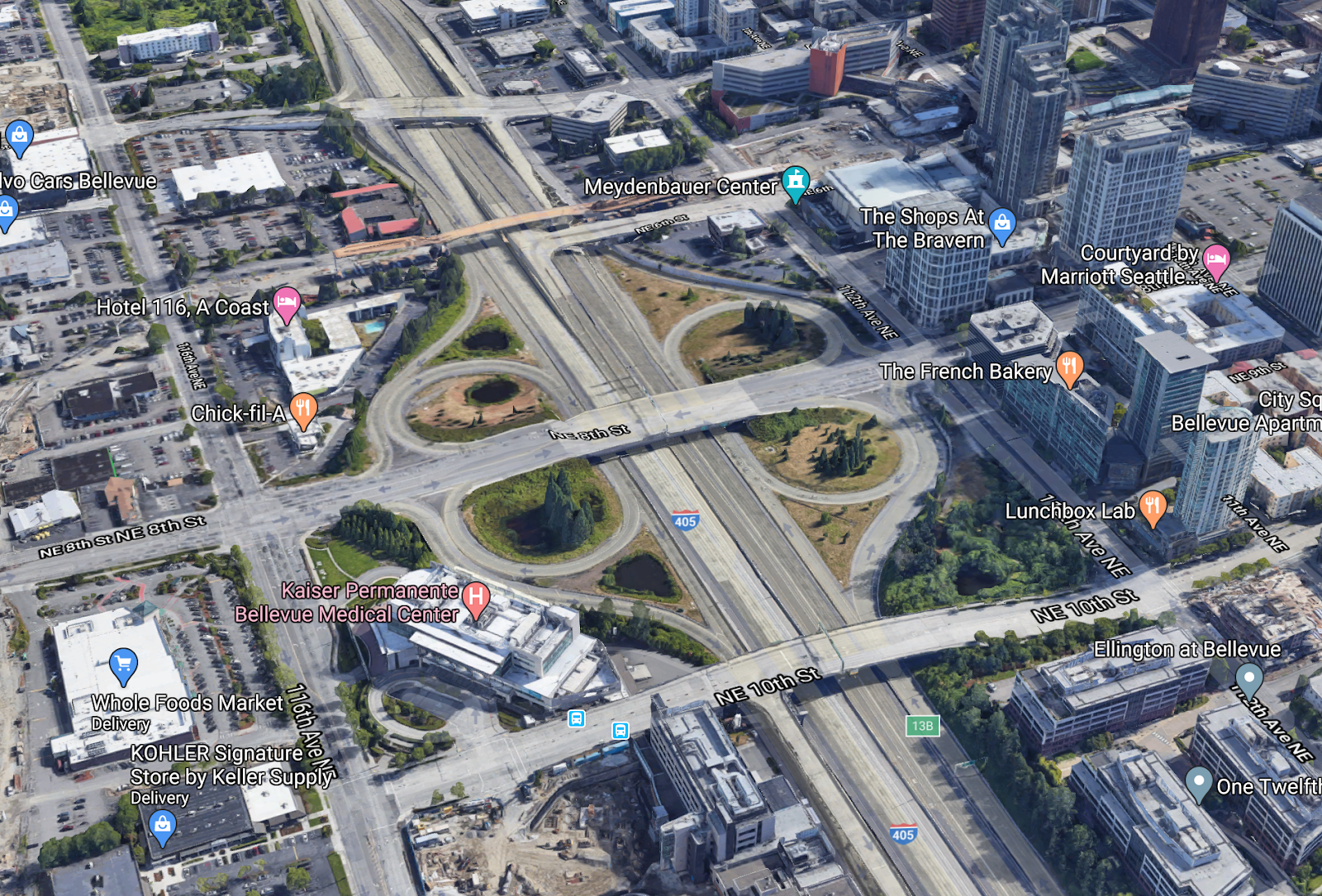
The monstrous interchange consumes more than 25 acres of land that’s close to hospitals, malls, and transit. And being a freeway, I-405 naturally acts as a giant growth barrier for Downtown. Highrises loom to the west, and strip malls line the avenues to the east. While being no more than a few hundred feet apart, the different sides of the freeway are two very different worlds.
Bellevue’s Lid and Freeway Plans
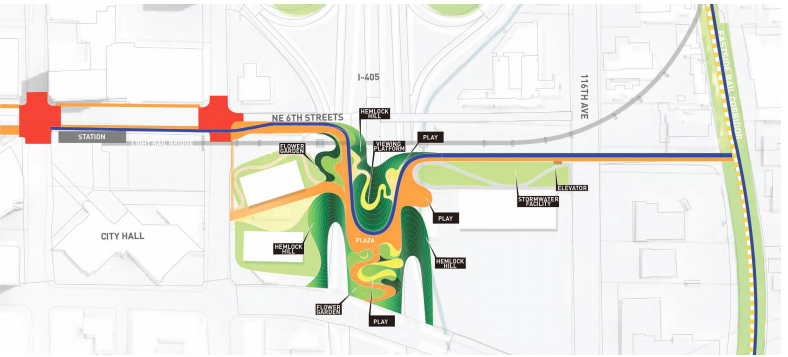
The City of Bellevue has an ambitious plan to bridge this gap by lidding a portion of I-405 from NE 6th Street to NE 4th Street. It’ll improve pedestrian access across the freeway with a multi-use trail along the light rail guideway and provide green space with a landscaped park atop the freeway’s right-of-way. The Bellevue City Council selected a preferred lid alternative in 2018, but hasn’t yet identified or allocated funding. The City study projects the lid will cost between $116 million and $130 million.
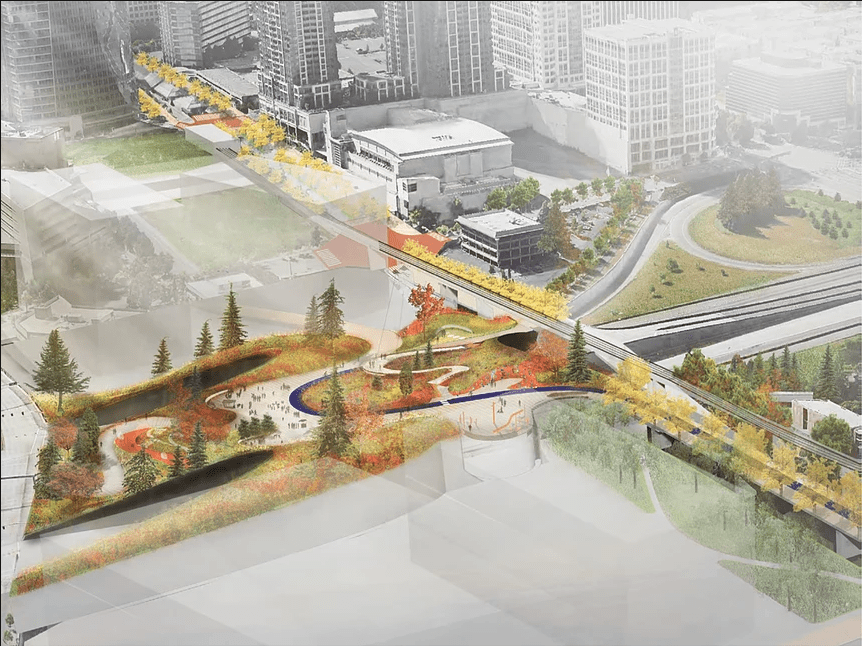
But there are flaws. The two giant freeway ramps shoved through the lid’s southern end mean that more than a quarter of the lid is barely usable. The trees hiding those ramps then take up another chunk of land, and the whole lid has awkward hills to conform to the 6th Street ramps. Plus, with only three connections to the outside world, the park itself is extremely isolated.
If anything, this lid wasn’t built to satisfy pedestrians but rather developers. Without good integration into the rest of Downtown, it’ll be unlikely that the lid will attract much use, and without changes to the nearby road network people will still be discouraged from walking.
Could the lid just be another attempt to greenwash highway expansion? The Washington State Department of Transportation is adding two toll lanes on I-405 from Bellevue to Renton and the City is planning to build yet another freeway interchange downtown.
Both projects masquerade themselves as congestion-reducing improvements, but these “Lexus Lanes” and “concrete dragons” will do anything but. Expanding I-405 will only create more traffic and more pollution—hardly a good idea in the midst of a climate crisis—and building new interchanges always hinders walkability.
The whole debacle bears a striking resemblance to the proposed Rose Quarter Freeway “lids” down in Portland which many have also accused to be an attempt to greenwash widening I-5. Like our I-405 lid, Portland’s lids don’t add much useful park space nor do they substantially benefit the community.