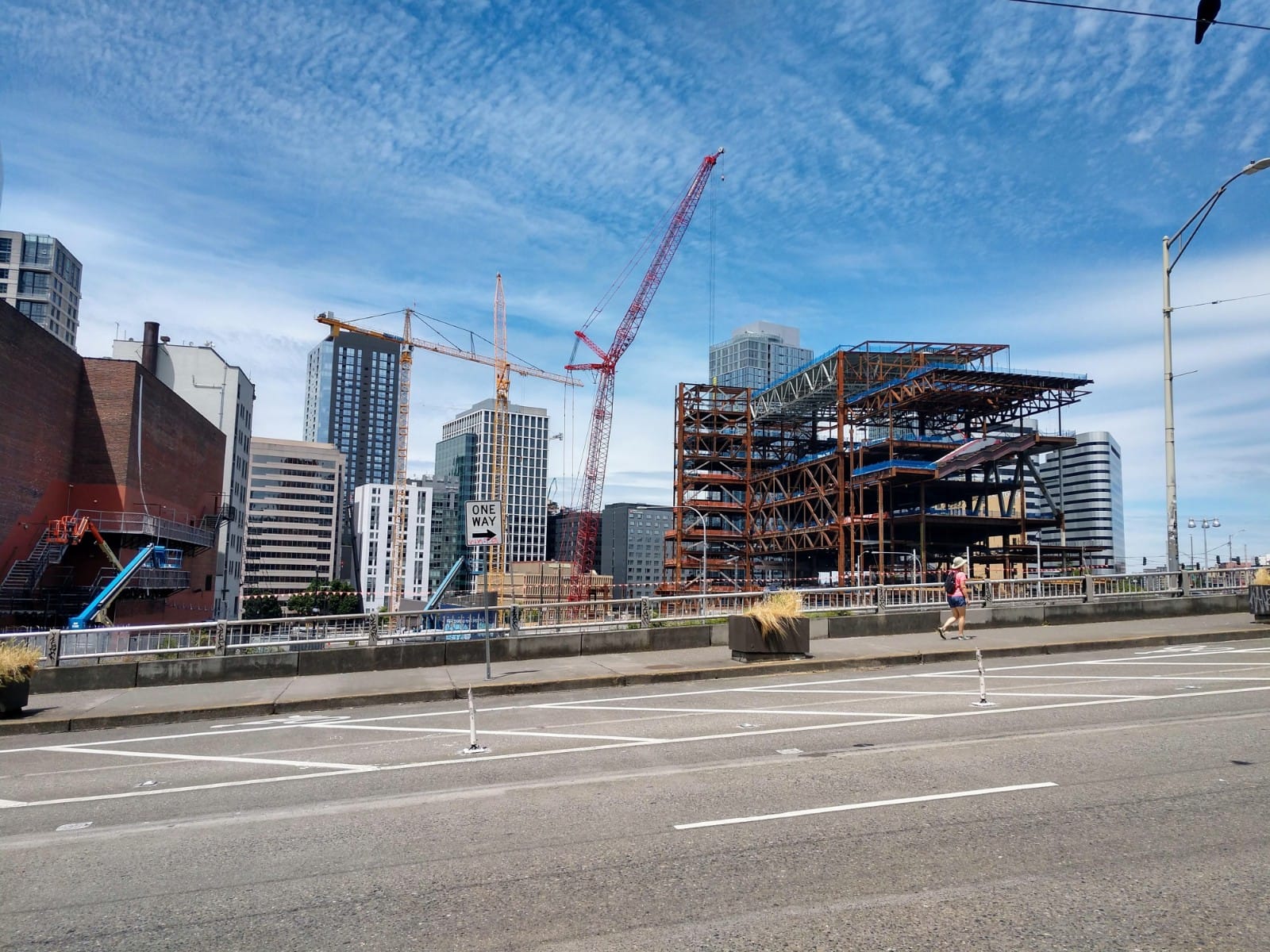
On Thursday, King County Executive Dow Constantine outlined his plan to loan $100 million to the Washington State Convention Center (WSCC) to prevent a construction stoppage on its now $1.9 billion expansion, which he portrayed as 80% done.
Plenty of questions remain. The terms of the deal were not released beyond a 1% interest rate that seems pretty generous considering the risk involved, and brushing aside those concerns by saying that the return on investment is similar to what the County’s $3.4 billion investment fund averaged in the bank is hardly convincing. The County is taking on risk by loaning money to a troubled enterprise like the WSCC and it’s consuming borrowing capacity, hazarding that future loans will get worse rates if the County’s credit rating suffers in the process.
Earlier this year, developer Matt Griffin revealed the project has a $300 million shortfall, which suggests the project is still $200 million in the hole. County officials said they had provided a “template” and suggested that the City of Seattle and the State of Washington will each chip in their own $100 million low-interest loans. They have yet to make such a commitment, though a spokesperson for Governor Jay Inslee did express interest in working on it with the state legislature.
The convention center has pitched itself as too big to fail, and the County pointed directly to the ultimatum it had received in its press release: “The Convention Center indicated that if a solution to the $300 million funding gap is not found in the coming weeks, it will be begin taking steps to shut down the project in the spring, letting go of 1,000 construction workers.”
Labor heard the threat. Nicole Grant, executive secretary of the MLK County Labor Council, spoke on behalf of the project, which to its credit created a robust apprenticeship program responding to the demands of labor leaders. “We cannot stop,” she said. “Thousands of jobs are on the line.”
Whether his hand was forced or not, Constantine stressed the benefits during his media tour on Thursday.
“It was clear to me we had to do something to make sure the project is done on time, that those construction workers stay employed and that our visitor industry benefits from this asset as soon as possible,” Constantine said in an interview with Puget Sound Business Journal.
When asked during his press conference what assurances the County has that the loan will be repaid or that the convention industry would recover, Constantine suggested such doubts were unfounded and betrayed a lack of faith in Seattle. He called it a “safe investment” and predicted a strong rebound in travel and tourism. (And apparently trade expos and business conventions are what people have in mind once they have a vaccine coursing through their veins.) The WSCC’s finances are backed by a hotel tax gathering revenue from all hotel stays in the county at a rate of 7% in Seattle and 2.8% elsewhere–regardless of whether they are related to a convention. That broad tax could help overcome shortcomings of the convention business, but it would also mean the convention center is skimming revenue that likely wouldn’t have happened anyway rather than creating it anew.
Critics question whether the public can really recoup the nearly two billion dollars that have been pumped into this project. One of the sharpest critics has been architect David Dahl who has penned op-eds in both The Urbanist and Crosscut.
“Expanding the Washington State Convention Center was a mistake, with obvious flaws in the data that was used to promote the expansion,” Dahl wrote. “The current crisis has only accelerated a trend of diminishing returns on convention center construction that has been ongoing for decades.”
The pandemic could dampen demand for large in-person gatherings for quite some time, particularly as companies have invested in conferencing software and hardware and gotten comfortable with it, Dahl suggested.
“The technological innovation that powers much of the regional economy (and will be the likely centerpiece of the region’s recovery) is actually pushing convention centers as a building type towards obsolescence,” he added. “Rather than rushing to throw good money after bad, our elected officials should be questioning why so much public money was poured into such a dubious investment in the first place.”