The move embroiled the City of Bellevue in a costly legal fight. Already on the hook for $40,000 in legal fees, the City could be in for much more as the battle against a state mandate to loosen parking requirements near frequent transit drags on.
Although it may not have been subject to much fanfare, the outcome of Bellevue’s City Council meeting on Monday, April 26th represents the culmination of months of work, itself predicated on state legislative action from over a year ago. With its unanimous approval of Ordinance 6575, City Council passed substantive reforms to parking minimums for new affordable housing, multifamily developments, and accessory dwelling units (ADUs) near frequent transit stops. Because parking can comprise a significant portion of project costs, requiring less legally-mandated parking can be a small way to encourage the further development that will be required to address Bellevue’s burgeoning affordability crisis.
The approved Land Use Code Amendment (LUCA) stipulates different parking minimums depending on a development’s distance to transit stops, frequency of service at those stops, and the type of development being planned. Because the overlapping conditions can be confusing (both for the public and for planning commissioners during the LUCA approval process), here’s a brief summary of the important outcomes:
- New affordable housing units a) up to 80% of Area Median Income (AMI) b) located within one quarter-mile of transit that operates 2-4 times per hour = 0.75 parking spaces/unit.
- New affordable housing units a) up to 80% AMI b) located within one half-mile of transit that operates more than 4 times per hour = 0.5 spaces/unit. Units at 60% AMI or lower with the same transit conditions will only require 0.25 spaces/unit.
- New market-rate multifamily developments located within one half-mile of transit that operates more than 4 times per hour = 0.75 spaces/unit.
- New senior housing units within one half-mile of transit that operates more than 4 times per hour do not require parking for residents.
- New ADUs within one quarter-mile of transit that operates more than 4 times per hour do not require an off-street parking space.
- As staff emphasized to concerned community members and commissioners numerous times during the process, these regulations are mere minimums. Developers can still choose to build more parking if they believe it benefits the project.
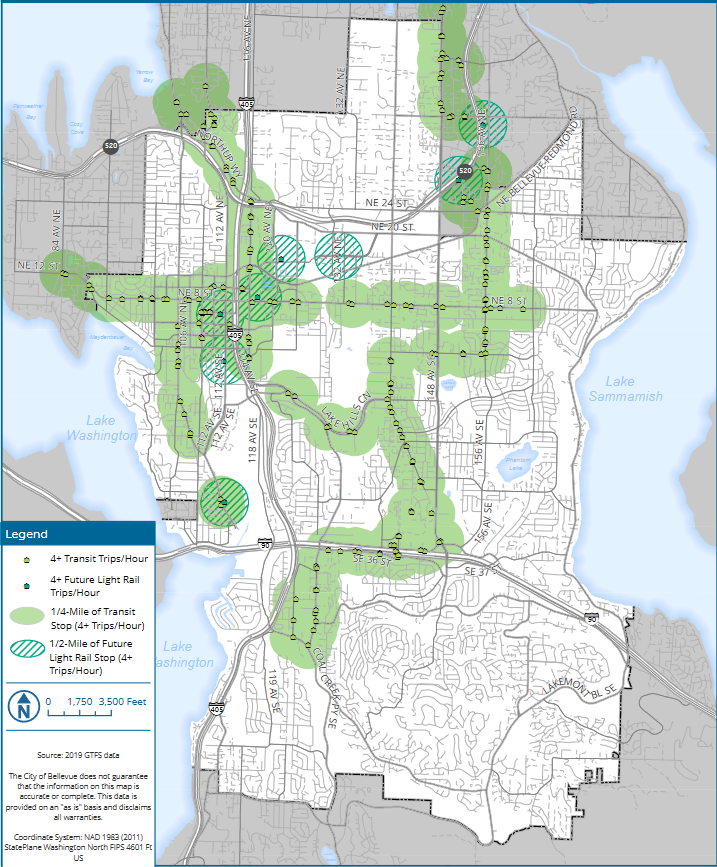
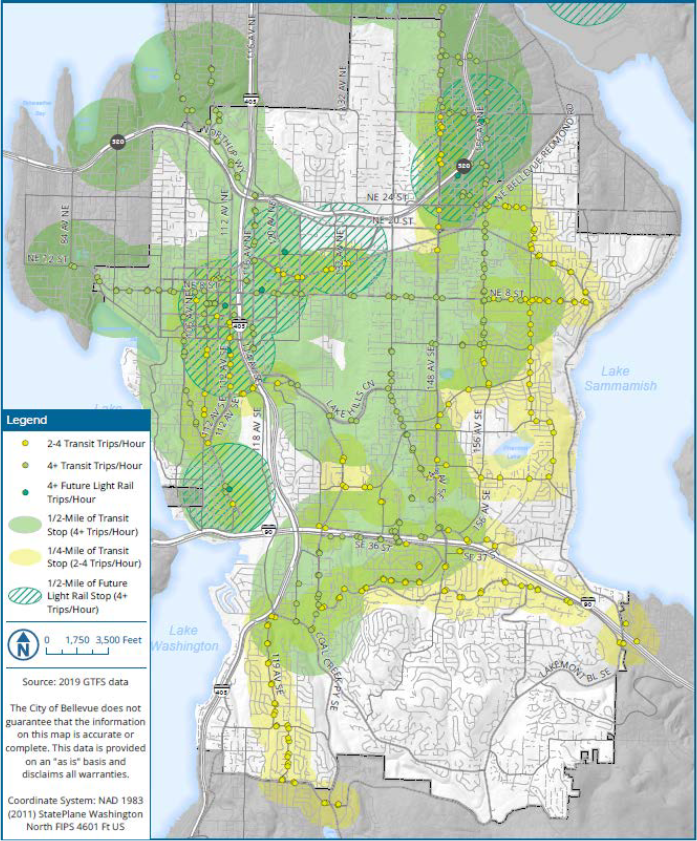
Bellevue’s scramble to comply with state law
Transit usage has been rebounding as we reach the end of the Covid pandemic, and Bellevue will be a major recipient of several system expansions in the near future (which have smartly been incorporated in this LUCA). This ordinance was therefore timely and received support from a wide coalition of housing advocates, developers, and members of the business community — but the city does not deserve all the credit. The foundations (and in fact the legal requirement) for this ordinance were laid by the State Legislature’s passing of Rep. Joe Fitzgibbon’s HB 2343 in 2020, which required cities planning under the Growth Management Act (GMA) to adopt lower parking minimums near transit.
To temporarily comply with the law, Bellevue passed an IOC (Interim Official Control, effectively a stopgap measure while staff and commissioners worked on a permanent ordinance) in May 2020 that was extended through May 18th, 2021, giving the city a hard deadline to pass the resolution before Bellevue would run afoul of state law. Luckily, Council was able to avert a legal crisis by passing the ordinance (which actually went beyond the state-mandated minimums) with weeks to spare.
A resounding success story in local governance, were it not for the East Bellevue Community Council (EBCC) throwing a wrench in the whole process and placing its jurisdiction in potential legal jeopardy.
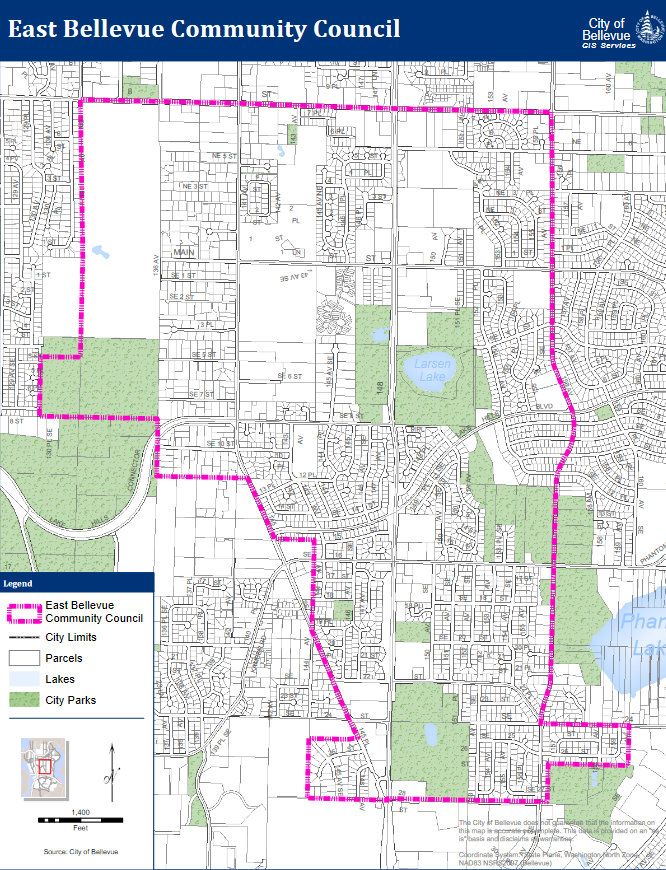
The East Bellevue Community Council’s jurisdiction. Most of the multi-family housing on 145th Pl SE is explicitly excluded, meaning most residents live in single-family houses (City of Bellevue). 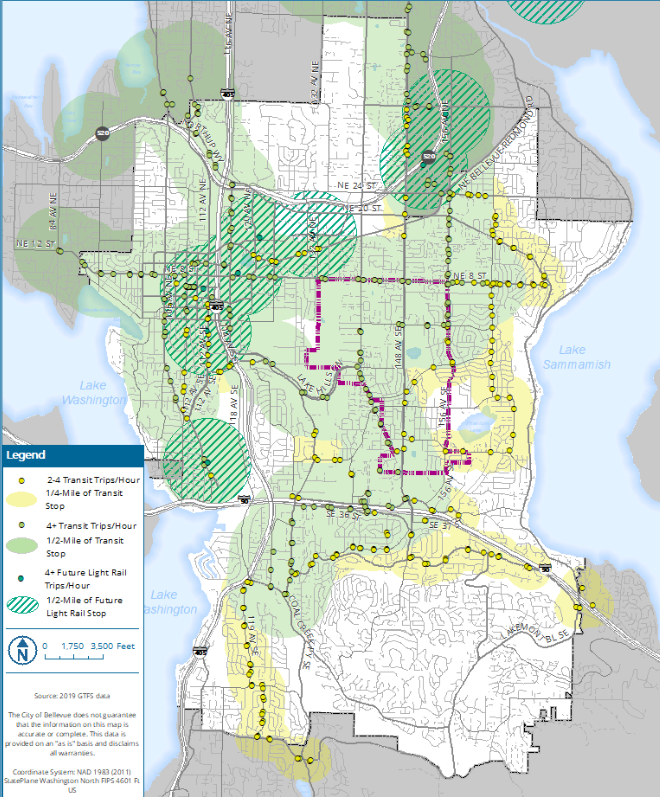
EBCC boundary overlaid on the previous frequent transit network map. A significant portion of this network falls within the EBCC jurisdiction (City of Bellevue).
At its May 4th meeting, the EBCC rejected the parking reforms in a 3-2 vote, meaning that the LUCA will not apply within its jurisdiction. The EBCC is one of two remaining community councils in Washington State — entities created during annexations that give local communities veto power over land use decisions within their borders. Although purported to be about preserving local autonomy, in practice these councils add additional red tape and bureaucratic hurdles to new developments and provide opportunities for community members to reject implementation of important affordable housing strategies. This is certainly not the first time a land use decision unanimously approved by the City Council has been vetoed by the EBCC, and so long as the body exists it likely won’t be the last.
“I think that everyone has the right to own a car or cars. This [ordinance] makes it more of a burden.”
EBBC Vice Chair Ron Epstein
However, what’s unique about this decision is that, with the expiration of the city’s IOC on Tuesday, the EBCC’s jurisdiction is now in violation of state law. I reached out to the City of Bellevue for confirmation, and they do not recall a time where specifically East Bellevue was in violation of a state land use law that the rest of the city was in full compliance with.