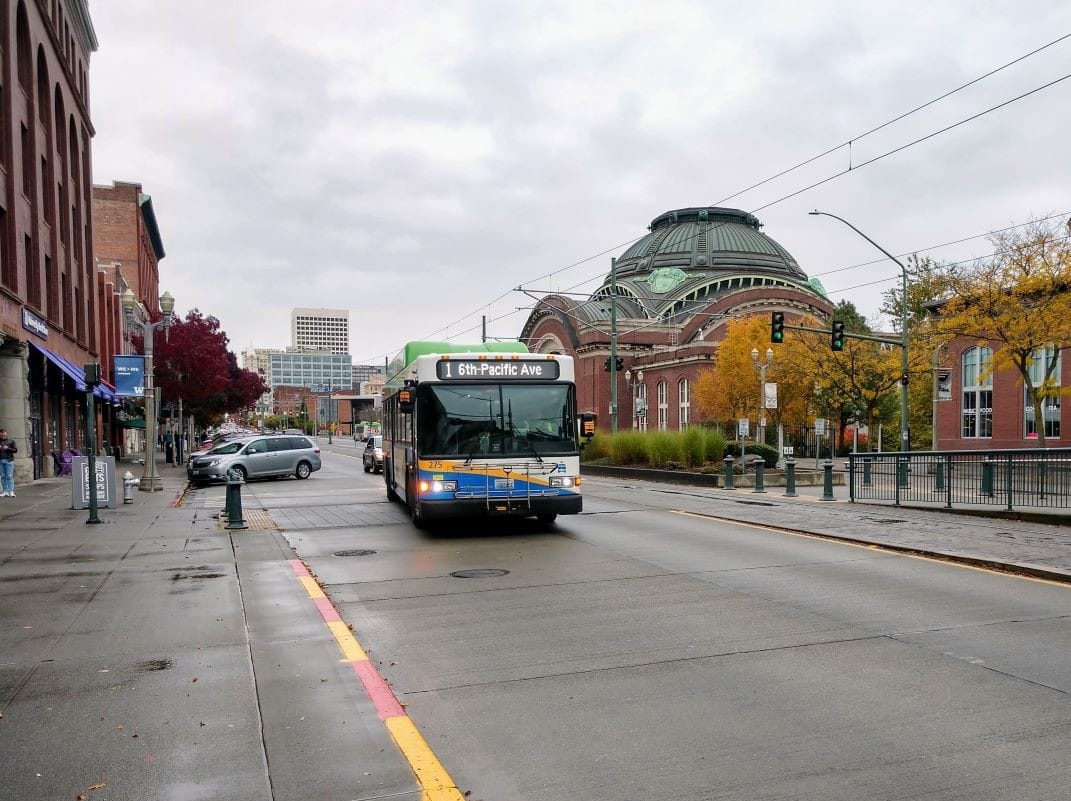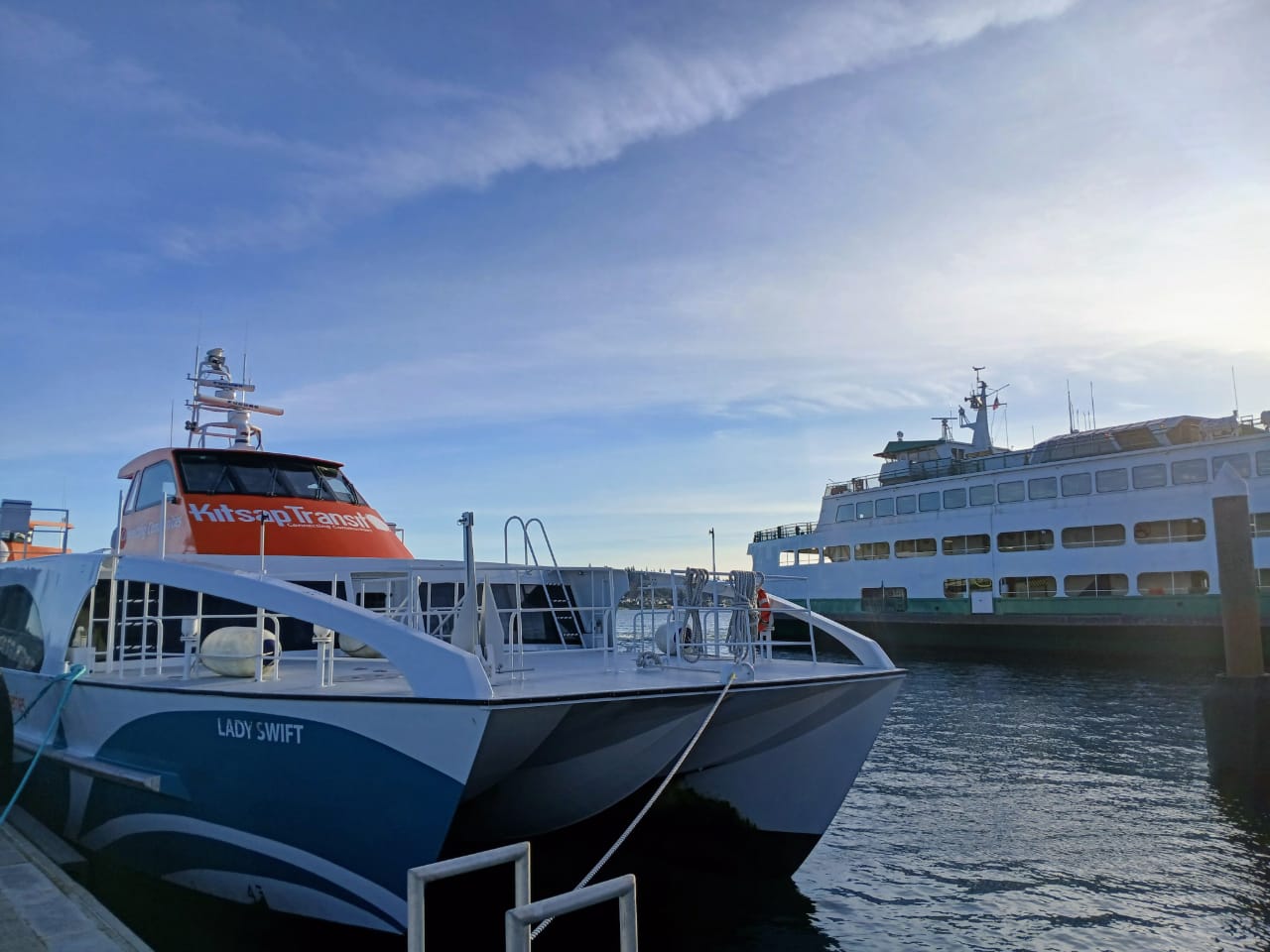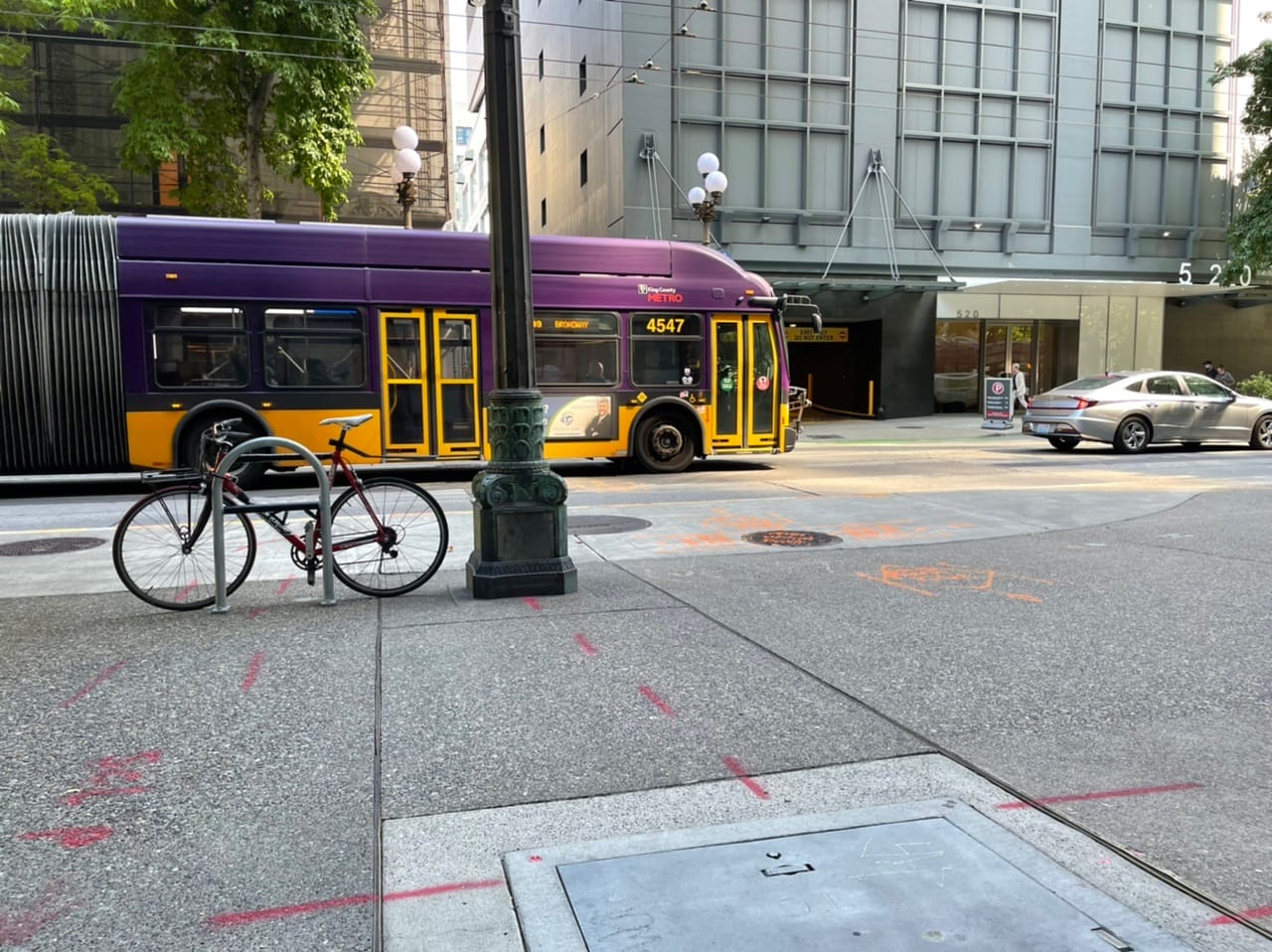
Pierce County representatives argued that transit riders in their districts are being left behind by the Puget Sound Regional Council and the state.
In what was supposed to be a meeting about allocations of federal funding for transit, turned into a fiery, tense meeting about the future of the Puget Sound Regional Council (PSRC) on Thursday. The council’s Executive Board debated regional equity, funding allocation amounts, and even if Pierce County has a place in the body anymore. At stake was just over $900 million in federal pass-through money to keep eight of the region’s transit agencies running and shore up finances blunted by the pandemic.
Road to more federal funding
Since 2020, Congress has passed three rounds of pandemic response relief funding with latest passed and signed into law in March delivering over $30 billion to transit nationally through the American Rescue Plan Act (ARPA) of 2021. This was an early win by President Joseph R. Biden who backed the economic relief package. Prior allocations under the Coronavirus Response and Relief Supplemental Appropriations Act of 2021 (CRRSAA) and Coronavirus Aid, Relief, and Economic Security (CARES) Act were made in April of this year and April of 2020; those two allocations alone have delivered more than $1.14 billion to transit agencies in the region.
Federal pass-through transit funding is based upon statutory formulas for urbanized areas (UZAs). For Puget Sound, that means there are several UZAs that qualify for statutory formula grants, including Mount Vernon, Olympia-Lacey, Bremerton, Marysville, and Seattle-Tacoma-Everett. The latter three fall under the PSRC for allocations while the former two are allocated by their own metropolitan planning organizations.
As part of a long-standing practice, the PSRC makes allocations to transit agencies based upon an “earned share methodology.” This distribution methodology considers a transit agency’s operating and service characteristics in determining allocations. In simplistic terms, the more service an agency provides to riders, the more federal pass-through funding it will get to support those investments.
What’s equity in funding?

This practice received criticism in 2020 by boardmembers like Pierce County Councilmember Derek Young who said that allocations should include greater equity. To address some of this criticism, the Executive Board approved this April’s allocations with a 2.5% equity adjustment. That allowed Pierce Transit, Everett Transit, and Washington State Ferries to receive more funding than they otherwise would have been entitled to under the typical earned shared methodology.
For the latest round of funding allocations under ARPA, the equity discussions were raised again. A special caucus met to reach consensus on how Seattle-Tacoma-Everett UZA allocations should be made with various considerations in mind and equity. But those discussion folded without agreement on changes. So a recommendation on allocations fell to transit agency leaders within the region.
At the end of August, regional transit agency leaders recommended that the PSRC move forward with the typical earned share methodology but with a 2.5% equity adjustment forPierce Transit, Everett Transit, and Washington State Ferries again. This recommendation was provided to the Executive Board on Thursday, but it immediately came with questions and concerns by boardmembers.
Hester Serebrin, a member of the Washington State Transportation Commission and Policy Director at Transportation Choices Coalition, asked agency staff if there was any definition of “equity” for allocations.
“There isn’t any specific definition of equity. We had three transit agencies in the region — Everett Transit, Pierce Transit, and Washington State Ferries — voice concerns that the earned shared methodology did not meet their needs,” said Josh Brown, Executive Director of the PSRC. “So there’s not a statistical analysis, definition, formula. Simply through that conversation and collaboration amongst the transit executive’s there as a decision that all the transit agencies, except for those three, would take a 2.5% reduction and those funds were then redistributed to the three agencies requesting additional monies.”
Everett Mayor Cassie Franklin followed on to say that the “earned share model is not equitable to transit agencies that do not have the funds to grow to meet the need in communities that we’re serving.” She added, “So if we’re basing the allocations strictly on the rate of how much service we’re providing, how are we ever going to get ahead in providing more service if that is the only tool used?”
A pitch for larger equity adjustments
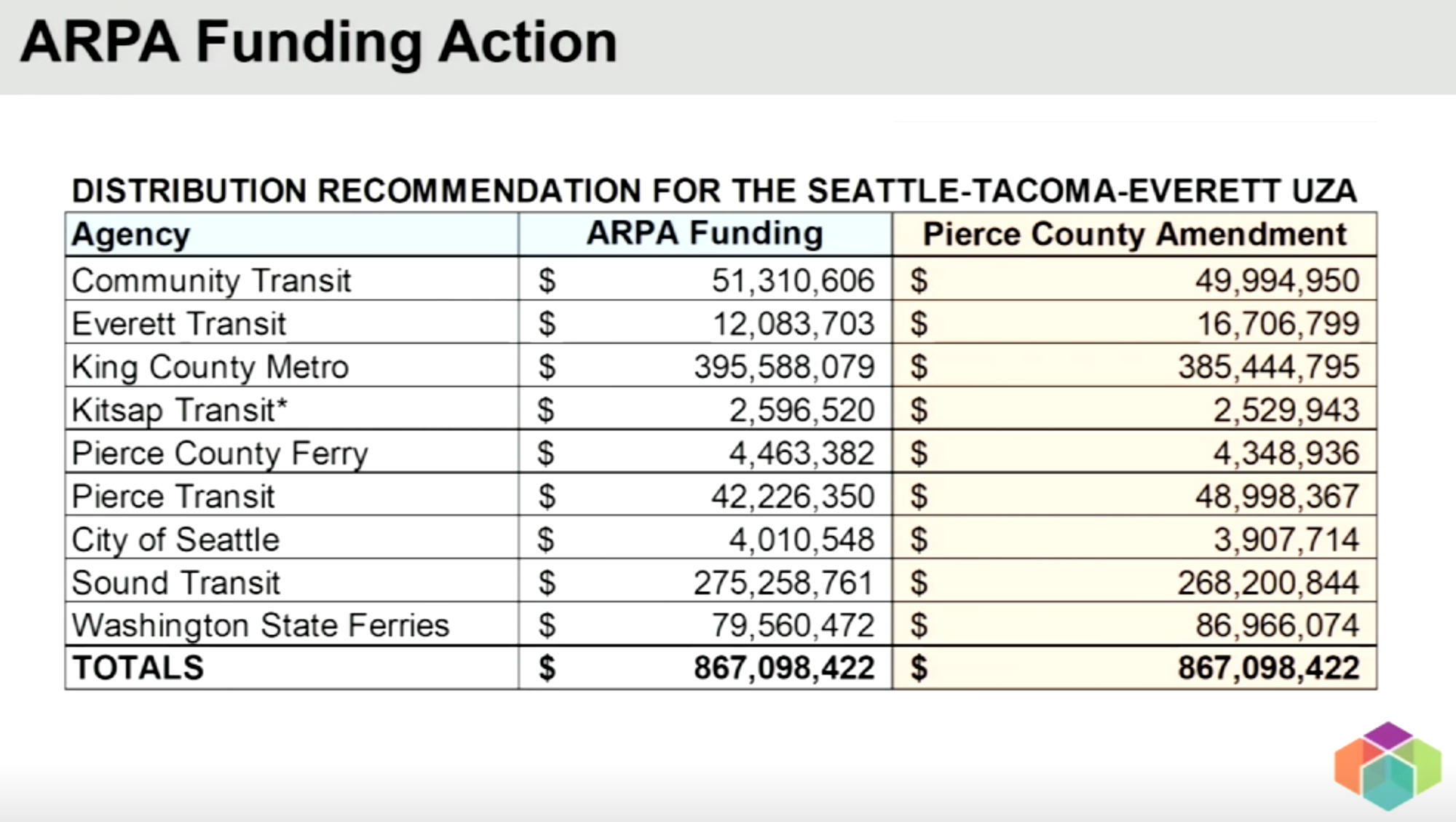
Councilmember Young then proposed his amendment to the allocations, which would have increased the equity adjustment to 5% forPierce Transit, Everett Transit, and Washington State Ferries. He said that some PSRC members aren’t getting “equity” and that despite discussion around it, the body hasn’t “been throwing actions behind those words.” He was clear that the base 2.5% equity adjustment proposal wasn’t fair and that even his 5% version wasn’t enough.
Before getting to a vote, Young discussed why there is a severe imbalance in transit funding and service across the urban region. “The problem has its roots not in our organization, but in the legislature. It’s the way we fund things in Washington, particularly around transit, and that is almost entirely localized at this point and based on sales tax,” he said. “So, what that means is that agencies that don’t have, that weren’t able to pass through voters the full amount [of authorized transit sales tax], which Pierce Transit has narrowly failed twice and will probably seek it again, means we can only raise two-thirds of revenue that other agencies can. Then on top of that, for every dollar that is raised through sales tax in King County, Pierce County can only raise 60% and that’s due to wealth.”
Pierce County’s under-invested in
Young isn’t wrong. Pierce County has long been a bastion for anti-tax sentiment and part of that has meant a serious lack of investment in public services and assets (excluding, of course, the immense highway expansions that continually have been made by the state), leaving a legacy of partially self-inflicted disinvestment over many decades. The county has also drawn its urban growth boundary so widely that it has meant very low densities, high costs of public services, and lower tax bases.