Throughout the summer and fall of 2020, Front and Centered held listening sessions with organizations of people of color across the state about transportation. Overwhelmingly people told us they wanted better transit and cleaner air.
These are demands that match our moment. The need — and the opportunity — to make our transportation systems more clean and fair has never been more clear:
- Forty percent of Washington State’s greenhouse gases come from the transportation sector. Black and Brown communities experience 60% more pollution than they create. Minority communities have less access to jobs and other basic amenities like schools, groceries, and healthcare. Even transit service is often planned and delivered in ways that leave out Black, Indigenous, and people of color (BIPOC) riders. And amidst a 35-year spike in pedestrian deaths, Native Americans are six times more likely to be killed on Washington’s roads.
- While remote work is here to stay, finally laying to rest that the ‘solution’ to congestion is more roads, many frontline workers will rely on spotty transit to support those lucky enough to work from home.
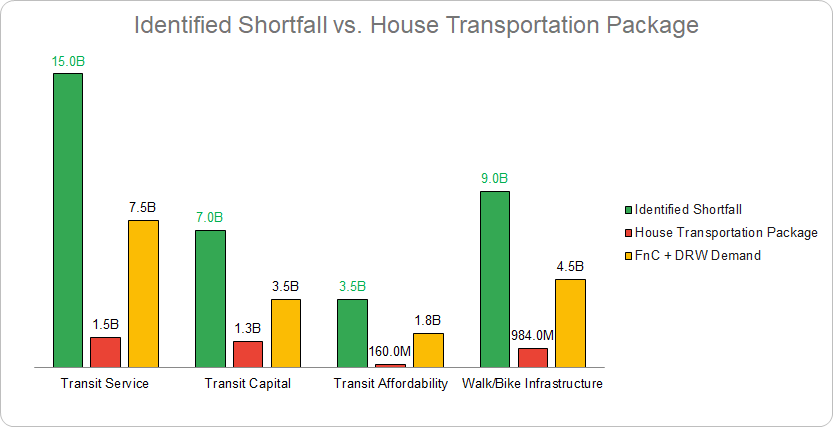
A coalition of advocates tallied the needs for transit, and walk bike facilities across the state. Let’s just say that after generations of neglect there is a lot of unfinished business. $25 billion for transit service, capital, and buying down fares for lower-income people, and $9 billion to make safe places for people to walk, bike, and roll wheelchairs, scooters, and other assistive devices. The proposed packages don’t even come close.
We can do better than this.
And it’s not just us saying it. President Biden’s Secretary of Transportation is signaling it’s time to pivot to safety, equity, and sustainability. National advocacy groups like Transportation for America wrote recently that just pouring money into the same programs that created the problem in the first place is no way to dig ourselves out of this mess:
- We can’t say we’re for fixing “crumbling road and bridges” and yet go on building new stuff; we can’t afford to fix;
- We can’t say we’re fighting climate change with a vehicle only transportation system; and
- We can’t say we’re helping communities of color but continue to widen the highways that displace Black and Brown communities and make the roads that disproportionately kill people of color.
Washington State should stop doubling down on a losing bet. Let’s fund at least half of the transit and walking, bike and Americans with Disabilities Act (ADA) needs in our state over the next 10 years. That would be $12.5 billion for transit and $5 billion for sidewalks, bike paths, and curb ramps. And at the same time, let’s start the work, in earnest, to reduce pollution in our communities.
Below is a comparison of the identified shortfall in transit and walk, bike, and ADA infrastructure with the proposed house transportation package. The green bars represent the needs over 10 years identified by the Joint Transportation Commission. The red bar represents the house transportation package. And the yellow bars show Front and Centered and Disability Rights Washington’s demand for funding that will begin to close the gap and provide safe dignified transportation for all Washington residents regardless if they can drive a car.
Front and Centered is the largest coalition of communities of color-led groups in the Pacific Northwest, whose diverse missions and work come together at the intersection of equity, environmental and climate justice. Coalition membership means community groups believe in the principles and values upon which Front and Centered was founded. Together, and with key partners our coalition actively works towards the vision for a Just Transition.