After five months in the Seattle market, GIG Car Share is expanding the homearea for its vehicles. The expansion increases the homearea from 13 square miles to 23 square miles. New areas include Ballard, Columbia City, Green Lake, Mount Baker, Phinney Ridge, and parts of Madrona and Leschi. An additional 120 new vehicles will also be added to the fleet beginning December 7th to facilitate expansion and demand.
The company had a rocky start hoping to launch in April only to have the pandemic hit. That wound up delaying the start of service until the end of June, in time for the 4th of July holiday, but leaving a four-month gap in carsharing service since the last provider, Car2Go, folded. GIG Car Share began serving the central areas of Seattle with 250 vehicles, which exclusively consists of a Toyota Prius fleet equipped with rooftop bike racks.
The homearea did contract slightly around the University of Washington campus and it ostensibly excludes popular park areas, perhaps because some have seen parking lot closures and access road restrictions due to Covid. The homearea also comes with a spate of restricted zones where car trips cannot be ended in, such as Eastlake Ave E, Aurora Ave N, and many Downtown Seattle and Capitol Hill blocks.
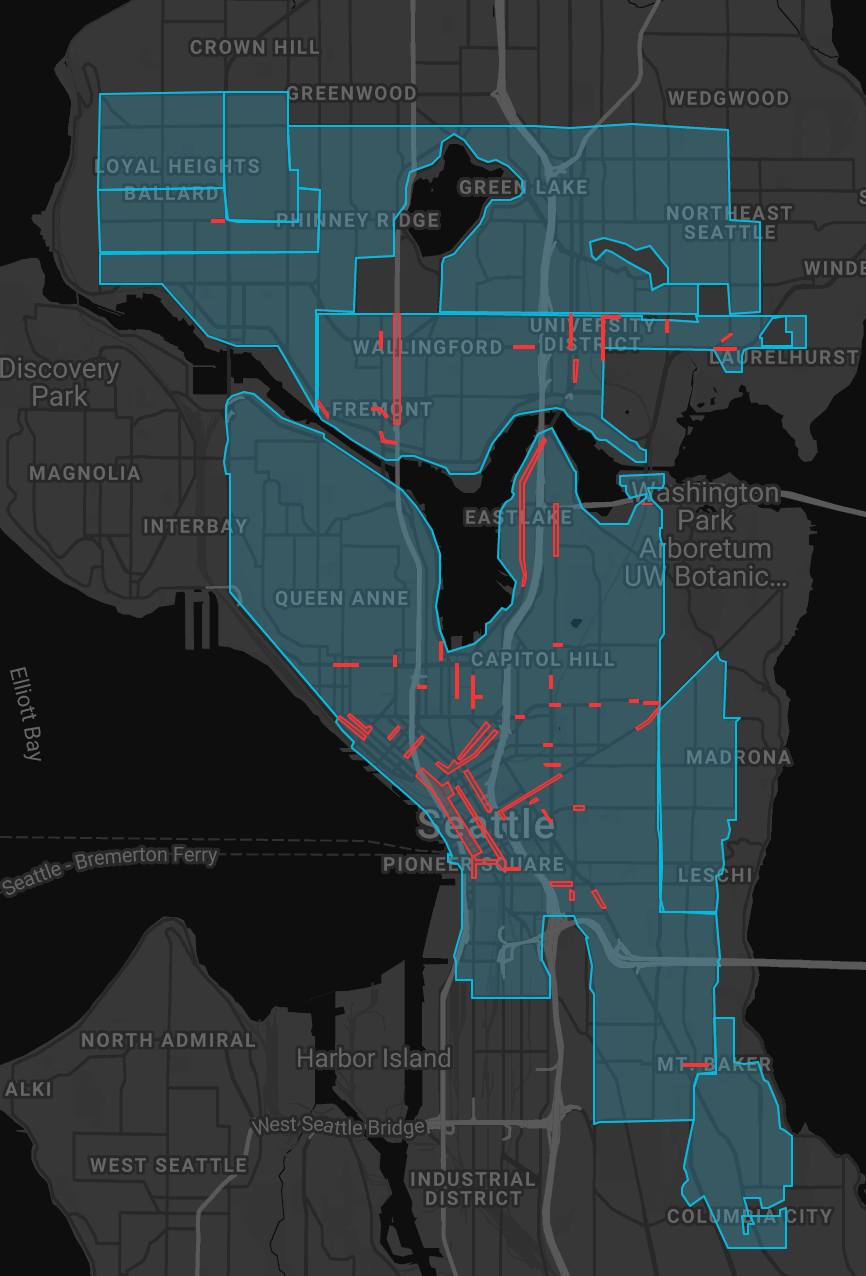
Except where otherwise restricted by GIG Car Share, users are allowed to end vehicle trips anywhere within the homearea by parking on-street where legally permitted. That means users can park in paid on-street parking spaces, time-limited on-street parking spaces, and within restricted parking zones without extra charges. Of course, this does not apply to on-street parking spaces for deliveries, short-term unload, handicap, on-street parking spaces that turn into auxiliary lanes, and other special on-street parking designations. Consistent with other carsharing programs, users will be charged for use of a vehicle during stops outside the homearea.
The expansion to Southeast Seattle will certainly be a welcome change. Exclusion of these areas was a point of early concern when the company launched, at least in social justice and urbanism social media circles. Part of that is because predecessor carsharing companies made Southeast Seattle communities a lower priority for early coverage. However, the companies eventually expanded to reach all areas of the city. In July, GIG Car Share stated that the extent of the homearea is “based on market research, demand, population density and accessibility to transit and retail.”
The City’s free-floating carshare permit conditions require GIG Car Share–and any other future competitors–to provide homeareas that include the entire city within two years of starting operations. The permit conditions also place no limit on the number of cars. At the peak of its heyday, Car2Go operated 750 vehicles on city streets and covered the entire city within two years, which coincided with fleet expansion to the maximum allowed at that time.