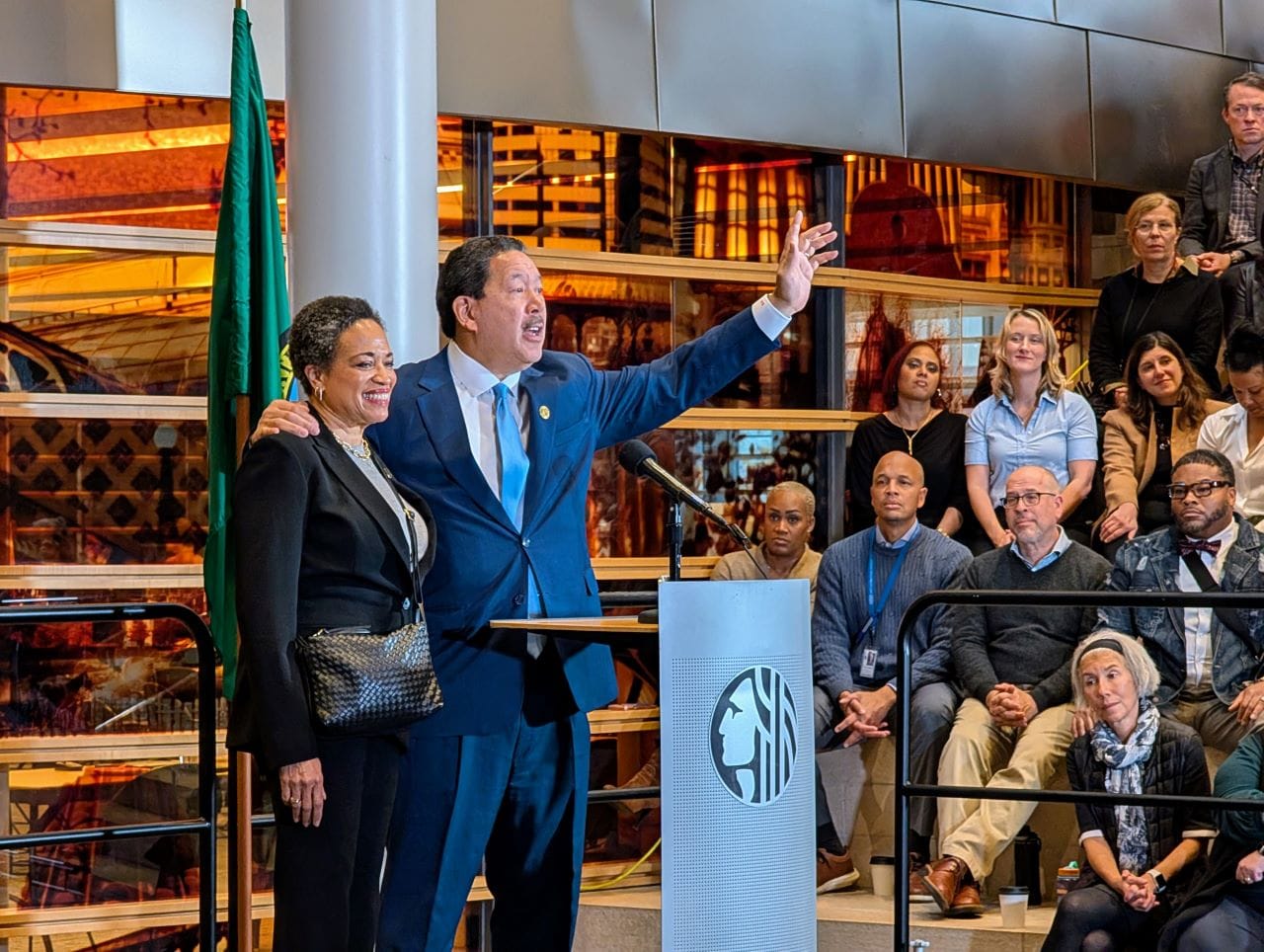
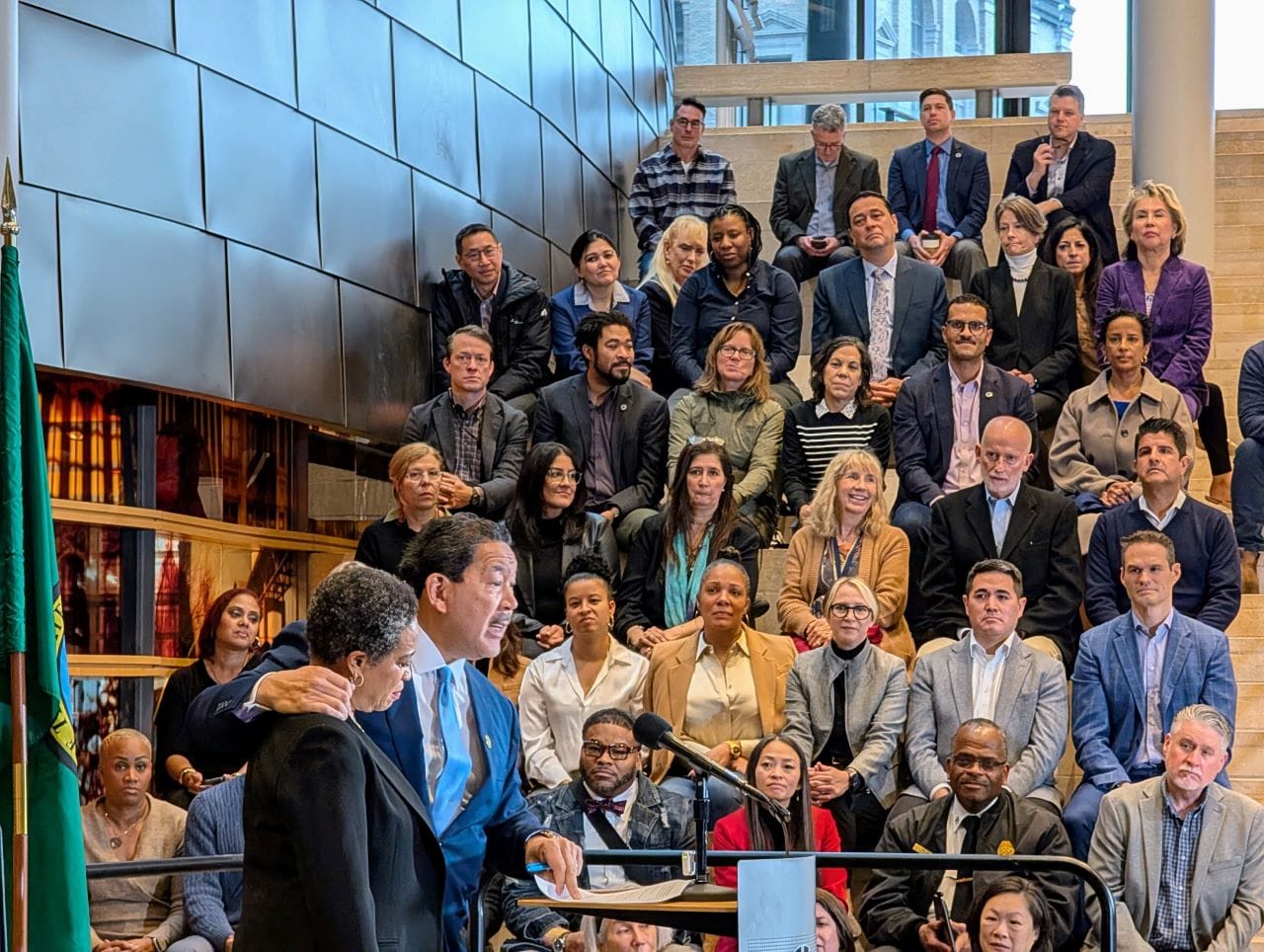
At noon Thursday, Mayor Bruce Harrell conceded the election to progressive challenger Katie Wilson, surrounded by supporters, cabinet members, and colleagues in the lobby of Seattle City Hall. Harrell vacillated between a conciliatory tone that extended an olive branch to his successor and a few defiant moments when he seemed to pick up campaign attack lines once more.
The departing mayor said he had no regrets and would not have done anything differently than he did, even as he alluded to his campaign’s difficulty resonating with younger voters, who broke sharply for his opponent.
Wilson co-founded and led the Transit Riders Union, a grassroots advocacy group that has fought to reduce transit fares, expand tenant protections, and raise the minimum wage in a number of Puget Sound cities. That appeared to give her credibility on affordability issues that many Seattleites are grappling with, but especially younger folks.
“The Wilson administration will have new ideas. You will have a new vision,” Harrell said. “By winning the election, they have earned that right. We must listen to the young voters. We realize that when I had won in 2021 to this current election, there were 12,000 more ballots of people who voted, new people with new ideas. There were over 50,000 new registered voters.”
Seattle Mayor Bruce Harrell just conceded to progressive challenger Katie Wilson at a ceremony at City Hall. Wilson won by about 2,000 votes in a close race.
— The Urbanist (@theurbanist.org) November 13, 2025 at 12:18 PM
[image or embed]
Wilson won 50.2% of the vote, opening up a 0.73-point lead as of November 13, with nearly all ballots tallied. She trailed by seven points on election night, when about 42% of ballots were counted, but closed the gap in later results, which tend to trend toward progressives in every Seattle election. It was a close race, but her lead has grown just beyond the machine recount threshold.
After a half-hour speech, Harrell took questions from reporters. Asked if he might be conceding too soon, Harrell briefly elevated concerns making the rounds in conservative circles that there were “anomalies” in the election results and that turnout was unexpectedly high. However, he still landed on conceding being the right decision, ultimately.
“So to be candid with you, Sebastian, a lot of people were saying that I shouldn’t concede and that there were anomalies, differences,” Harrell said. “This is an incredibly high voter turnout, and it was unexpected, these numbers. But I looked at the numbers, thought it was appropriate to concede, and I’ll let others worry about that. I wanted to bring to my cabinet some closure.”
One area where Harrell didn’t offer closure, though, was on an end to his political career. He left that door open.
“What we’re going to do is we’re going to take a little time, put things in prayer, and we’ll make some decisions,” Harrell said. “So I haven’t excluded anything.”
Harrell hinted that a harder line against Trump was part of Wilson’s appeal with younger voters. Harrell ramped up rhetoric against Trump late in the campaign, but early in the year took a collaborative tone, saying he was “not going to D.C. with my fist balled” and praising Trump’s inner circle of tech billionaires.
“The young people believe their voices are not being heard,” Harrell said. “They’re seeing due process violated. They’re seeing a throwback in history of this country that we love, a throwback into racism and unfairness. We have to listen to these young voices. While it is very seductive to stay in campaign mode and look at the Wilson administration from a competitive lens, I will not do that.”
Ultimately, Harrell argued he shared the same core values with Wilson.
“I believe in our hearts, but they want the same thing, fairness, justice, peace, equity, equality,” Harrell added. “They’re going to fight for safety. Their administration will fight for educational opportunities. They will fight for environmental sustainability. And I pray that they’re fighting with love, if there’s one legacy that I want to leave, that I try to lead with love.”
Harrell added that it fit into his One Seattle theme, a signature branding effort of his term, while appearing to grant the concept was so broad as to be often misunderstood.
“I say this loudly for the Wilson administration,” Harrell said. “We may have different tactics on how to get there, but I believe our core values are the same. And I cannot say that in other states. I cannot say that in other cities. I can say that for someone just born eight blocks from here, I can say that about the city of Seattle: that you care about these things, and that is the ‘One Seattle’ concept. I know people wanted to know where was I going with this concept? It’s going to the concept that above all else, we will focus on what we have in common. We cannot be defined by our differences. We can celebrate our differences only toward the path toward commonality.”