The City of Seattle has cut back significantly on its plans for street safety projects citywide, but especially in Downtown and the southern neighborhoods. This has left advocates confused and frustrated, as the City had extensive plans for protected bike lanes and greenways that would create a comprehensive network. And voters just overwhelmingly approved a $930 million levy to build these projects. While that is sorted out and the City adds on another layer of Seattle Process with a “Center City Mobility Plan”, there is one key opportunity that we could implement today at low cost: redesigning 4th Avenue through Downtown.
4th Avenue is a northbound one-way street and is among the widest streets in Downtown. Not surprisingly, it carries the highest amount of vehicle traffic in Downtown—but not so high that bikes lanes are infeasible. According to the latest counts from the Seattle Department of Transportation (SDOT), between Yesler Way and Stewart Street average annual weekday traffic (AWDT) is 20,600 vehicles. North of Stewart Street to Denny Way, in the Belltown neighborhood, AWDT lowers to 14,100.
These numbers along with the street’s use as a regional transit corridor and existing use by bicyclists, make the street ripe for a reconfiguration.
Current design
The existing design struggles to balance many needs. Like most of the Downtown streets, 4th Avenue is home to many ground level retail spaces, hotel lobbies, restaurants, and parking garage entries that draw private motorists and taxis but which also demand ample sidewalk space. The street also fronts major civic spaces like City Hall, the Central Library, and Westlake Park. On-street parking is located throughout.
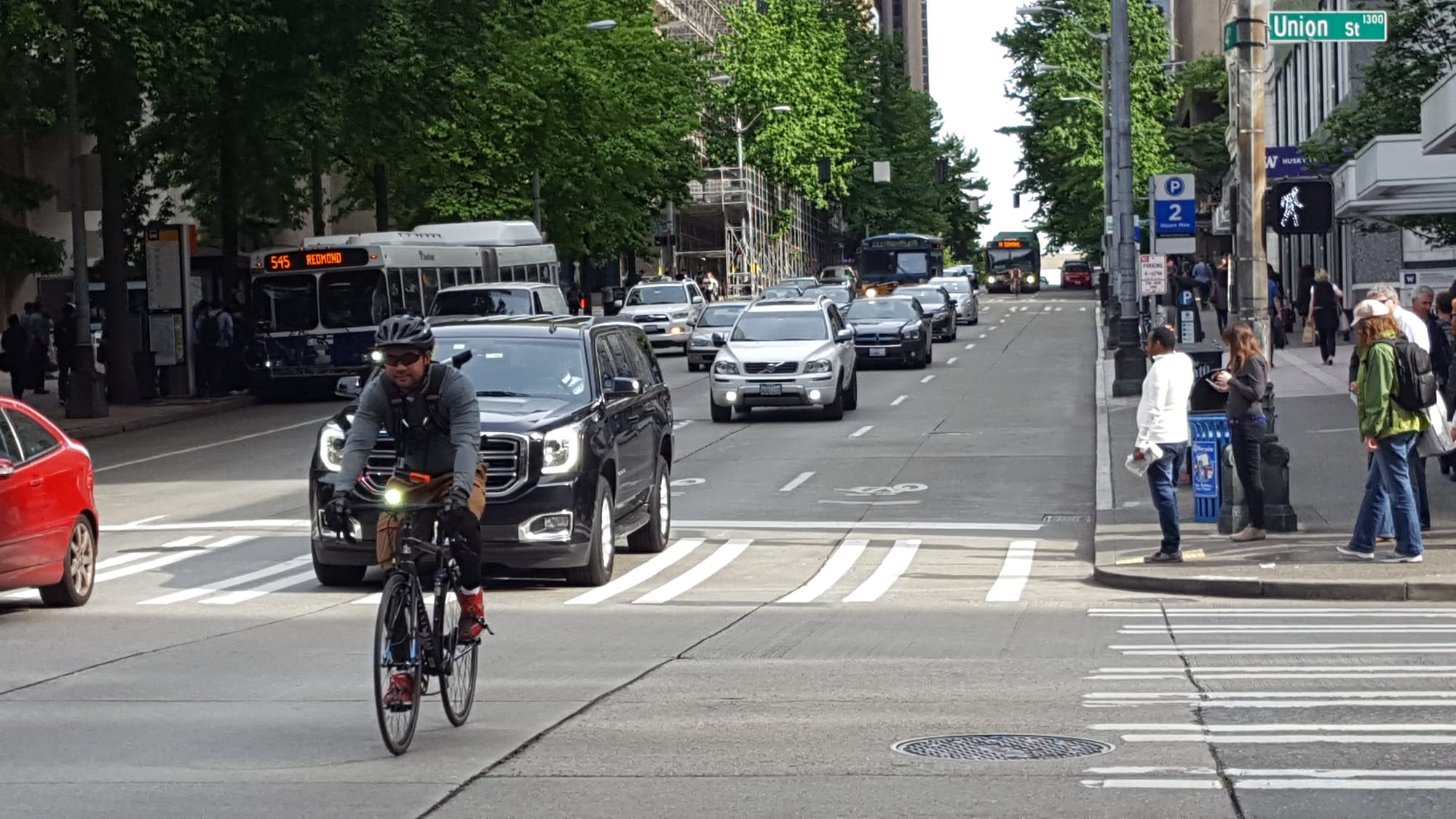
At the same time, 4th Avenue is a major bus corridor for regional Sound Transit and Community Transit routes and has a peak-hour bus lane. These buses tend to exit 4th Avenue at Olive Way, which leads to on-ramps for Interstate 5. And because the street is relatively flat through Downtown, it’s also a popular route for people riding bicycles.
The most important consideration in street design is how much space is available, so we’ll quickly run through what we have to work with (thanks to this handy SDOT arterial list). The table below summarizes the right-of-way widths:

From the roadway width and knowing how many lanes currently exist, we can estimate how much space is allocated to each lane. The graphics below, generated with streetmix.net, generalize the existing conditions in Downtown and Belltown.

The upper image ignores an existing unprotected bike lane that only runs between S Washington Street and Spring Street next to the curb, pictured below.

The vehicle lanes are already below the standard of 12 feet, a good start that helps keep traffic speeds down. But there are more lanes than needed; as demonstrated by Seattle’s road diet criteria, traffic volumes less than 25,000 only require two drive lanes. In the Downtown portion, there are three drive lanes during most of the day and four to five drive lanes, including a bus lane, during peak hours. On the wider portion of 4th Avenue in Belltown there are no restrictions on the two parking lanes, resulting in four drive lanes all day long even though traffic volumes are lower there.

An excellent example of 4th Avenue’s excessive capacity has been illustrated when the left lane between Pine Street and Olive Way is closed for the Macy’s store renovations. Despite the reduction in capacity during the afternoon rush hour, through-traffic continues to move at a steady pace. See below for a video of this in action.