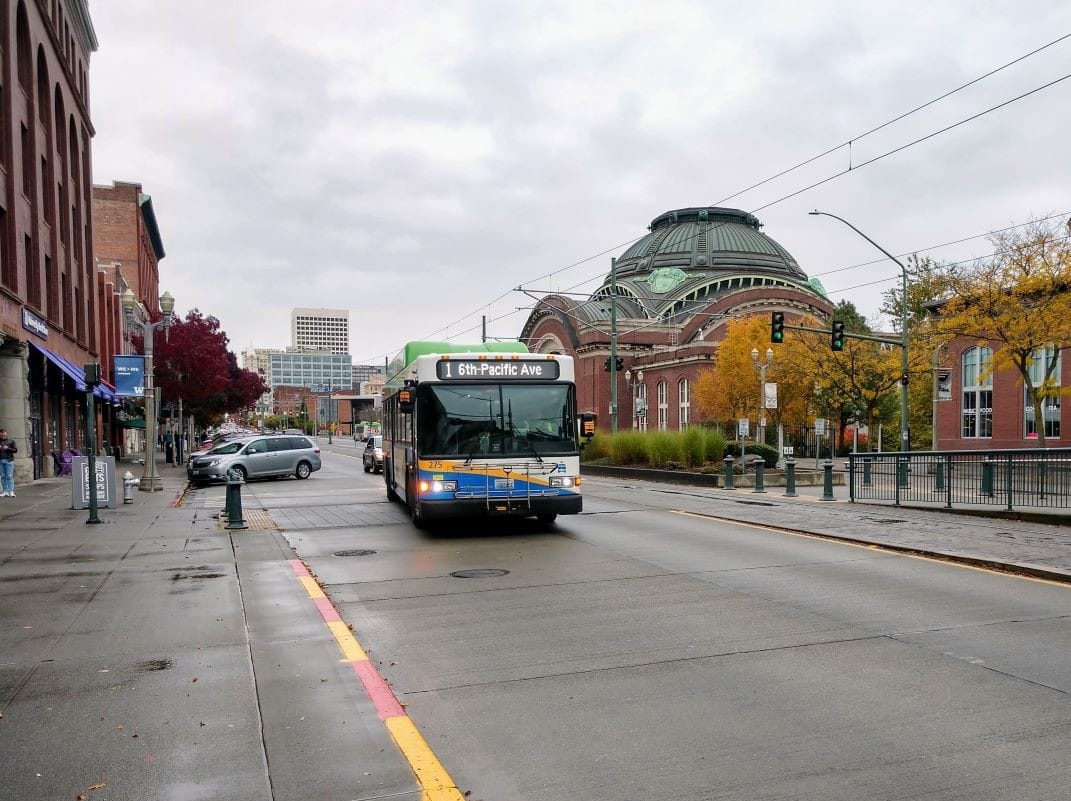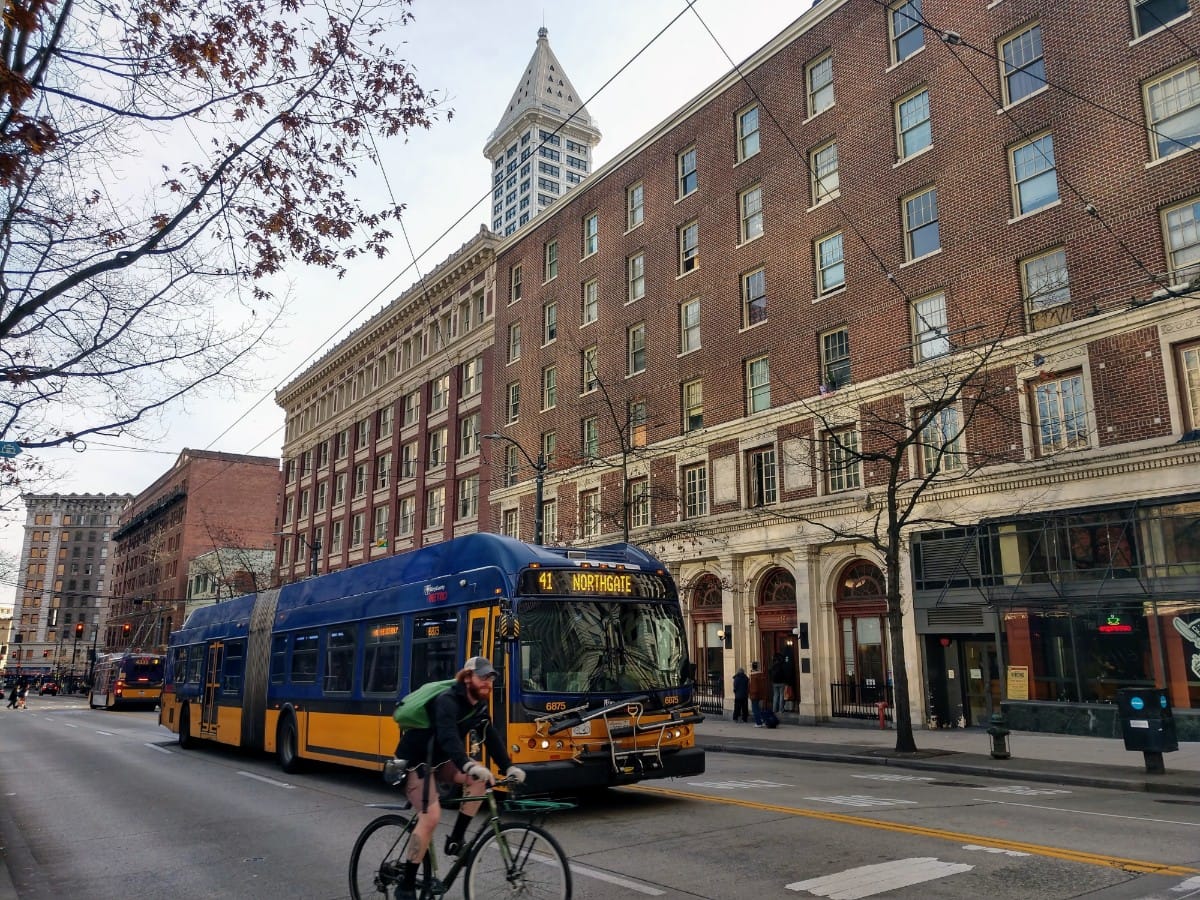
Perpetual thorn in Washington state government’s side Tim Eyman struck again last night. His Initiative 976 (I-976) cutting car tabs to $30 almost surely passed after running up a 55-to-45 margin on Election night returns, and that means massive cuts to transportation funding across the state. For Seattle that means that 110,000 hours of bus service funded through the Seattle Transportation Benefit District (STBD) will vanish unless the City backfills the cuts. Add in surrounding cities’ benefit districts and that’s another 65,000 hours lost.
“The measure, if it passes, would cut Transportation Benefit District funding by approximately $36 million, resulting in the loss of 175,000 Metro bus service hours on 74 routes in Seattle, Burien, Shoreline, Skyway, Tukwila, and White Center,” King County Executive Dow Constantine said.
While the cuts will mostly affect off-peak service, it will surely damage bus reliability and frequency. Bus crowding will likely also worsen. Seattle is leading the nation in transit ridership growth and in lowering car ownership rates, so the funding cuts come at a time when Seattle should be ramping up service. I-976 jeopardizes that momentum, and it jeopardizes ORCA LIFT and Youth ORCA, reduced fare transit pass programs directed at low-income residents and students, respectively, and funded through benefit districts.
Executive Constantine called the funding cuts “devastating” and announced he was directing the King County Prosecuting Attorney to prepare a lawsuit to challenge on constitutional grounds.
“The passage of I-976 underscores the ongoing need for comprehensive state tax reform, but in the short term we must clean up another mess that Tim Eyman has created for our state, our region, and our economy,” Executive Constantine said. “There will be many discussions in the weeks and months ahead to determine how to overcome the loss of safety and mobility caused by this irresponsible initiative, but the impact of I-976 to transportation is – in a word – devastating.”
Seattle also intends to sue, Melissa Santos reported in Crosscut: “Mayor Jenny Durkan and City Attorney Pete Holmes plan to hold a press conference Thursday to announce a lawsuit that will seek to block the initiative.” The state, however, isn’t planning a lawsuit of its own: “State Rep. Jake Fey, who chairs the Transportation Committee in the state House, said he wasn’t trying to sue on behalf of the state at this point,” Santos said.
Blocking the Will of King County Voters
It wasn’t lost on the Executive that state voters were intervening to overturn the will of his constituents. King County passed Sound Transit 3 with 58% of the vote; they passed the carbon fee initiative with 58% of the vote, and thus far they’re rejecting Tim Eyman’s I-976, with 57% voting no. But voters from outside King County effectively have blocked the county from taxing itself by popular vote. Sound Transit said I-976 amounts to a $20 billion hit to its light rail expansion plans. Transportation Benefit Districts have also passed by a wide margin; Seattle’s passed with 62% in 2014.
“We in King County–where Sound Transit 3 was overwhelmingly approved and I-976 was overwhelmingly defeated–we are going to keep pushing ahead, building a transportation system and economy that gives every person access to a better future,” Constantine added.
Of course, the City, County and State may see the folly in Eyman’s transportation cuts (if they stand) and step in with a funding plan. The Washington State Legislature will surely take some action. But will it be enough to recover from the massive blow dealt to state transportation systems last night?
State Democrats Scramble for Fixes
Early indications from State Senator Marko Liias (D-Mukilteo) suggest that the State Legislature doesn’t yet have a plan in place to address the cuts. Moreover, the Senate is not yet committing to finding new revenue. They appear to be running in survival mode.
“Basically, I kind of view this as a sinking ship, and I have to do what I can to try to save most of the people on the ship–but the ship’s going down,” State Sen. Steve Hobbs (D-Lake Stevens), who chairs the Senate Transportation Committee, told Santos on Wednesday. Hobbs has been a proponent of a small carbon tax to fund highway projects.
Asked what we the State Legislature should do, Liias tweeted: “Use a climate lens to evaluate which investments are kept/cut. If it doesn’t reduce emissions and protect the future of the planet, those projects should be the first to go. Then launch a conversation with the people about what kind of future we want? More traffic or more options.”