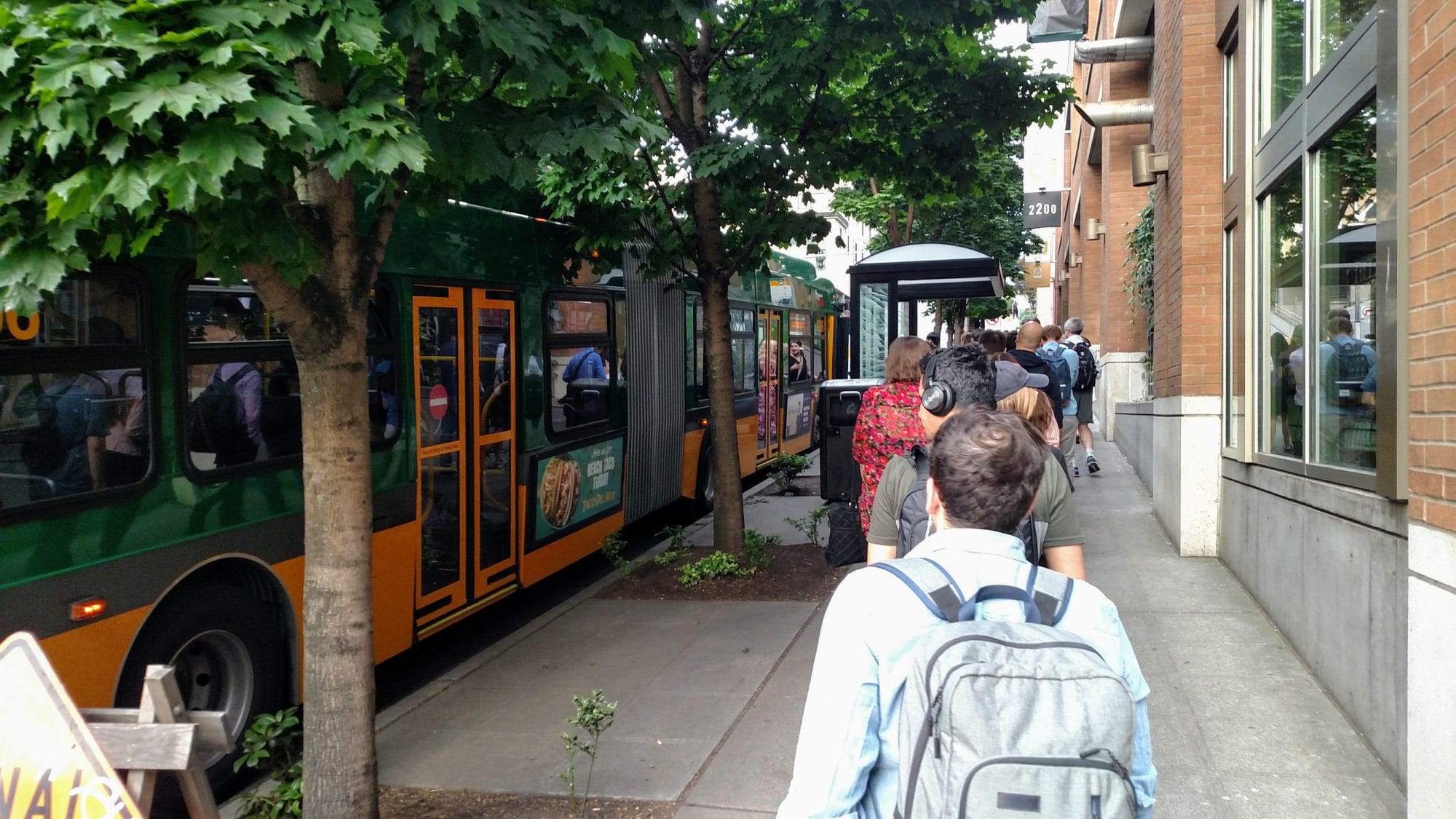
King County Superior Court Judge Marshall Ferguson granted an injunction on Initiative 976 this morning, pausing 175,000 hours worth of transit service cuts in the county and countless more impacts statewide. Timed just before the Thanksgiving holiday, the injunction should put transit advocates in a thankful mood. An injunction is only a reprieve rather than a permanent invalidation of I-976, but it does bode well for the outcome of the case.
Sound Transit got an even bigger reprieve as the counsel for the State conceded that the section of I-976 that sought to force Sound Transit to retire or defease bonds backed by the Motor Vehicle Excise Tax (MVET) has no deadline, making it pretty much impossible to enforce. Sound Transit wouldn’t have to lower the MVET until those bonds are paid off, although it may not be able to bond off the MVET going forward unless I-976 is thrown out.
On Tuesday, Judge Ferguson heard oral arguments on the injunction at King County Courthouse. Garfield County brought the case against I-976 along with King County, the City of Seattle, Intercity Transit, the Amalgamated Transit Union, and others. The plaintiffs have levied many constitutional complaints against I-976, but it seemed the charge that ballot language was misleading and violated the “subject-in-title” rule in particular seemed to resonate with the judge yesterday.
“The ballot title states that ‘voter-approved charges’ are excepted from the $30 limit on motor vehicle license fees, but Section 2 of I-976 indicates that only charges approved by voters after the effective date of I-976 are excepted from the $30 limit,” Judge Ferguson wrote in his decision. “In other words, all existing voter approved charges are apparently extinguished by I-976, even though the ballot title suggests that all voter approved charges, past or future, survive I-976.”
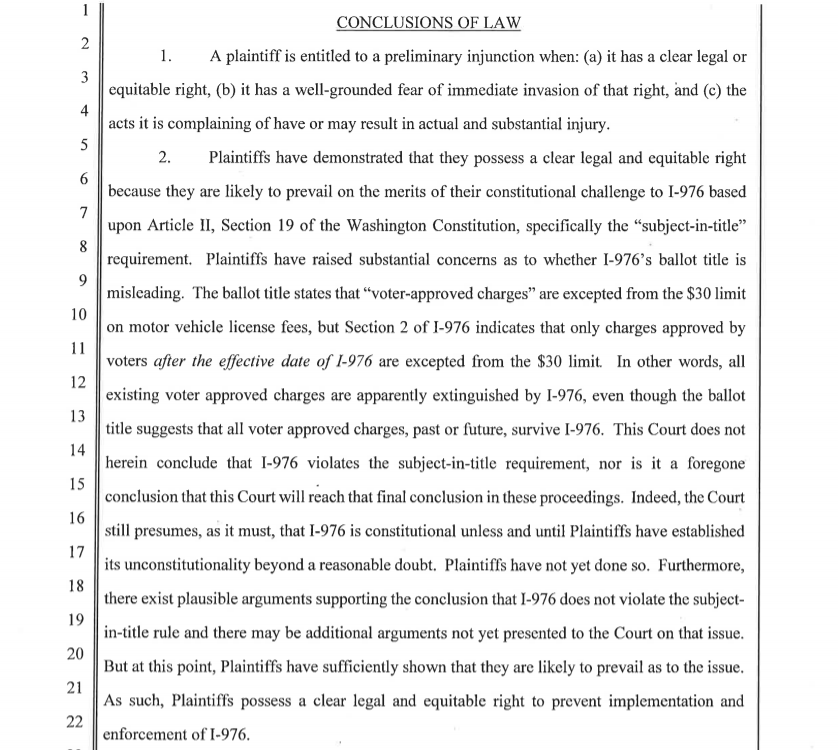
This isn’t to rule that I-976 is unconstitutional, Judge Ferguson continues, but “at this point, Plaintiffs have sufficiently shown that they are likely to prevail as to the issue.” Thus, plaintiffs have a “clear legal and equitable right to prevent implementation and enforcement of I-976,” the judge said. The judge set a deadline of December 5th to file additional motions, briefings, or hearings. That is also the date that I-976 would have gone into effect (save for Sound Transit) if not for the injunction.
Counsel for the City of Seattle made the argument that state initiatives lack the power to overturn the will of Seattle voters, who overwhelmingly rejected I-976 and overwhelmingly passed the car-tab-funded Seattle Transportation Benefit District in 2014 (with 62.4% of the vote) and the Sound Transit 3 ballot measure in 2016 (with about 70% of the vote). The judge seemed less moved by this as a constitutional argument, but time will tell as the full case is argued. The transit plaintiffs may only need to prevail on one of their charges to invalidate I-976. There is also a possibility the court will strike down some aspects while preserving others. For now, cuts are delayed, at the very least.
“This injunction allows us to continue our ORCA Opportunity program, which provides free transit passes to more than 14,000 Seattle residents,” Mayor Jenny Durkan said in a statement. “A supermajority of Seattle voted this irresponsible measure down in Seattle. That is because Seattle votes every day with our feet and with our dollars to invest in more transit.” The Mayor is correct that transit has been popular in Seattle, where we’ve lead the nation in transit ridership growth and in lowering car ownership rates.