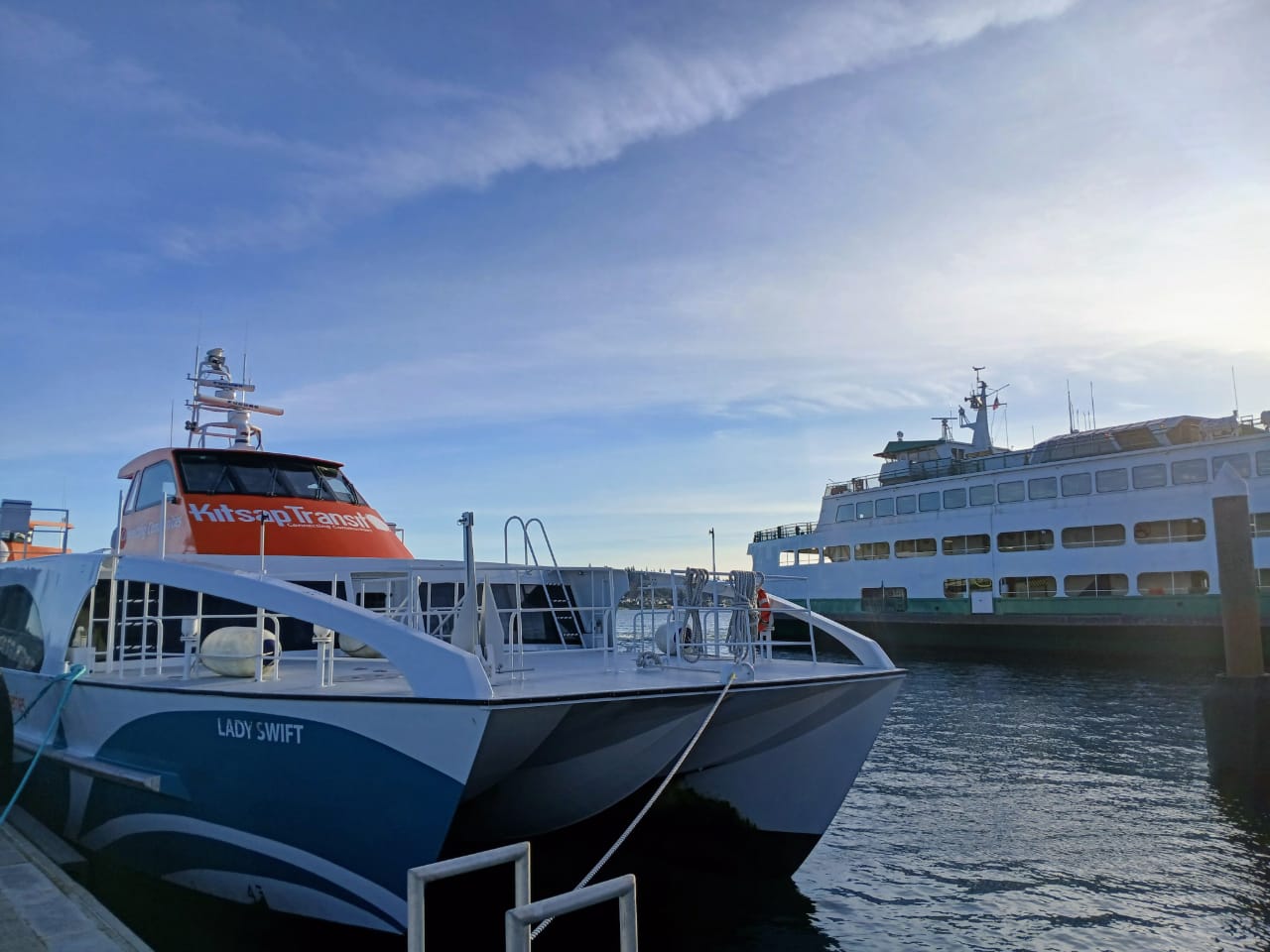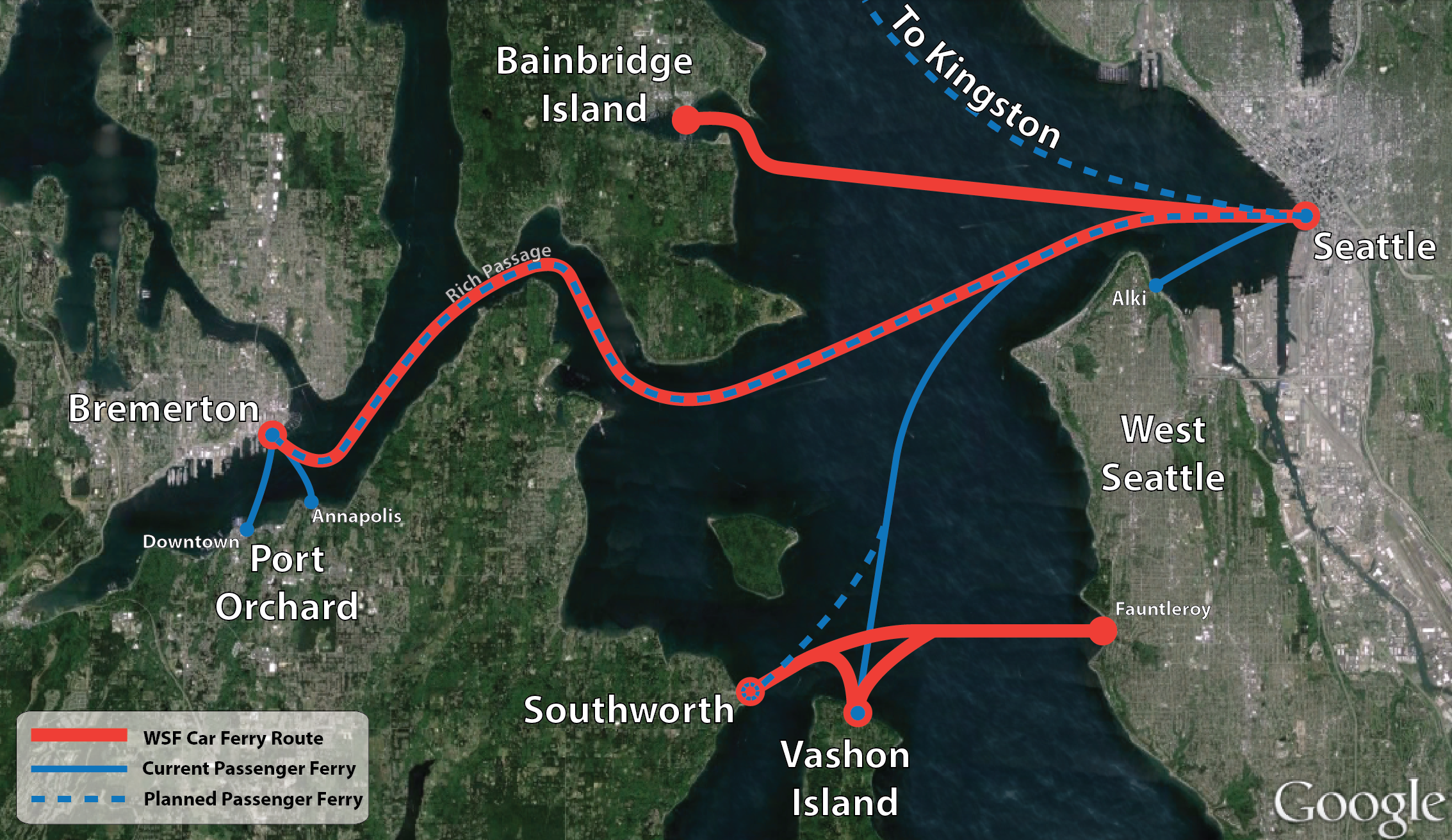
Kitsap Transit plans to begin high speed foot ferry service between western Puget Sound and Seattle within the next few years. Trips between Bremerton and Seattle would be 25 to 30 minutes faster than the current car ferry run, and the agency’s business plan outlines ideas for similar service to the unincorporated communities of Kingston and Southworth. If the project proves sustainable, unlike many previous efforts, it will reinforce economic connections across Puget Sound and provide a boost to small communities on the peninsula.
Puget Sound ferries date back over 100 years, beginning with a ragtag collection of private services known as the Mosquito Fleet. Over time the companies merged, and by the 1930s the Black Ball Line was the sole operator. It introduced car-carrying ferries around the same time, purchased from San Francisco companies as the Bay Area began building bridges. After WWII, Black Ball Line cut service and raised prices in response to lowering demand. Squabbles between the company, the public, and the state eventually led to Washington state purchasing the company for $4.9 million in 1951.

Today Washington State Ferries (WSF) is the largest ferry system in the United States, carrying some 22 million passengers per year on 10 routes and 22 vessels. There are numerous other routes, public and private, serving the Puget Sound. King County runs a water taxi between downtown Seattle and West Seattle hourly and to Vashon Island during commute hours. Clipper Navigation runs passengers from Seattle to the San Jan Islands and Victoria, Canada. Black Ball Ferry Line operates a car ferry between Port Angeles and Victoria. And Kitsap Transit runs half-hourly and quarter-hourly foot ferry routes between Bremerton and Port Orchard. Kitsap Transit, a separate government entity from Kitsap County, is behind a renewed effort for high speed, passenger only service between the Kitsap Peninsula and downtown Seattle.

For decades WSF has run a Bremerton-Seattle route that takes 60 minutes, the longest in the system. Bremerton is the largest city in Kitsap County and is home to a major Navy shipyard, so there have been several previous attempts to provide faster service between the two cities. Notably, in 1998 WSF began high speed service with two 350-passenger ferries built in Anacortes, the MV Chinook and MV Snohomish. The 30 minute crossing did well, carrying over 800,000 annual passengers. But only a year later, waterfront property owners sued WSF in response environmental damage caused by powerful wakes along Rich Passage, a narrow strait between the mainland peninsula and Bainbridge Island. A court-ordered study published in 2001 recommended much of the trip be reduced from 34 knots to 16 knots, ending the service’s speed advantage and leading to declining ridership. After the plaintiffs received settlement, the state legislature pulled funding and WSF ended the service in 2003. Except for infrequent backup service on other routes, the two ferries were mothballed until San Francisco’s transit district purchased them in 2008.
As another private stint in the mid-2000s failed, WSF obtained federal grant money in 2004 to further study the issue. The next year Kitsap Transit took over the Passenger Only Fast Ferry Study. A team of researchers looked at the unique geology and marine environment of Rich Passage, and built computer models of different wake patterns. Property owners and residents from Bainbridge, Port Orchard, and the rest of the county were actively involved. Much the study’s $8 million federal funding was earmarked by Congressman Norm Dicks, who has since stepped down.

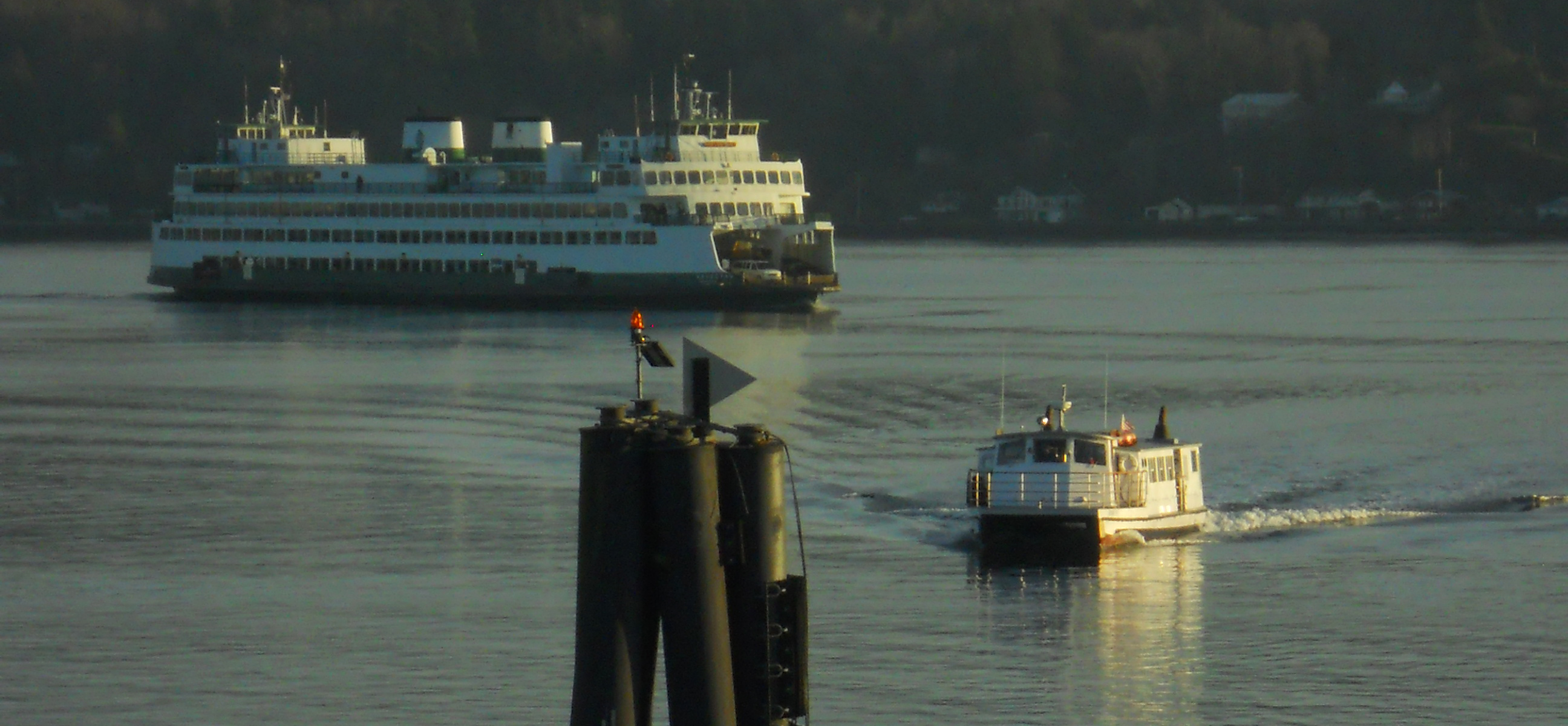
In 2009, the study concluded that a catamaran with a foil could reduce wake enough at high speeds to prevent shoreline damage. Kitsap Transit signed a deal with All American Marine of Bellingham to custom build a $5.9 million ferry, the 118-passenger Rich Passage 1. Instead of propellers it uses water jets, and the weight is kept down with an aluminum and composite structure. The foil is hung between the two hulls and shaped like an airplane wing to provide lift at high speed, allowing the vessel to ride higher in the water and face less resistance.