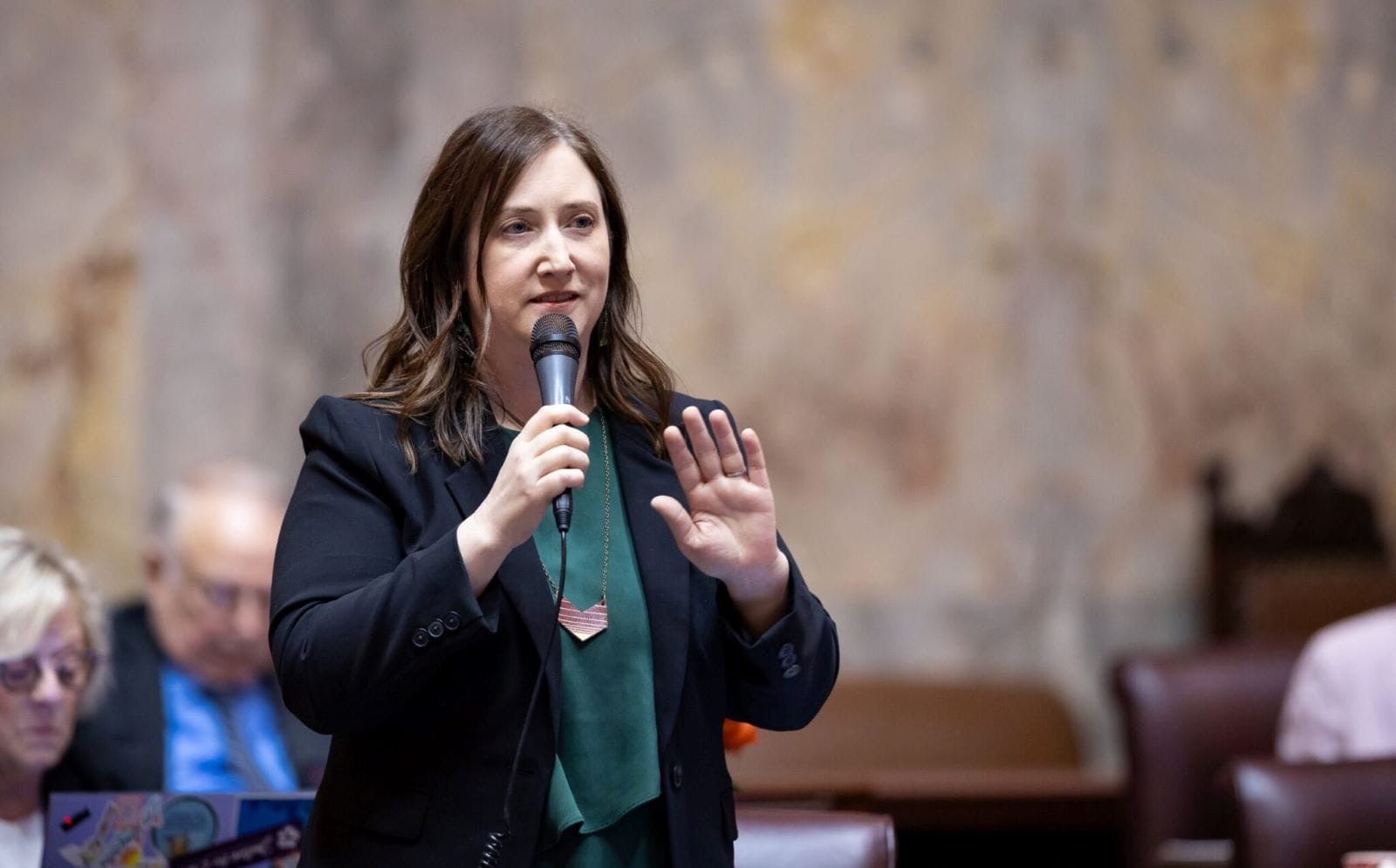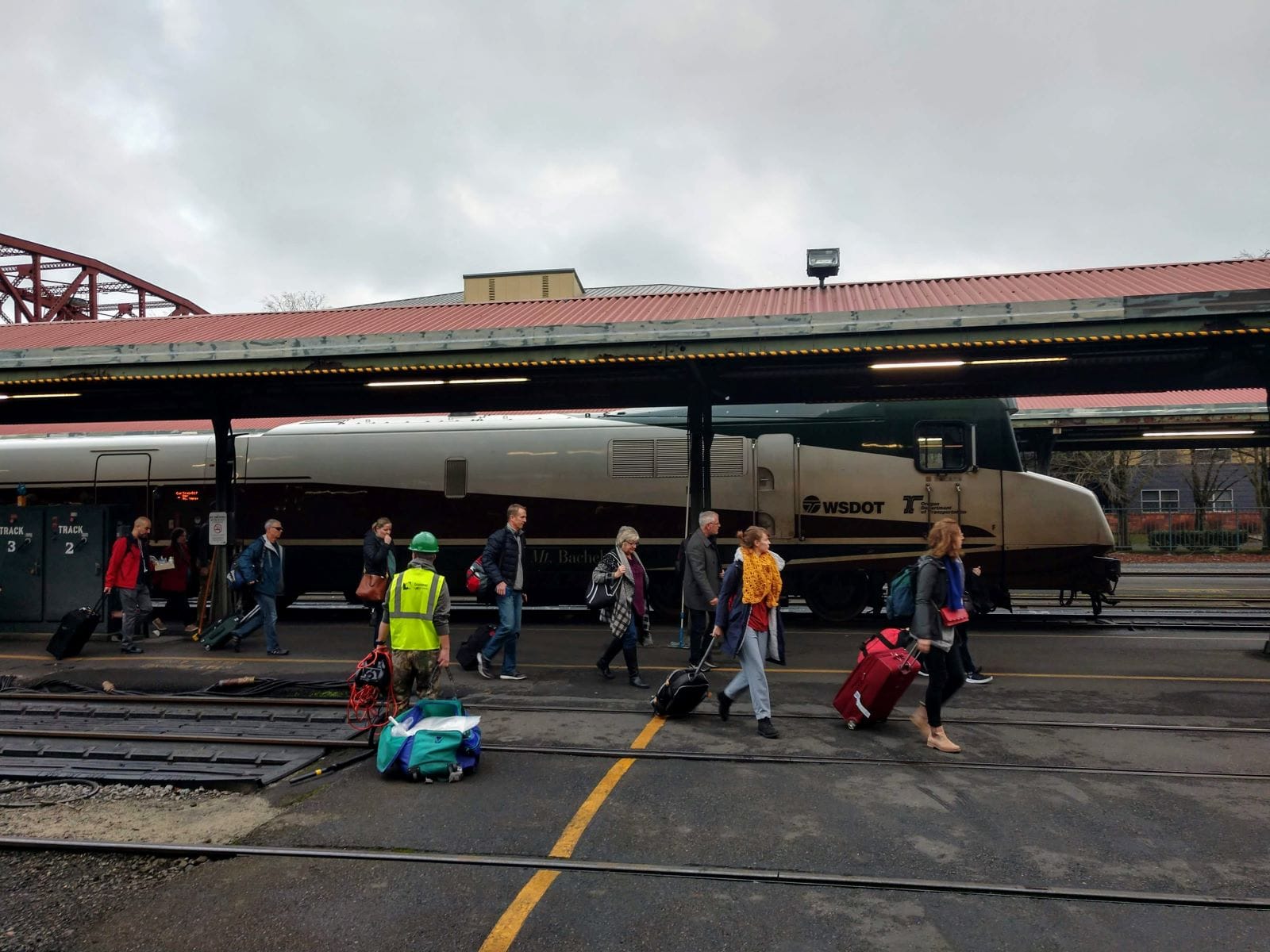
New intercity passenger rail legislation filed in the Washington State Legislature would set ambitious targets for enhanced Amtrak Cascades service and accountability. Sponsored by Rep. Julia Reed (D-36th, Seattle), House Bill 1837 would establish goals for cutting travel time, increasing daily roundtrips, and boosting on-time performance from Seattle to Portland and Vancouver, British Columbia. Sen. Javier Valdez (D-46th, Seattle) is also sponsoring a companion version (SB 5667) in the Senate. Legislators in both parties are already lining up to back the companion bills, with 17 co-sponsors in the House and Senate.
Under the proposed 2035 goals, Cascades service would be improved to 2.5-hour trip times between Seattle and Portland with at least 14 daily roundtrips and 2.75-hour trip times between Seattle and Vancouver, B.C. with at least five daily roundtrips. Additionally, Amtrak Cascades would need to maintain at least 88% on-time performance. The goals are predicated on the delivery of corresponding corridor improvements over the next decade to reach the targeted service characteristics.
A pro-rail coalition worked with legislators to champion the bills. Banded together as the “Rail Can’t Wait” campaign, the coalition included the Climate Rail Alliance, WA Physicians for Social Responsibility, and Solutionary Rail — a group which also penned an op-ed in The Urbanist last April. On Tuesday, the coalition published a press release arguing now is the time for a new Cascades service and infrastructure enhancement implementation law, nudging the Washington State Department of Transportation (WSDOT) to action.
“This legislation is needed to address concerns that WSDOT’s plans for Amtrak Cascades are not sufficiently robust,” the coalition press release reads. “Commenting on these plans, House Transportation Committee Chair [Jake] Fey and Ranking Member [Andrew] Barkis wrote that the WSDOT plan needs to drive transformative improvements in trip speed, reliability, and frequency that make traveling by rail along this corridor more convenient, accessible, and competitive with other modes of travel.”
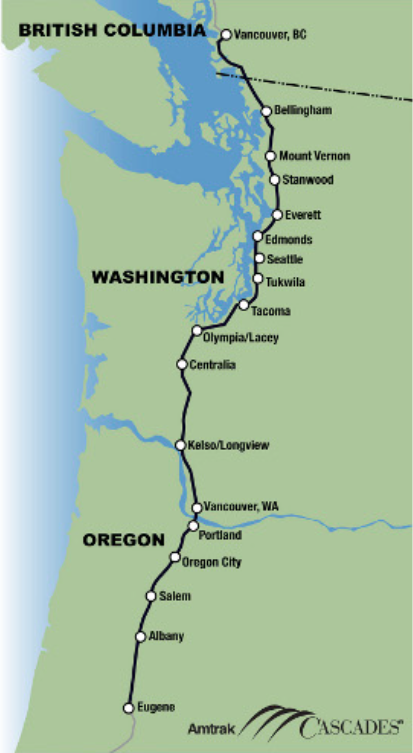
The plan would more than double service over today’s levels and shrink travel times by 28% to 39%. Cascades service is currently scheduled to take 3.5 hours between Seattle and Portland with six daily roundtrips and 4 to 4.5 hours between Seattle and Vancouver, B.C. with two daily roundtrips. The plan would also put WSDOT under the microscope for reliability, with the goal of pushing on-time performance back to a reasonable level. Cascades on-time performance (defined as reaching the final destination within 10 minutes of scheduled arrival) has collapsed from 81% in 2013 to 48.2% between January and October of last year.
The proposed legislation doesn’t include funding to turn goals into reality, but WSDOT is still in the midst of a multiphase planning process to identify, design, and develop cost estimates for infrastructure improvements to deliver on alternatives for enhanced Cascades service. The bill would signal legislative intent to follow through on funding once the agency completes the implementation plan — of course there are no guarantees in a tough funding environment.
WSDOT has studied Amtrak and Cascades service expansions and upgrades several times in its history, but the proposed legislation would represent the first time that the state legislature has backed a specific service expansion plan and accountability for conventional intercity passenger rail in statute.
Since 2023, WSDOT has been participating in the Federal Railroad Administration’s Corridor Identification and Development (Corridor ID) Program. As part of this, WSDOT has drafted up service concepts and preliminary identified potential infrastructure improvements under the new Cascades Service Development Plan (SDP). A final version of the SDP has yet to be published, but doing so will enable WSDOT to move further into the design and cost estimating phases of the Corridor ID program and queue up SDP capital infrastructure projects for federal grant funding and financing. The state legislature could also eventually be a source of revenue for the projects.