The news on One Center City has not been very uplifting. The effort to keep Seattle moving during coming transit logjams got a re-brand to “Imagine Seattle,” but it appears to still be lacking for bold imagination and timeliness.
The problem, dubbed the “Period of Maximum Constraint,” stems from convergence of several major construction projects, a shortage of bus base capacity, and buses coming out of the Downtown Seattle Transit Tunnel (which will decrease their efficiency and further crowd surface streets). This will leave a gap in transit capacity for a few years before more light rail extensions come online–starting with Northgate Link in 2021 and followed by East Link in 2023 and Lynnwood Link and Federal Way Link in 2024–which should free up bus platform hours. It might take opening all those light rail extensions to truly release the pressure valve on our transit network, meaning the constrained period could drag on until 2024.
Though billed as a bold visioning process, One Center City has yet to lead to anything revolutionary being adopted thus far. The major addition to the transit network will be a new downtown transit pathway using Fifth Avenue and Sixth Avenue and providing transit lanes in some stretches but not in others. This should provide a workable alternative for buses kicked out of the transit tunnel next year. But Seattle’s transit ridership is growing steadily every year bucking national trends. Plenty of doubt remains if we’ve done enough to meet demand and prevent rampant overcrowding and delays.
We should not let this crisis go to waste. This is an opportunity to improve our transit network rather than do the bare minimum to scrape by. That’s why I propose that Seattle should roll out as many dedicated transit lanes as possible across the city within one year’s time. There’s no reason to settle for mediocrity. Our bus bases being at capacity means King Count Metro Transit doesn’t currently have room to add new buses even if it wanted to, which is pushing the Seattle City Council to look at using private operators to add bus service. This creates an imperative to use our platform hours more efficiently rather than letting buses languish in traffic.
Even without RapidRide improvements, a handful of Metro buses carry in the ballpark of 10,000 daily riders–Routes 5, 7, 8, 36, 40, 41, 44–and they should be our first priority when adding new transit lanes. We should also look at the next tier of high ridership routes as we look to make the transit network run more smoothly as we face the prospect of transit gridlock and overcrowding.
Early Rollout of RapidRide Lanes
Incidentally, some of these highest ridership bus routes also are slated for RapidRide upgrades as part of the Move Seattle levy that voters approved in 2015. Unfortunately, most of those RapidRide upgrades are now backloaded to 2021 or later, meaning they wouldn’t be around to help the bulk of the most constrained period from spring 2019 to when Northgate Link opens in 2021. A relatively easy solution would be to roll out the bus access and transit (BAT) lanes expected with new RapidRide lines early. Broader changes, such as getting the shiny new buses, stop consolidation, and off-board payment, can work their way through the process and deal with the realities of Mayor Jenny Durkan’s Move Seattle “reset”– a rumored scaling back of projects blamed on federal money drying up (which hasn’t happened to date) or taking longer to arrive.
Revised RapidRide Rollout Schedule
| RapidRide Corridor | Open Date | Existing Route | Fall 2015 Weekday Ridership | Fall 2016 Weekday Ridership | Platform Hours |
|---|---|---|---|---|---|
| Madison "G" | 2021 | 12 | 3,500 | 3,300 | 84 |
| Delridge "H" | 2020 | 120 | 8,700 | 8,600 | 226 |
| Rainier | 2021 | 7 | 11,500 | 10,800 | 255 |
| Roosevelt | 2021 | 70 | 5,300 | 7,500 | 182 |
| N 45th St | 2022 | 44 | 7,500 | 8,400 | 167 |
| Westlake | 2023 | 40 | 10,600 | 11,400 | 284 |
| E 23rd Ave | 2024 | 48 | 11,200 | 5,500 | 183 |
| West Seattle | 2012 | RapidRide C | 8,800 | 11,100 | 289 |
| 15th Ave NW | 2012 | RapidRide D | 11,800 | 14,300 | 256 |
| Aurora Ave | 2014 | RapidRide E | 15,800 | 17,000 | 299 |
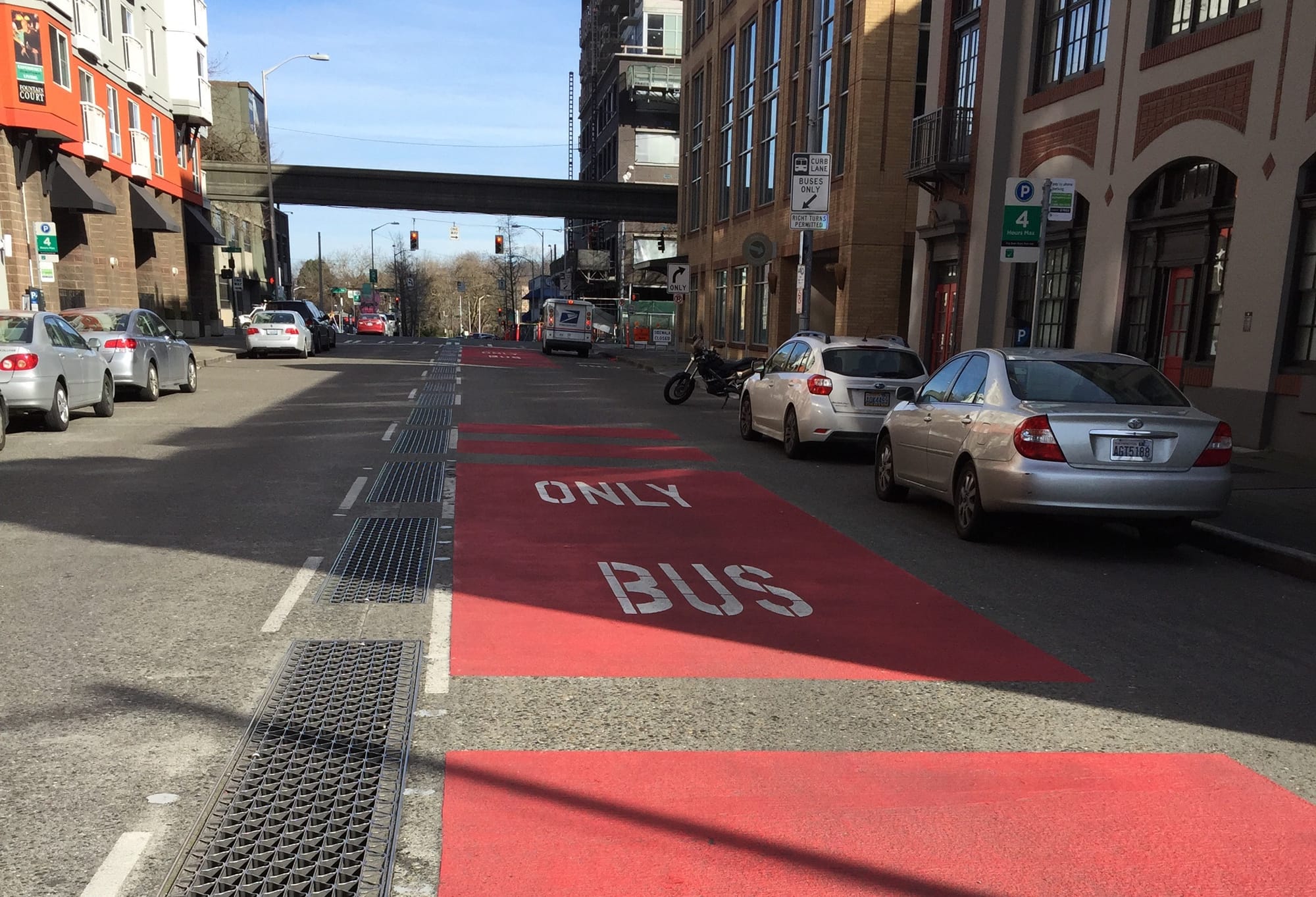
For example, the Seattle Department of Transportation has settled on a design with a northbound BAT lane for the Rainier RapidRide line upgrading Route 7. Why should we wait until 2021 to paint the red bus lane on Rainier Avenue? Let’s do it now to realize some of the transit time savings.
Route 44 has sections with just one lane in each direction, but segments in Ballard and the University District are wide enough to add transit lanes. That such a slow route has managed 8,400 daily riders suggests ridership potential is huge once the route is faster and more reliable, and we shouldn’t wait for RapidRide to take big strides.
The Madison RapidRide G Line isn’t a good fit for early rollout since it’d create a new route (significantly different than Route 11) and relying on a rebuilding Madison Avenue to allow for a center-running transit design. Because of Madison delays, the RapidRide H Line will be the first new RapidRide out of the gates in 2020, improving Route 120 which serves Seattle’s Delridge corridor, White Center, and Burien. The plan adds transit lanes only sparingly, with most transit lane additions coming in Burien and White Center.
Route 40 jumps out for its high ridership–its 11,400 daily riders in fall 2016 was slightly more than the RapidRide C Line–and imagine how high ridership would be if that bus wasn’t so painfully slow at rush hour. The 40 accomplishes its high ridership with a whopping 284 platform hours–significantly more than the RapidRide D Line. With more transit priority, those 284 platform hours could carry many more riders. Paint on the pavement would suffice to improve flow in the interim before the 40 gets full RapidRide upgrades in 2023. The 40 benefits from transit lanes on Westlake Avenue in South Lake Union, but lacks them on Leary Way despite a four lane design with room to add them. Queue jumps at the Fremont Bridge could also work wonders. Another issue is enforcing transit lanes better since motorists frequently ignore them and block buses packed to the gills with upwards of 100 riders.
Camera Enforcement of Transit LanesTransit lane enforcement would help deal with the period of maximum constraint, getting more efficient use of our existing transit lanes. Too often Third Avenue bus lanes are blocked with motorists, clogging our city’s key transit artery. Our transit agencies boast of Third Avenue being the busiest bus mall in the country, but unfortunately, SDOT has been slow to make Third Avenue bus-only 24 hours a day and extend restrictions to Bell Street. Apparently, extending the hours is being planned for September, although just how much longer the bus-only restrictions will be is hazy.
To make matters worse, the Seattle Police Department has not been able to sufficiently crack down on rampant scofflaws violating the bus-only hours we do have, and the Washington State Legislature has not been willing to allow Seattle to use camera enforcement of transit lanes.
PSA: Follow traffic laws. Yes, even if you're from out of town. Being from the suburbs doesn't mean you get to break Seattle traffic laws with impunity. What kind of logic is that!? #VisionZero #DealingWithYokels https://t.co/9smv2mx97Y pic.twitter.com/14jpBpg8dw
— The Urbanist (@UrbanistOrg) January 18, 2018