Our top two advance primary is doing a disservice to voters, especially in crowded races.
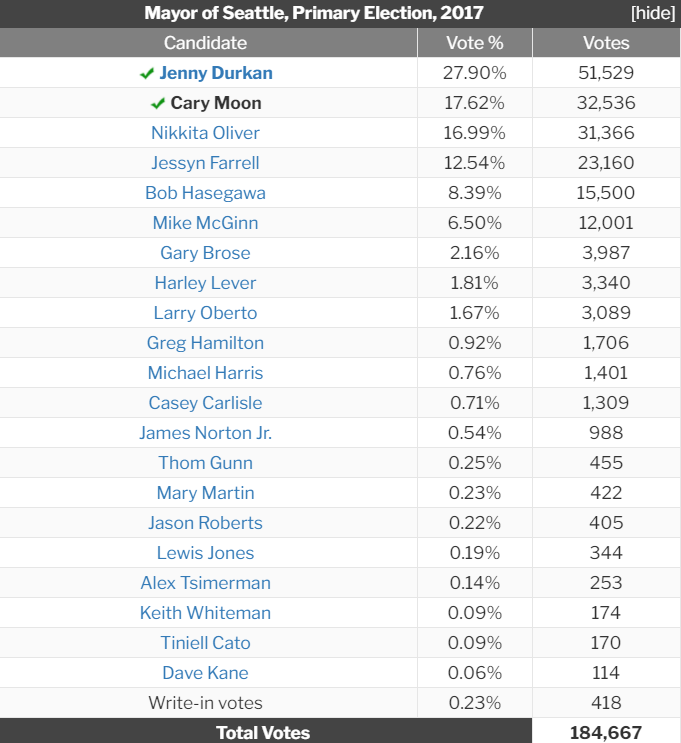
With Seattle’s 2021 mayoral election looming and Mayor Jenny Durkan’s announcement she’s not running for reelection, the field could become quite crowded in the next few months. The 2017 election that also featured no incumbent. Durkan and Cary Moon ran in the general election, but before that we utilized a top two blanket primary to determine who would participate in that general election. In a rather crowded field, our system produced a result that advanced the winners of only 45.5% of the vote, sidelining the votes of a majority of 2017 primary voters.
Nikkita Oliver gained 17% of the vote, Jessyn Farrell 12.5%, Bob Hasegawa 8.4%, and Mike McGinn 6.5%. Fifteen candidates, including beef jerky baron Larry Oberto, split the remaining 10% of the primary vote. Second and third choice votes may have propelled a runner up into second place or even first. We’ll never know because our election system doesn’t ask.
The State’s top two primary system was approved by the people of Washington in 2004 to replace the short-lived partisan primaries. The vote came after Governor Gary Locke passed partisan primaries that lasted until 2008 when the Supreme Court reinstated a top two primary system, restoring our state’s historical blanket primary into its modern incarnation. This was an improvement from a system that limited voter participation with party identification, created spoiler vulnerable general elections, and increased election costs. While it can create general elections with majority winners, it’s clear that even with our current system the state can end up with races that don’t require the approval of a majority of the voters.
Currently, Washington state election law only allows local elections in this primary system. There is some movement to expand our voting options, and create more equitable and accessible election systems. Of particular relevance and potential realization has been ranked-choice voting. FairVote Washington is looking to allow ranked choice in Washington by way of a Local Options Bill, first examined by the state legislature in 2019. Ranked choice voting also made a recent appearance in the Seattle City Council, which on December 7th all councilmembers approved a 2021 state legislative agenda that mentioned support of the option.
The other ways we can conduct elections
So how does ranked choice work? Ranked choice allows voters to rank candidate options from most favored to least. Voters’ first choice votes are counted. If a winner or winners are unable to capture a majority of votes in the first round, votes can be transferred based on how the type of ranked choice system decides to eliminate or reallocate first choice votes and so on. In the Local Options Bill proposal, multiple iterations of ranked choice voting systems are outlined.
For single winner elections like the 2021 mayoral election will be, two new systems are presented. Both use an instant runoff voting method that has voters rank candidates, and in the first round counts first choice voters. If there is no majority winner then, a new round is conducted with the worst performing candidate eliminated and votes tabulated based on the highest ranking candidates available on ballots. If no majority winner is achieved this process is repeated until a majority is reached for a single candidate. The Local Options Bill from 2019 allows localities to either just have one round of voting and eliminate the primary, or keep two rounds of voting with the number candidates reduced to at least five for a general election.
More complicated is the system for multiple winner elections, potentially suitable for electing multiple citywide councilmembers. Local Options Bill would establish the option of single transferable vote, a system that has a calculated winning threshold based on the number of winners for the election. It uses instant runoff’s elimination of the worst performer, but first checks to see if there are surplus votes from candidates that have exceeded the winning threshold and then proportionally reallocates the excess. Rounds of tabulation are conducted until all the winners are produced. Scottish council elections use this method of voting, and their electoral commission has produced the following video.