Urbanists looked at Paris with envy when the city’s mayor, Anne Hidalgo, in her bid for reelection, advanced her vision for the French capital to become a “15-minute city.” Under this framework, new developments would be planned and infrastructure would be retooled so that all the necessities of day-to-day life could be accessed within 15 minutes’ time without using a car. The reduced auto use from switching to such a planning paradigm not only directly benefits residents’ health and safety, but also serves as an important tool in reducing urban greenhouse gas emissions.
In 2016, passenger vehicles alone comprised over half of Seattle’s emissions, and electric cars will not save us in time to avert the looming impacts of the climate crisis. If we’re really going to reduce emissions by 45% by 2030 (less than ten years from now!) like our state mandated in last year’s Clean Energy Transformation Act (CETA) legislation, every city in Washington needs to play their part and considerably reduce our state’s largest contributor to greenhouse gas emissions: motorized vehicles.
Emphasis on every city.
In Bellevue–the most populous city on the Eastside, a regional center of technology and commerce, and my home–the transportation sector accounted for 43% of our emissions in 2018. However, we lag far behind Seattle in our cycling infrastructure, and although we have dedicated transportation staff who are passionate about seeing our city make the necessary changes, new obstacles seem to appear at every attempt for progress. From community opposition organized through the platforms of conservative political consulting firms, to anti-transit and anti-cycling organizations having uninterrupted time with important elected officials, to said organizations having had people in key positions of power in the city’s decision-making process for transportation infrastructure, it can really feel hopeless sometimes to envision a more car-free future for my city at all.
Even though the city appears to recognize the transportation challenges that increased population and commerce will bring, it can feel that Bellevue is too far gone to fundamentally change–that we’re too entrenched in automobile-friendly infrastructure, single-family zoning, and love of our metal boxes to be able to make the necessary transformative changes.
But are we really?
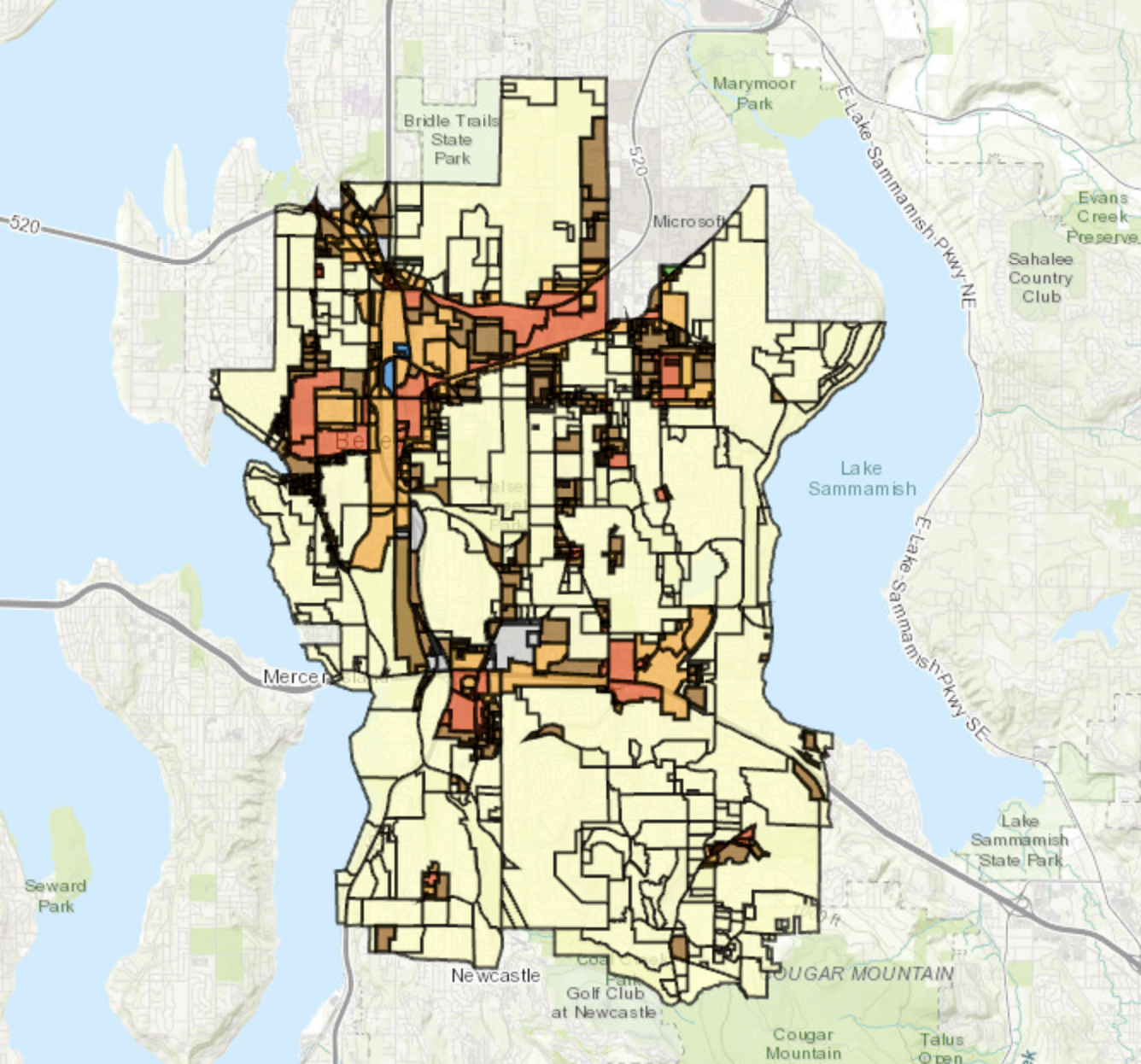
Paris’s vision of the 15-minute city presents a novel opportunity for urbanists worldwide–not only a method to measure our future progress, but a metric by which we can assess our current status. With significant swathes of Bellevue dabbled with low-density developments and single-family housing, it’s easy to overlook the potential that the city, even in its current form, can have to transition to greener infrastructure. In all four corners of Bellevue, there are pockets of businesses and development that can provide day-to-day goods and services to our city’s residents even without a car. Although our roads are primarily configured for automobile traffic, what if they weren’t? What if the City of Bellevue were to delineate our roads as primarily for cycling traffic? How would Bellevue fare under this new paradigm? Would residents still be connected to essential goods and services, or would they be as helplessly isolated without the automobile as some fear?
By using the 15-minute city concept as an analysis tool, I was able to separately assess all of Bellevue’s neighborhoods, calculate their access to certain essential businesses via 15 minute cycle trips, and uncover data that challenges our assumptions about what transformations are possible for our state’s suburban cities.
Results
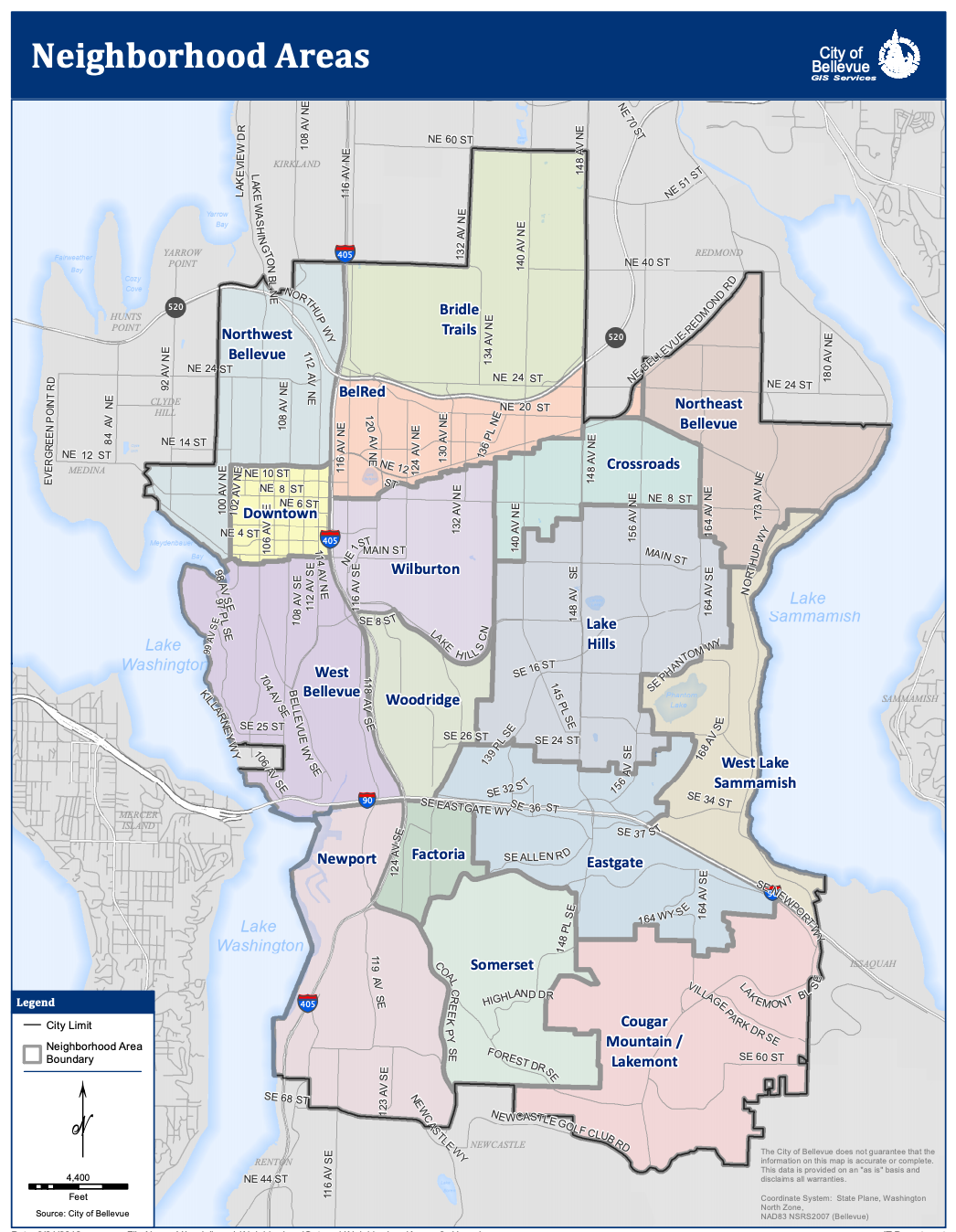
As one might intuitively expect, Downtown Bellevue has the largest 15-minute bikeable area out of all the city’s neighborhoods, at more than 12 square miles. Other neighborhoods with well-connected, grid-like road networks (such as Wilburton, Lake Hills, and Crossroads) also have larger catchment areas.
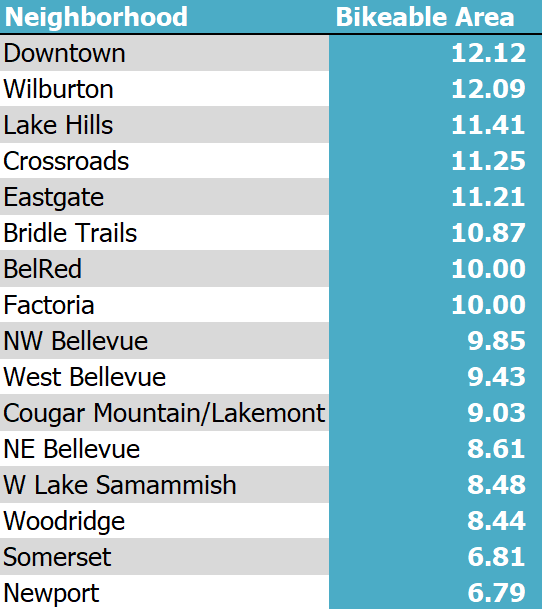
Such gridded networks enable more direct and efficient travel because of their straight lines, which stand in contrast to the windier, more indirect streets common in the subdivisions of NE Bellevue, W Lake Sammamish, and Somerset. Neighborhoods like Newport Hills are further limited by geography; its border with Lake Washington means its catchment area can only extend in three cardinal directions. However, bikeable area size alone is not enough to determine access–it’s important to investigate how many businesses, services, and points of interest fall within these areas to see how neighborhoods stand.
Businesses
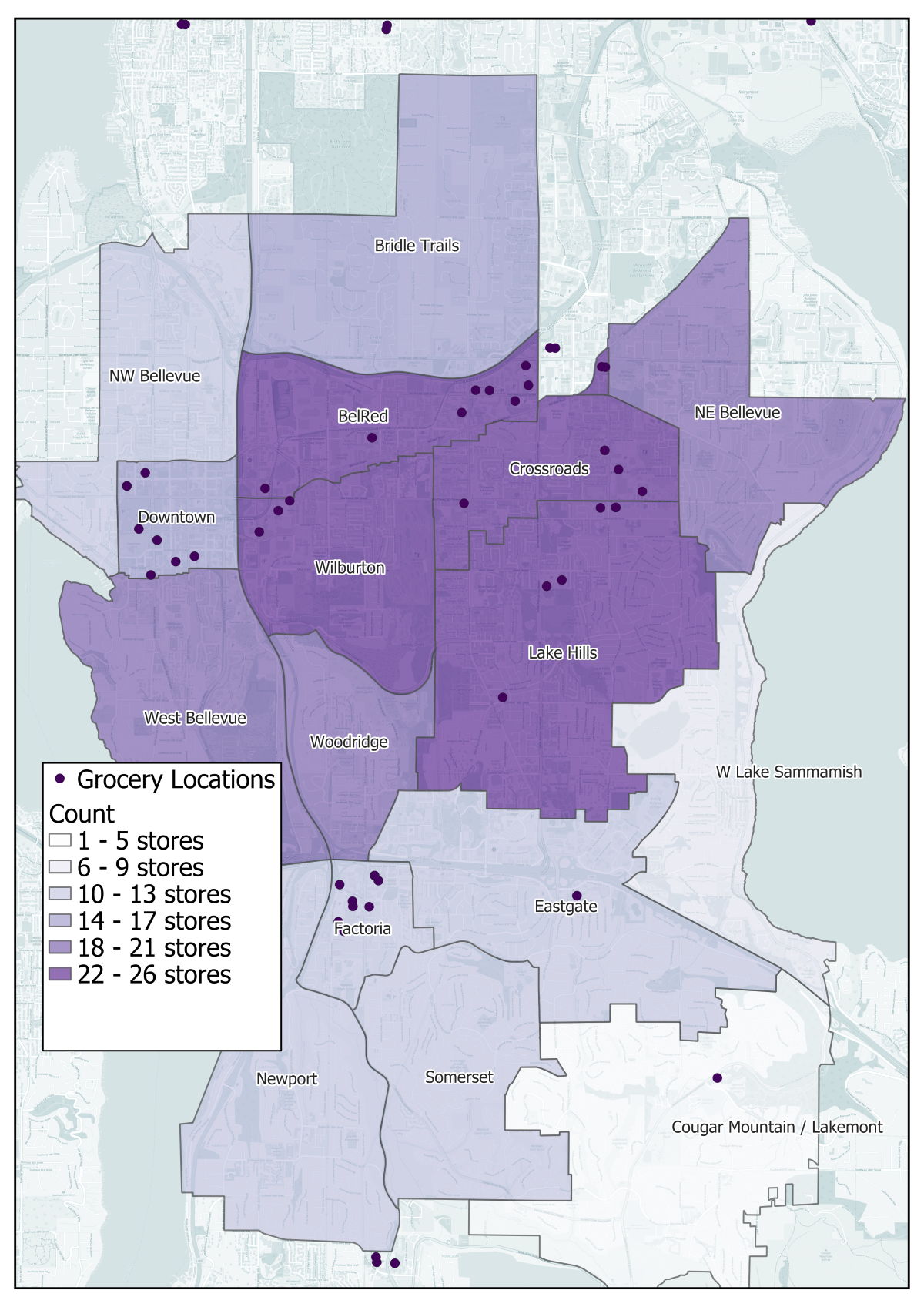
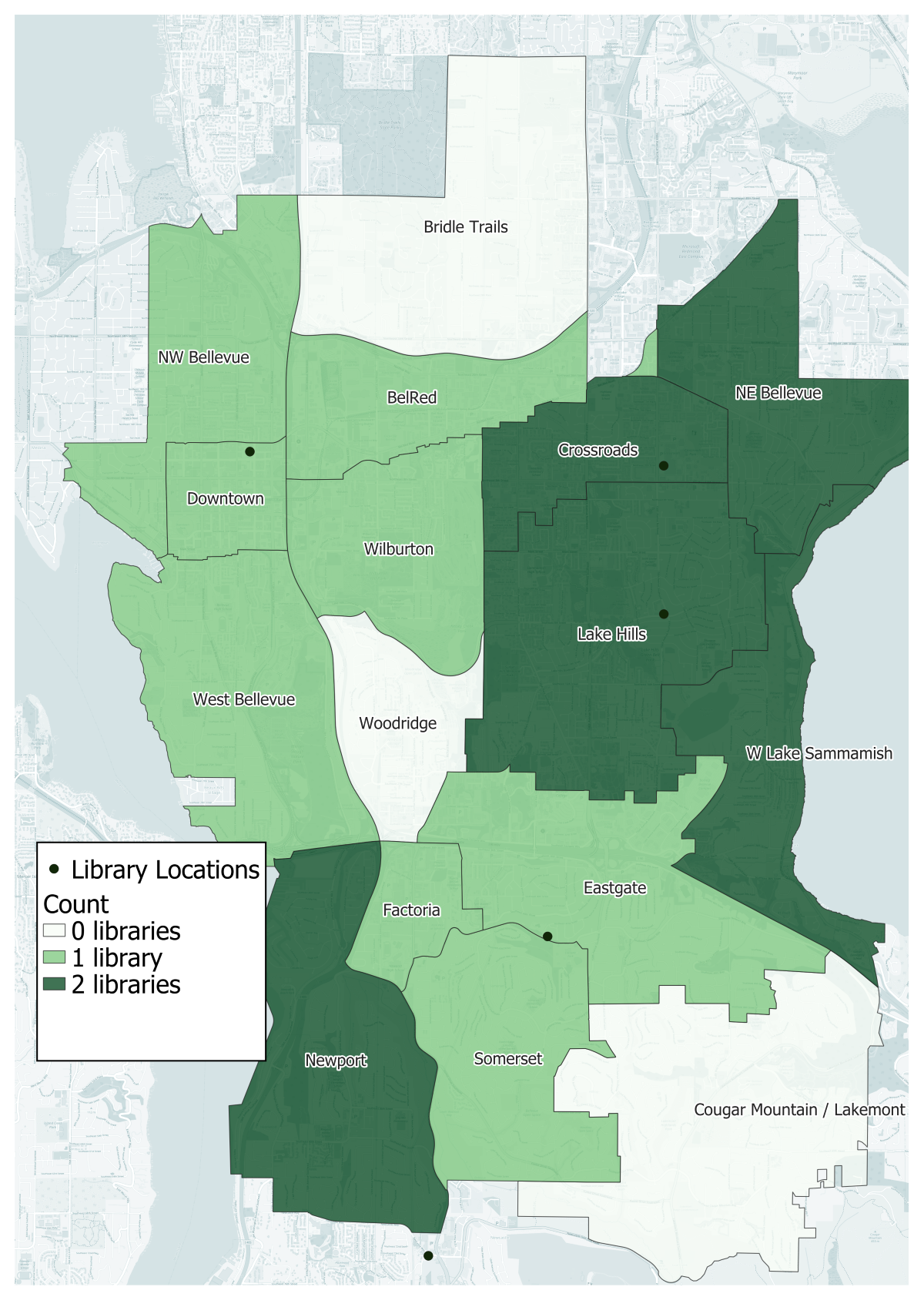
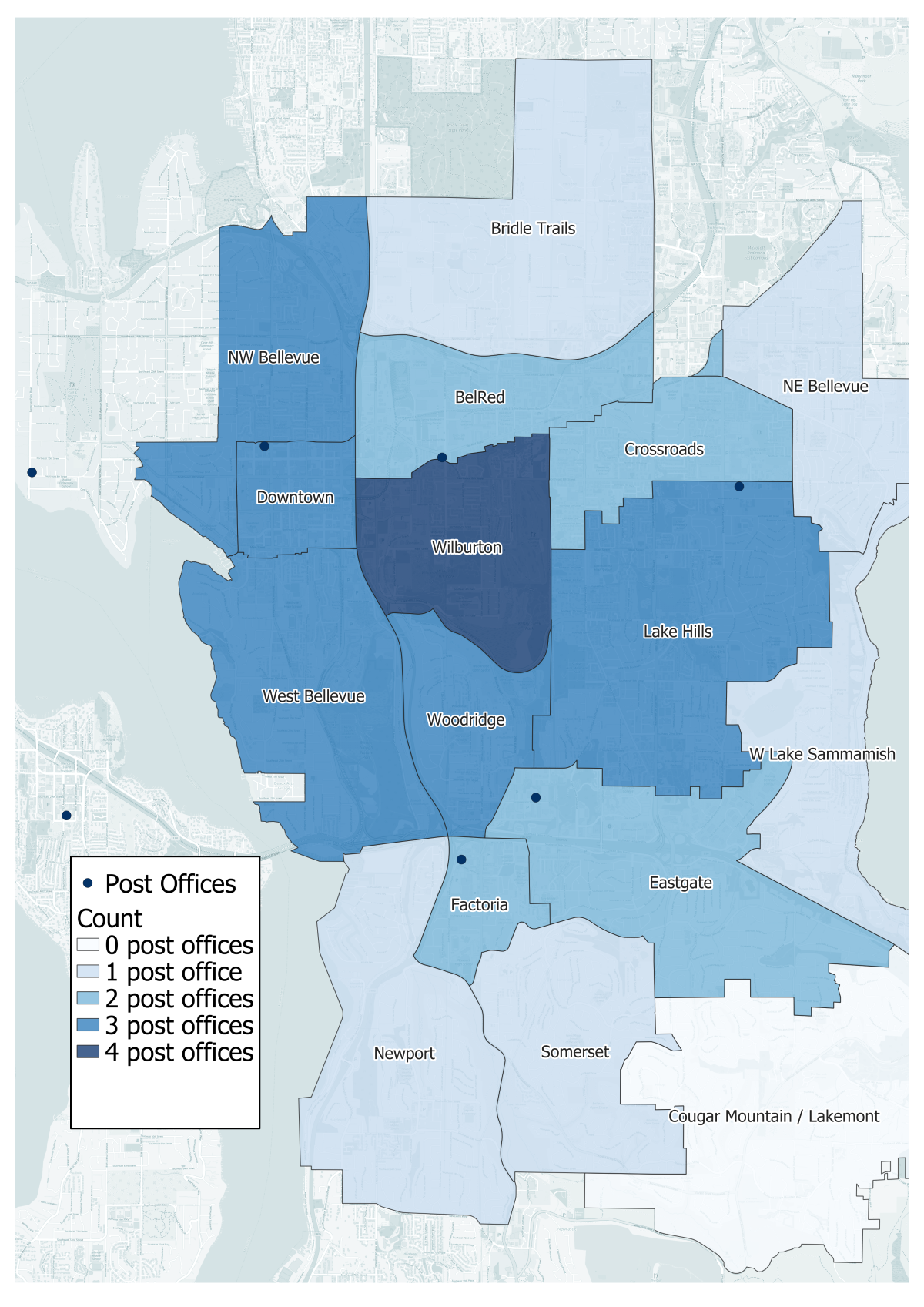
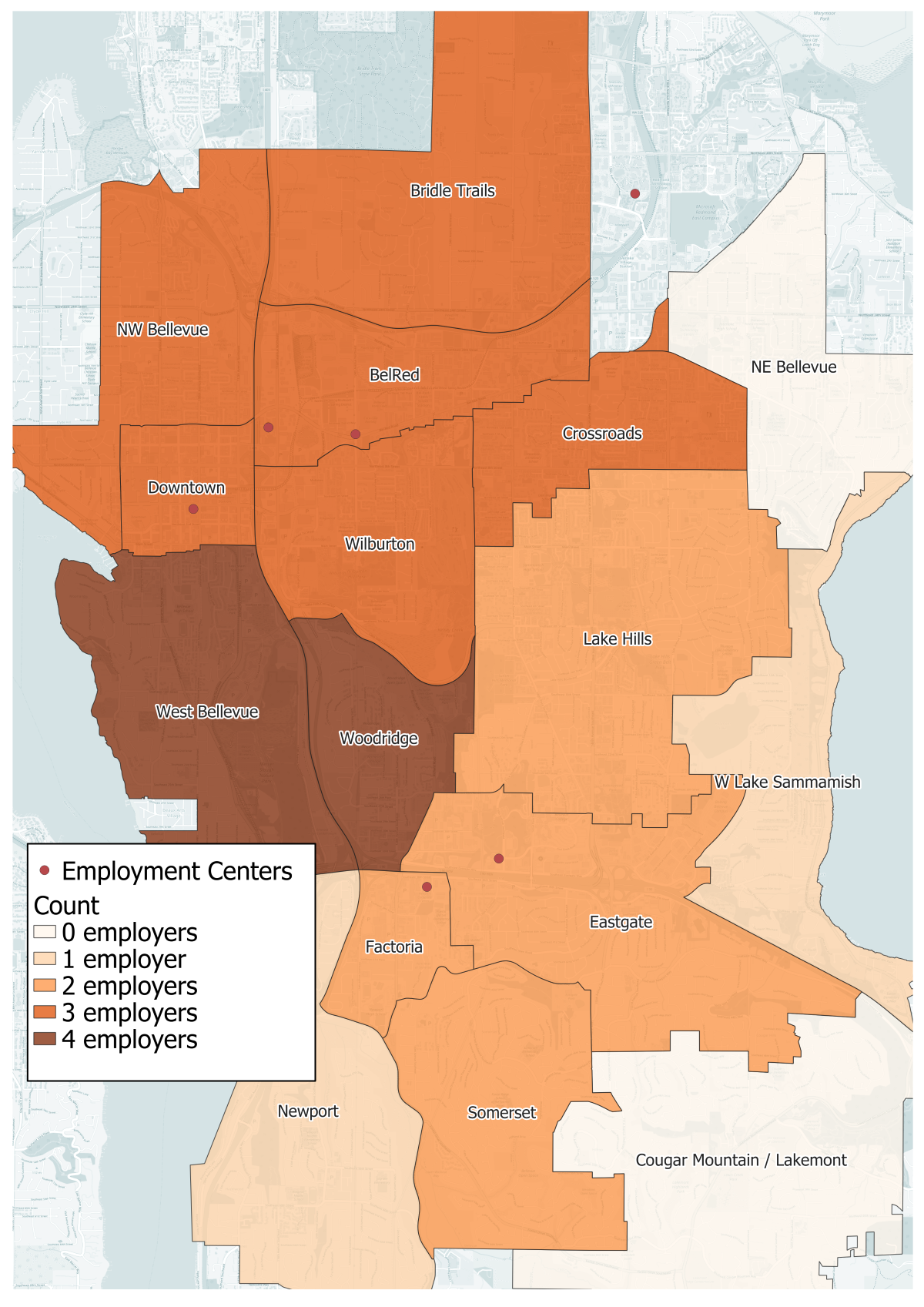
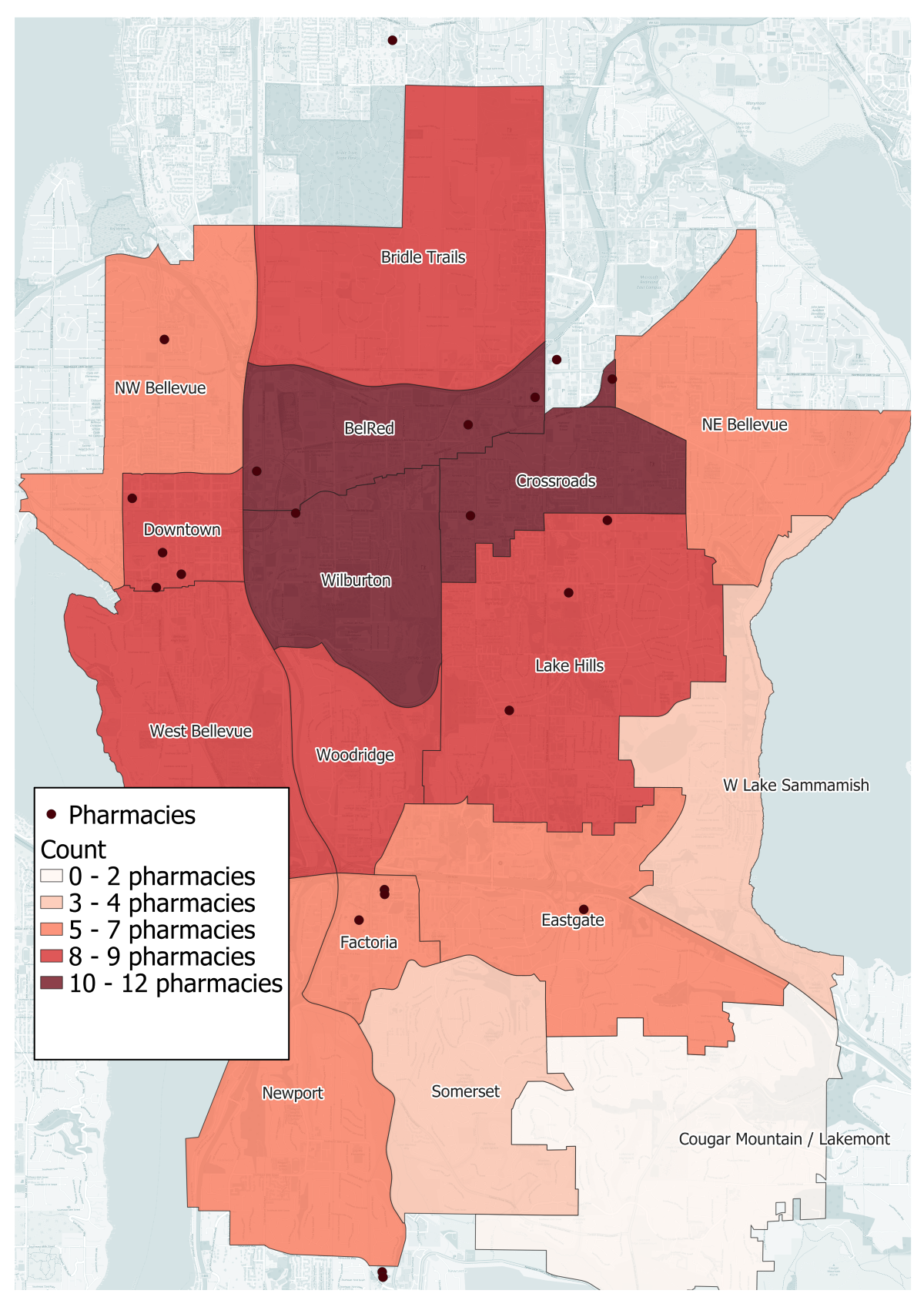
Nearly all neighborhoods had access to at least one business of each type examined (grocery store, library, pharmacy, post office, and major employment centers) within a 15-minute bike ride. Neighborhoods between SR-520 and I-90 consistently had the best access to the destinations examined, while communities on the periphery had more limited access (or none at all). Of particular note is Cougar Mountain/Lakemont, which had no employment centers, libraries, pharmacies, and post offices within a 15-minute bike ride (and only one grocery store). Contrasted with a neighborhood like Wilburton, with its access to three employment centers, a library, twelve pharmacies, four post offices, and 26 grocery stores, it’s evident that there is a disparity in destination access between Bellevue neighborhoods. However, it’s important to note that every neighborhood, except Cougar Mountain/Lakemont and Bridle Trails, has access to at least one location of each destination type, with many neighborhoods having access to multiple.
Schools
In addition to essential businesses, I also chose to examine Bellevue residents’ access to local schools, but I was required to change my approach. Because which public school one attends is assigned based on address, I instead chose to calculate bikeable areas from the schools themselves (rather than the city’s neighborhoods) and determine what percentage of the school’s attendance area fell within that polygon. It’s important to note that Bellevue School District does not encompass all of the city, and some parts of the district fall outside of Bellevue’s borders. However, the district does serve students from all of Bellevue’s 16 neighborhoods–students’ ease of access to their schools should therefore be a principal concern for Bellevue’s transportation staff.
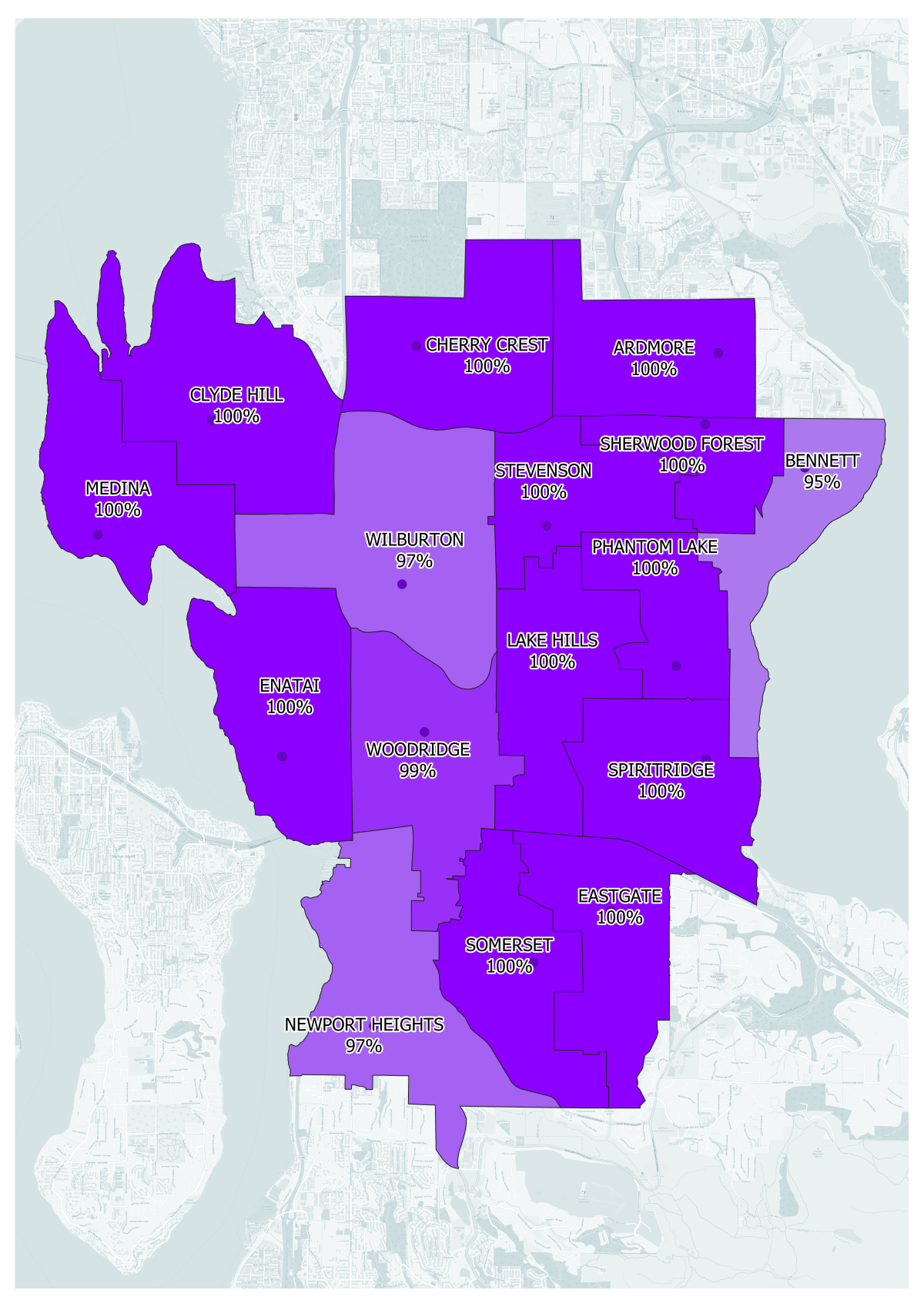
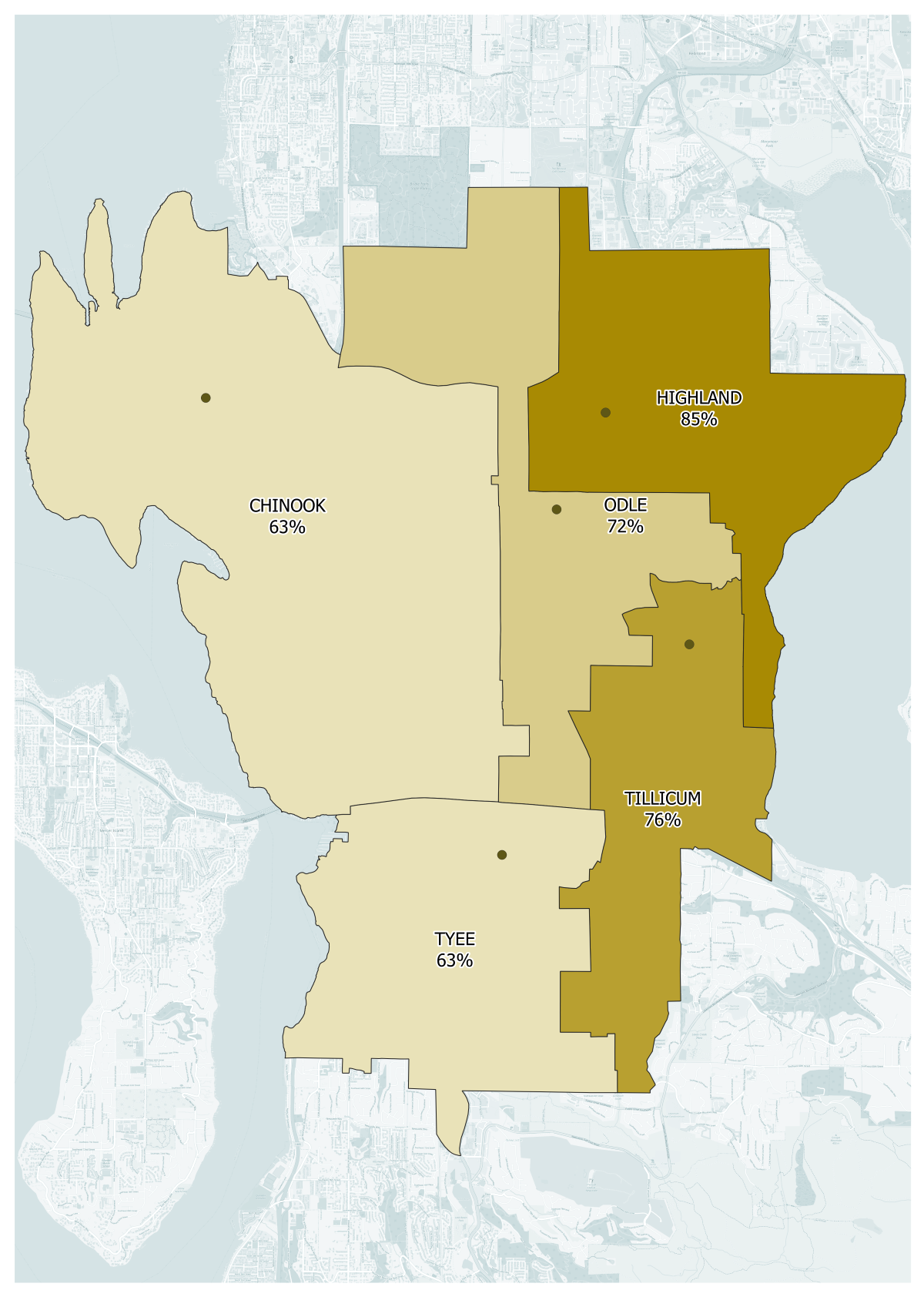
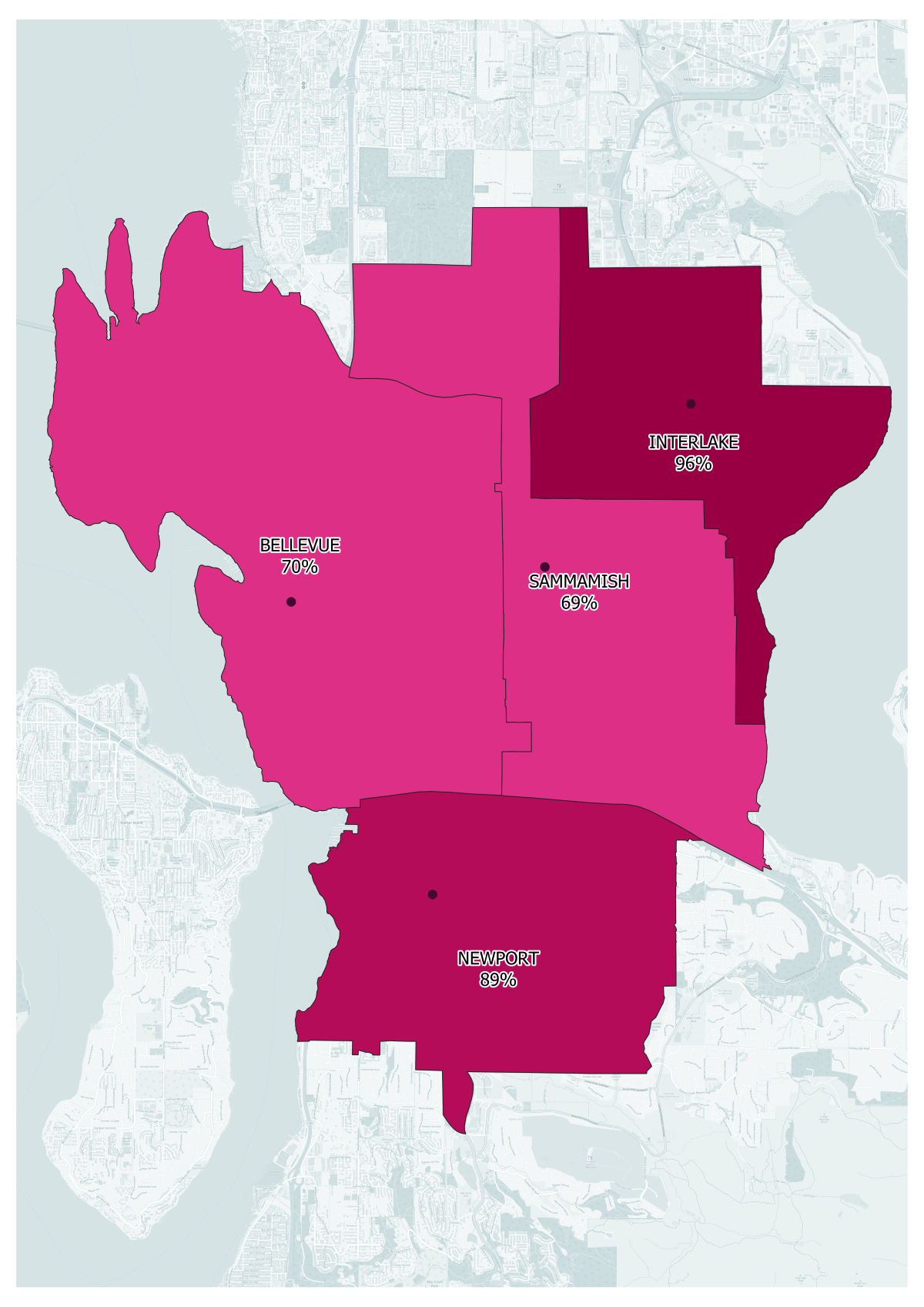
School bicycle access varied between both school and school level, but all schools were within a 15-minute bike ride of at least 60% of their district. On average, 78% of Bellevue School District high schools’ attendance areas were accessible within 15-minute cycle trips, with Interlake High School coming on top at 96%. For middle schools, the future site of Highland Middle School will be well-served for bike traffic; 85% of the school’s attendance area falls within a quarter-hour’s bike ride. Elementary schools are the most well-connected of all education levels. With their smaller attendance areas, at least 95% of each school’s attendance area is accessible within 15 minutes by a mode that’s kid-friendly, emissions-free, and effectively causes no damage to our roads. With so many important places in our city being so accessible to such a large proportion of our population, it begs the question: Why do we continue to prioritize infrastructure that makes it so hard to navigate our city without a car?