“This is the year for bold progress to make sure everyone has a home,” Sen. Marko Liias (D – Edmonds) said in a tweet shortly after dropping a bill aimed at encouraging denser housing near rapid transit. On Saturday, Rep. Julia Reed followed up on Liias’ SB 5466 by introducing the companion bill in the House: HB 1517.
Those set of companion bills dovetail with an effort to tackle single family zoning by requiring cities to allow missing middle housing options up to sixplexes in those areas. The Urbanist already put together a primer on that sixplex bill, HB 1110, which was spearheaded by Rep. Jessica Batemen (D – Olympia) and Rep. Andrew Barkis (R – Eatonville) and focused on loosening restrictions in the broad swathes of cities set aside for only detached single family homes.
A recent Urban Institute study found 70% of Seattle and Bellevue residential land is zoned single family, while in cities like Mercer Island and Lake Forest Park that number is closer to 90%. The study found that biggest way to increase housing production is to zone for denser multifamily zoning near transit.
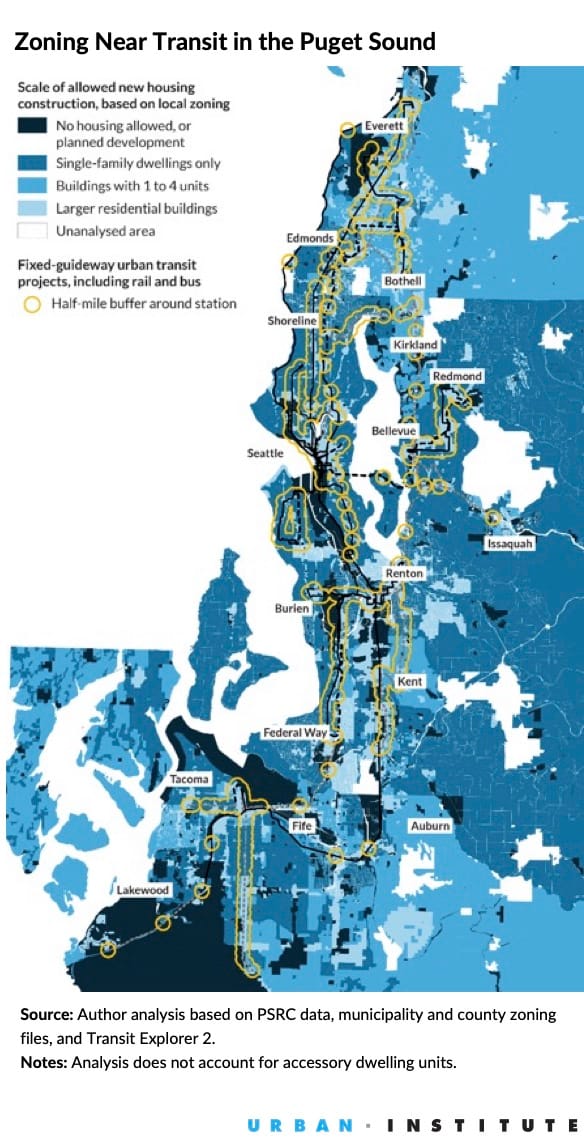
The newly introduced transit-oriented development (TOD) bill is aimed at requiring greater density near rapid transit and ferry terminals. Today, a significant portion of such areas are zoned for single family homes, no residential use whatsoever, or are subject to onerous and costly parking requirements. SB 5466 would loosen parking requirements and increase minimum density requirements.
“Major transit investments could transform regional mobility, but local rules currently limit housing growth,” the Urban Institute authors wrote. “Most housing is built in neighborhoods zoned for multifamily housing, but about one-third of station-adjacent land is zoned for only single-family homes. Almost 50% of this land requires at least one parking spot per unit, adding to housing costs.”
The bill could work in harmony with Housing Benefit Districts, proposed in HB 1111, which has the goal of acquiring and setting aside land in transit-rich areas for affordable housing development. Guest contributor Ron Davis penned a case for housing benefit districts in The Urbanist last year when the bill was first introduced. That bill didn’t advance in a busy short legislative session, but sponsors plan to mount a bigger push this session.
Liias declined to comment for this story, but he told PubliCola that TOD was more popular than missing middle housing, as reported in a recent Ryan Packer article.

“As I talk to my constituents, I’ve got folks in Edmonds, Lynnwood, Mukilteo, that are really wary about missing middle [housing],” Liias told Packer. “When I talked about transit-oriented development, virtually everybody’s in agreement that we should be siting more housing next to transit. That’s a much more consensus perspective.”
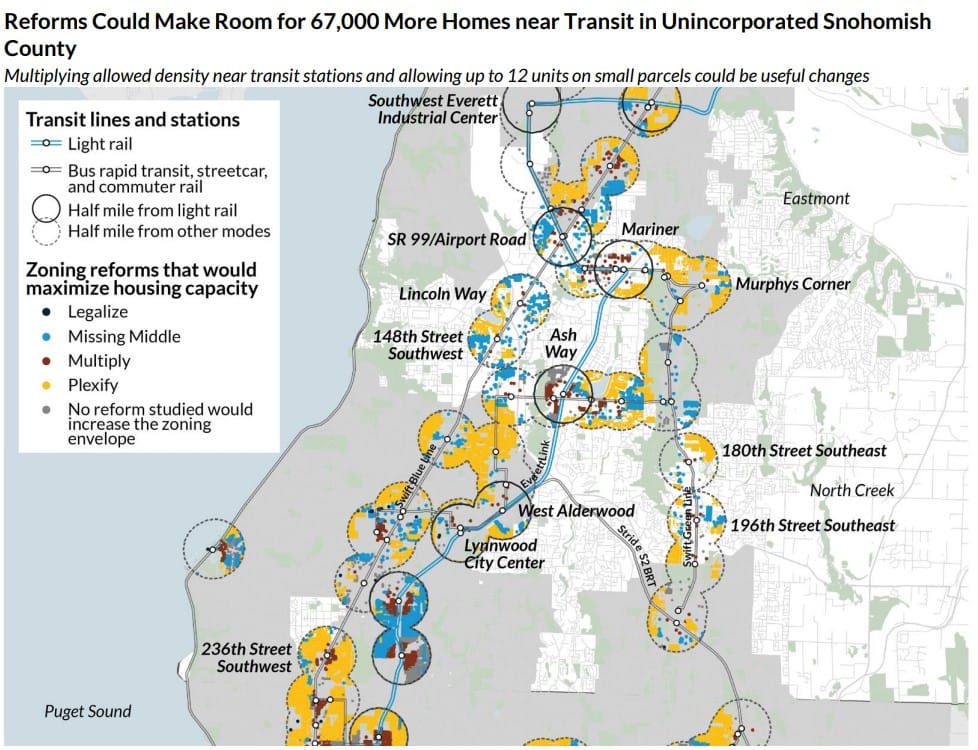
Despite his constituents’ wariness, Liias is signed on as a co-sposnor of SB 5190, the Senate companion of Bateman’s HB 1110.
While statewide polls indicate that missing middle housing is popular with voters, some cities — and Edmonds, Mukilteo, and Lynnwood have been among them — have seen their city councils grow more hostile to new housing and more deferential to residents concerned about preserving single family neighborhoods. Whether that opposition trips up HB 1110 remains to be seen, but lawmakers strategy this session also entails forging ahead on multiple paths to make progress on housing policy.
The TOD bill appears set to provide a significant jolt to housing production if it passes. “The legislation provides development targets within the 1,320 yards around light rail and bus rapid transit station areas and gives local jurisdictions flexible tools to meet these targets in ways that reflect the unique characteristics of their communities,” a spokesperson for Sen. Liias wrote in a press release. “The Urban Institute predicts that this approach will create hundreds of thousands of new housing units close to the frequent transit service that will help families and workers commute to work and services efficiently.”