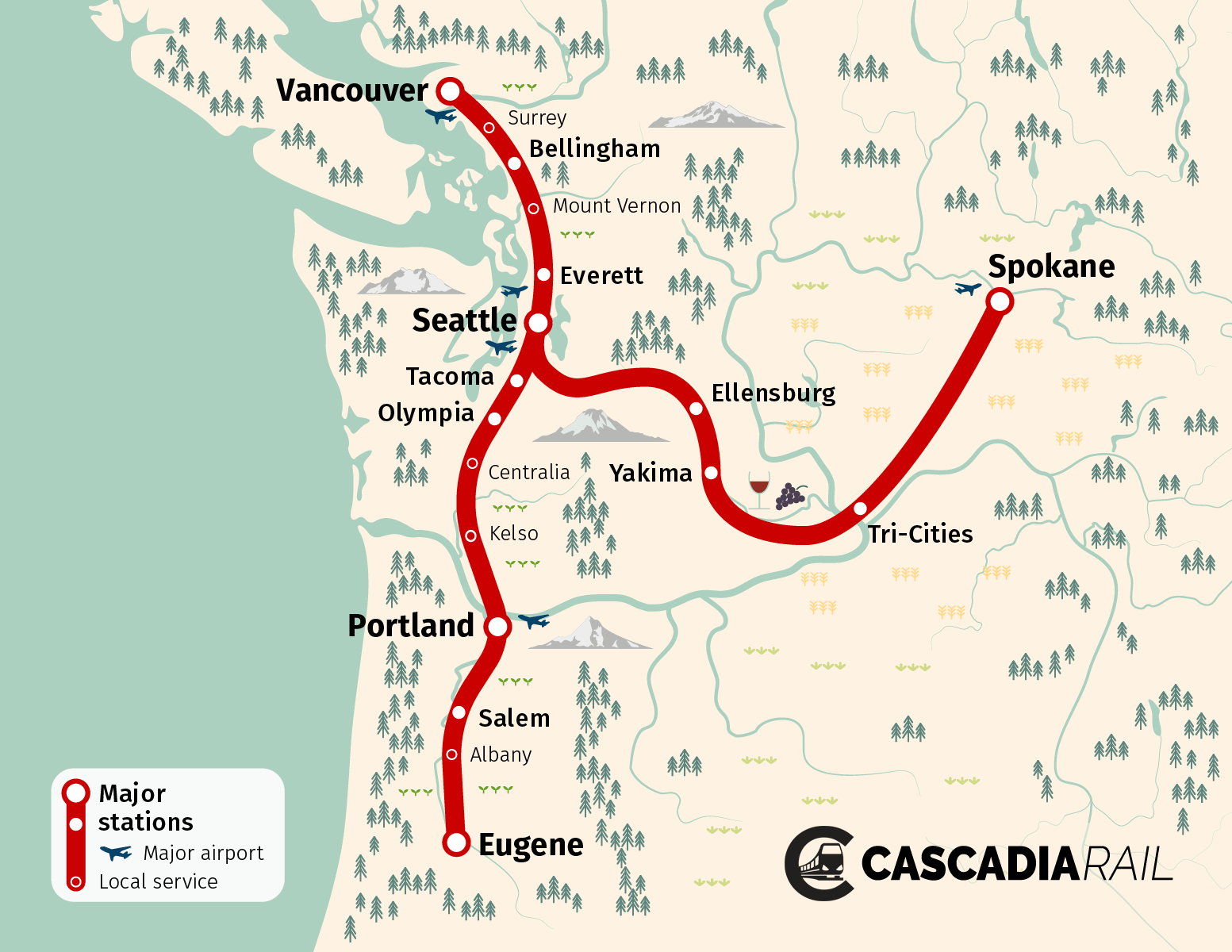
On Monday, a new advocacy organization called Cascadia Rail announced itself to the world, piquing interest with their spiffy map by maestro cartographer Oran Viriyincy. Cascadia Rail’s vision is to connect every major city in Cascadia, which is a colloquial term for the states and provinces along the Cacade Range–namely Oregon, Washington, and British Columbia, but sometimes broadened to include Northern California and Idaho.
From a Washington state perspective, what makes this map and this vision so exciting is how elegantly it connects major urban centers across the state. Washington’s Stampede Pass corridor brings in Ellensburg, Yakima, Tri-Cities, and Spokane–the last three being the largest metropolitan areas in Eastern Washington. Yakima and Tri-Cities boast access to some of best wineries in the state, opening up huge tourism-expanding potential, not to mention attracting talented people to Eastern Washington’s booming industrial and business sectors. The inland corridor might not see bullet train style service, but even 120 mph conventional higher-speed rail could be a gamechanger. There could be big benefit in transport through the pass that is relatively immune to inclement weather, unlike driving I-90.
Cascadia Rail does envision ultra high-speed rail (250 mph!) for the densely populated corridor between Vancouver, B.C. and Portland (perhaps extending to Eugene). This opens up local commuting options just as surely as intercity ones. Imagine if downtown Everett and downtown Tacoma were about 15 minutes away from downtown Seattle instead of at least an hour in traffic. High-speed rail could also cut transit times to Olympia to 30 minutes. Today they’re close to two hours.

For Portland, high-speed rail could put Kelso, Salem, and Albany within 30 minutes, and Olympia and Eugene could be less than an hour away. For Vancouver, Surrey would be a blink away and Bellingham less than 30 minutes.
Lightning fast commutes means Everett and Tacoma could be much more attractive places for Downtown Seattle workers to live. Same goes for Portland and Vancouver and their neighboring cities on the line. Given the afforability crisis facing the entire Cascadia region, greater connectivity opens up more housing options for people seeking work in the expensive center cities. Thus, high-speed rail helps people economically displaced from a center city avoid being sentenced to a horrenous commute.
A bullet train can travel 250 mph; that is five times the speed of a Sound Transit light rail vehicle and three times as fast as the Cascade Amtrak line that currently runs from Vancouver, B.C. to Portland. https://t.co/wAnIiBVWin
— Cascadia Rail (@CascadiaRail) February 4, 2018