With time running out in Olympia, it looks like state legislators won’t be able to come together to pass a bill authorizing King County to tax big businesses. Rep. Nicole Macri (D-Seattle) said she didn’t have the State House votes for her bill, which permits King County to enact a 0.25% payroll tax hitting large companies with employees making more than $150,000.
Belatedly, the Seattle Metropolitan Chamber of Commerce issued a statement seeming to back the county payroll tax to fund regional homelessness response, albeit tepidly. But with the end of session looming on March 12th and some moderate Democrats still reticent to support the bill, it could be too little too late.
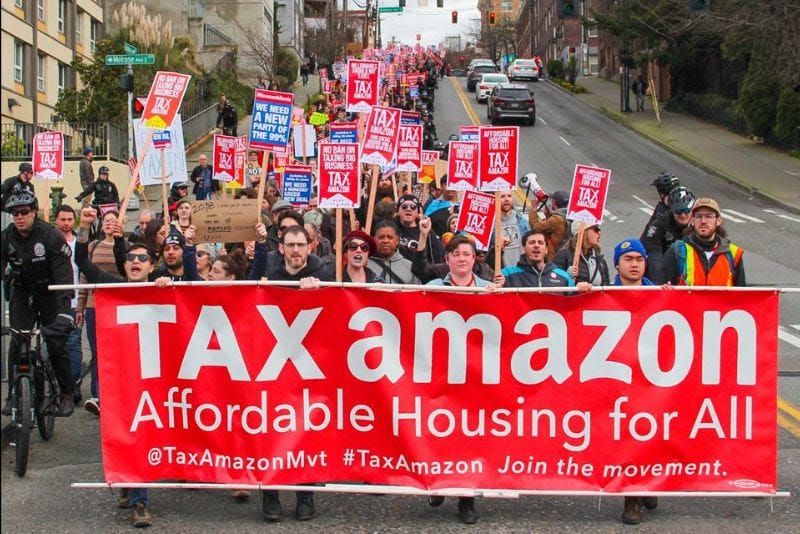
As Olympia dithers, the Tax Amazon movement is forging ahead and attracted 400 people to a march on Sunday. Councilmember Tammy Morales also signed on to Councilmember Kshama Sawant’s bill that would pass a 0.7% payroll tax at the Seattle level.
“As we wait through another legislative session for Olympia to address our state’s upside-down tax structure, the city must move forward … and act to provide the housing we need,” Morales said.
In February, Councilmember Sawant rolled out her bill to tax big business via a Seattle-only payroll tax geared to raise $300 million, dubbing the effort “Tax Amazon.” Incidentally, Amazon invested record sums trying to block Sawant’s reelection but failed. Initially, Sawant announced a 1.7% payroll tax directed at the top 3% highest grossing companies with $7 million or more in payroll–about 800 businesses. Further analysis by Council Central staff has revealed a 0.7% payroll tax on the same companies would be sufficient to raise the $300 million per year Sawant has targeted–twice what the countywide tax could raise as the state bill is currently written.
The bulk of the revenue–75%–would be dedicated to building social housing (which refers to both public housing and affordable housing provided by nonprofits) while 25% would go to electrifying homes that use oil or gas for heating and cooking–a plank of the Seattle Green New Deal. That level of investment could generate more than 2,000 homes per year if we assume similar leverage with outside funding sources as the Mandatory Housing Affordability program did for in-lieu fees.
While Mayor Jenny Durkan has spoken out against Sawant’s tax, a coalition of progressive groups is coalescing behind the tax, including 350 Seattle, Seattle Transit Riders Union, and UAW 4121, which represents more than 6,000 academic employees.
“As residents and postdocs, often we need to live close to the university and our labs,” said Natalia Mesa, a member of UAW 4121, in a statement. “That means that we sometimes pay 50% to 70% of our incomes in order to live and work in Seattle. While Jeff Bezos keeps getting richer and richer and getting more and more tax breaks, we are unable to live and work in Seattle. A victory for taxing Amazon means winning hundreds of millions for working people in affordable housing. I can promise you that union workers are in this fight.”