Give feedback and ask the City questions to push for a better plan to address the housing crisis.
Seattle released its draft “One Seattle” Comprehensive Plan last week to much disappointment and criticism by urbanists and housing advocates. The plan is both astounding and confounding in its complacency and lack of bold vision.
Headlines such as “Harrell Throws in the Towel,” “Seattle Releases Comprehensive Plan Less Ambitious Than Bellevue,” and “Harrell’s Anemic Growth Plan Is Not ‘Space Needle Thinking’” capture the feeling. And both the Seattle Planning Commission and the head of the City Council Land Use Committee seem to agree.
Despite being a year overdue, the proposal somehow manages to put off a number of hard decisions and push many important details into future planning processes regarding zoning changes and neighborhood plan updates for the city’s seven largest growth centers (as if in an effort to win by exhausting us all with process).
Our city has experienced nearly two decades of extreme rises in rent and housing prices as our city has seen an almost continuous boom in population and jobs fueled by a strong tech sector. Yet the plan suggests that the folks at the Office of Planning and Community Development (OPCD) and the Mayor’s office seem to think that everything is fine — it’s as if they all bought houses in 1989. But we can all see it’s not and this is why the majority of public comments during the scoping phase asked for the maximum housing supply option only to be blatantly ignored by the Harrell administration.
But what would a better version look like? What should we tell the city to change so we salvage the mayor’s small ball plan? Below are six ways to bring the plan closer to what we need — starting with an abridged summary for those chomping at the bit to submit their feedback now.
- Allow bigger buildings in more places to break out of the “Urban Village” strategy and scarcity mindset.
- Add more “Neighborhood Centers” to anchor small neighborhood business districts with housing.
- Zone for fourplexes and sixplexes that will actually get built and support families with three- and four-bedroom homes. The proposed restrictive size limits — particularly the floor area ratio (FAR) set at a measly 0.9 — are effectively erasing the value of the fourplex and sixplex zoning. Follow state model code and allow 1.6 FAR in sixplex areas instead.
- Embrace transit-oriented development and allow larger apartment and condo buildings near all frequent transit corridors. The mayor’s proposal appears to have jettisoned the transit corridor alternative from scoping.
- Remove parking requirements. Parking requirements are a secret tax on housing that render many projects infeasible. We cannot afford this amidst a housing crisis.
- Corner stores should not only be on corners. Allow more flexibility to ensure more neighborhoods can actually get a bodega or cafe.
1. Allow Bigger Buildings in More Places
Mayor Bruce Harrell’s draft Comprehensive Plan sticks with the “Urban Village Strategy,” which both has many problems and produced much of Seattle’s new housing. They are doing close to the minimum to expand upon it, despite choosing to take urban villages and rename them “Urban Centers.” The plan has one new “Urban Center” at 130th Street around the new Link light rail station, and they expand several of the most ridiculously shaped ones to encompass something closer to a 15-minute walkshed. As for capacity within Urban Centers, OPCD proposes to upzone Residential Small Lot (RSL) zones to Lowrise 1 (LR1), but otherwise leave them as is.
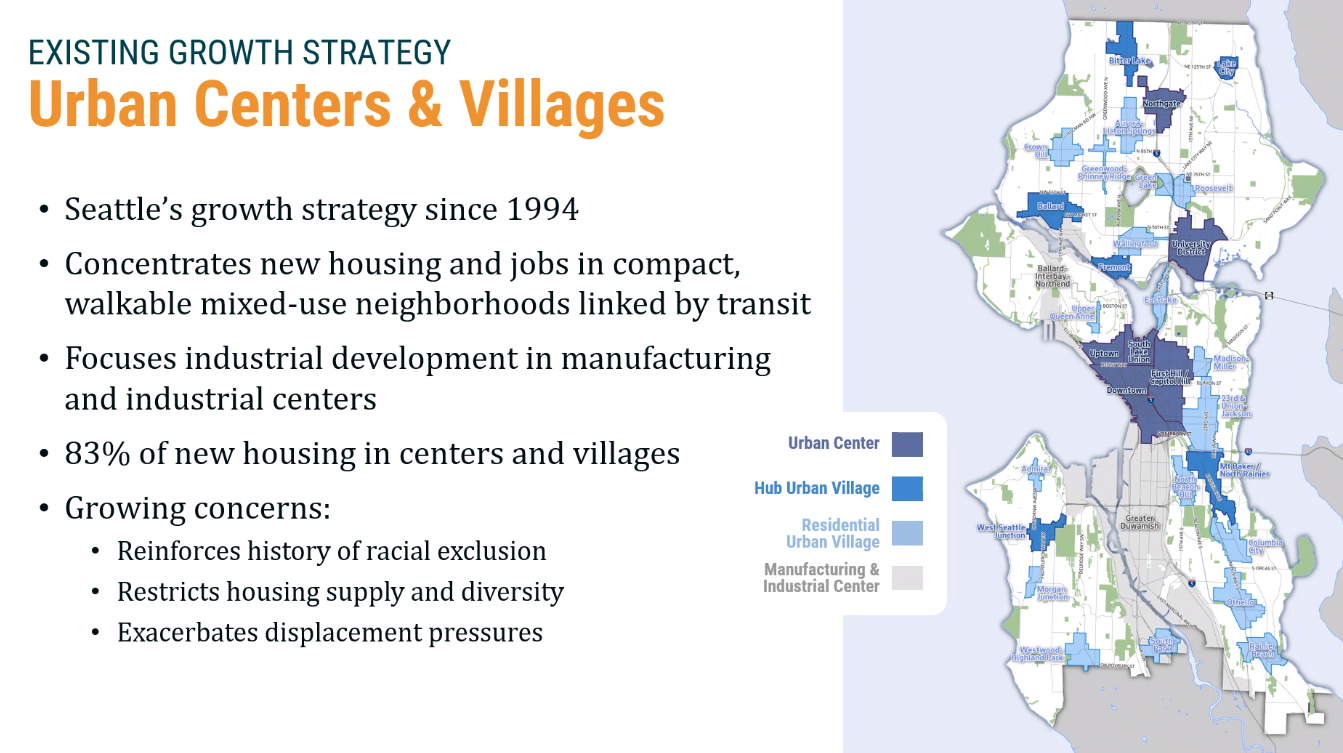
Urban Centers can and should continue to be anchors within a broadened growth strategy. This means more Centers in places such as Magnolia, Sand Point, and around the soon to open NE 145th Street Link station. Expanding existing centers to incorporate their full walkshed as proposed and that of Link stations (I’m looking at you Montlake) and generally erode the hard boundaries – see below.
There also needs to be talk of greater increases in zoned capacity as part of this process within existing Centers than OPCD proposes. As of today, there are townhouses getting built a block from light rail stations because that is what zoning allows, squandering our region’s multi-billion-dollar investment in transit and wasting capacity for new housing. The city needs to change that.
2. Add more neighborhood centers
The original proposal for neighborhood centers or “anchors” in the Draft Environmental Impact Statement (EIS) scoping document identified 42 locations. This has been reduced in the draft to 24 (plus the Urban Center at 130th Street replaced two anchors). Architect Dylan Glosecki has done a survey of existing small neighborhood centers and mapped over 80 that already exist throughout the city. If we want a 15-minute city that supports people being able to walk, roll, and bike for their basic needs then there must be goods and services available near people’s homes. Neighborhood centers and corner stores are how we make it happen.