Although Seattle, the economic and cultural hub of our region, rightfully receives ample scrutiny for its commitment to a greener, more equitable mobility system, it is important not to forget the similar responsibilities borne by our region’s other cities. In my previous article, I provided a vision for what transformative, paradigm-shifting change could look like for Bellevue’s transportation system. Although historically an auto-dominated city, our leaders could use lessons from other cities around the world and repurpose road space on key arterials to be used for safe, socially-distant walking, biking, and transit use instead. I was happily surprised that the expected “bikelash” was heavily outweighed by positive comments from urbanists, organizations, and community members alike who appreciated the future-oriented perspective for a city traditionally not associated with green mobility.
As an urbanist myself, I find it easy to get lost in such grand, top-down visions of how things could be different, and I think that such theorizing ultimately serves a positive purpose–it enables people of all political realities to stop and consider substantial changes to the status quo. However, I feel it’s also important to acknowledge the enormous political will such transformations can require, political will that is often not available in suburban towns with several conservative councilmembers. Therefore, it’s essential that advocates not lose sight of the visionary goals we have for our cities while also focusing on the concrete improvements that need to be made to our non-automobile infrastructure.
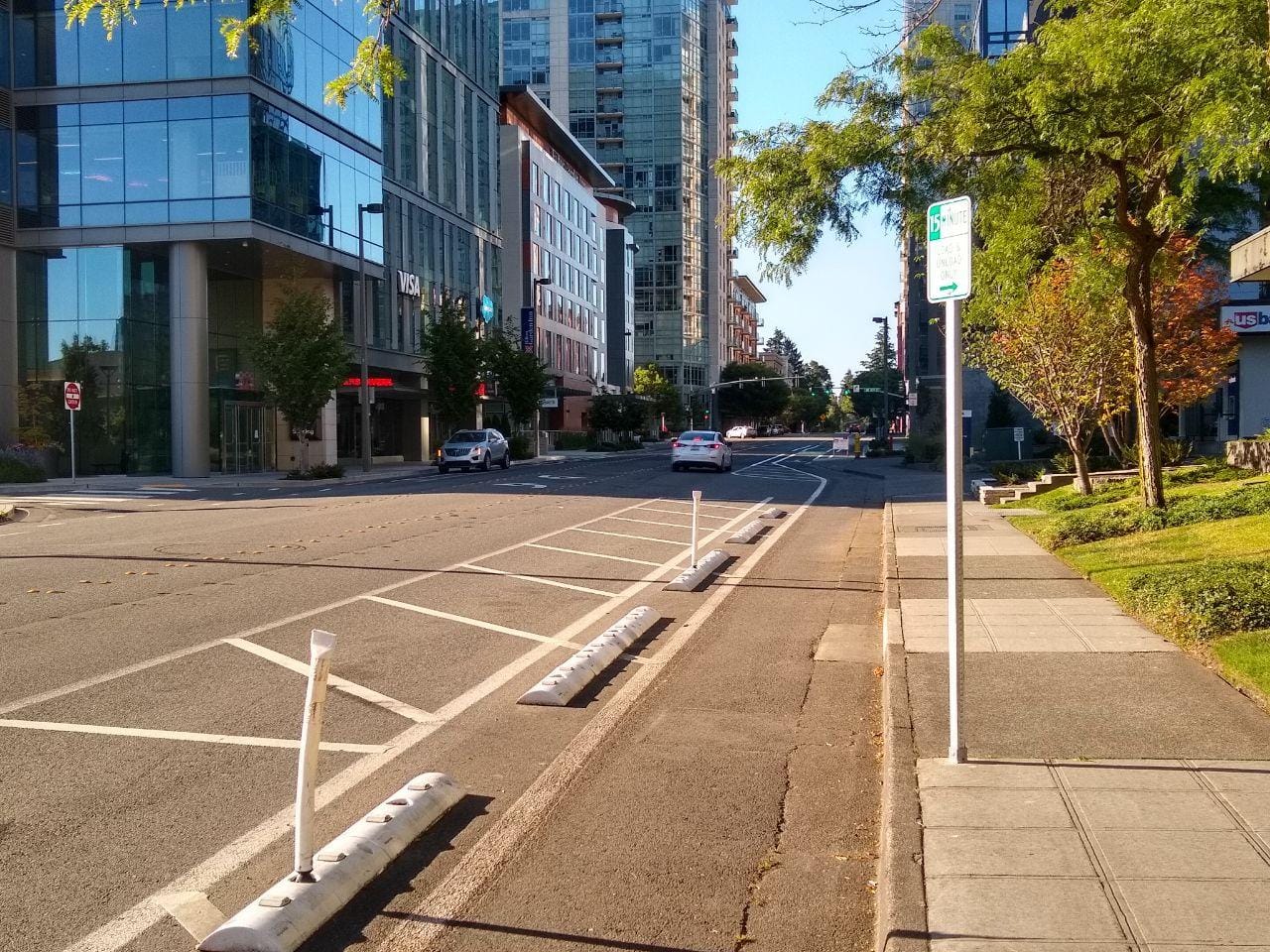
And in Bellevue, there is substantial room for some concrete improvements due to the significant absence of separated, protected bicycle facilities (there’s a rimshot there that’ll make sense by the end of this article). Although some newer facilities are prioritizing separation and distance from cars, there are certainly plenty of examples of unprotected, narrow, and outright uninviting bicycle lanes that do little to ensure the safety of current riders or entice the new ones we need to meet our climate targets. These types of facilities cater only to a limited percentage of potential cyclists because of the higher-speed automobile traffic directly next to them. Can you imagine the (rightful) uproar if we used public money to engineer city roads that only 10% of drivers felt comfortable driving on?
Bike riders of all persuasions already know that painted lanes are not enough to ensure their safety–I and other cyclists I’ve talked with can relay numerous anecdotes of drivers dangerously speeding past us as we feel the whip of their wind bristle on our arms. But being the scientist I am, I wanted to confirm this quantitatively, and in doing so underscore our obligation to make our city’s bicycle facilities truly accessible for All Ages, Languages, Ethnicities, Genders, Races, and Abilities (ALEGRA).
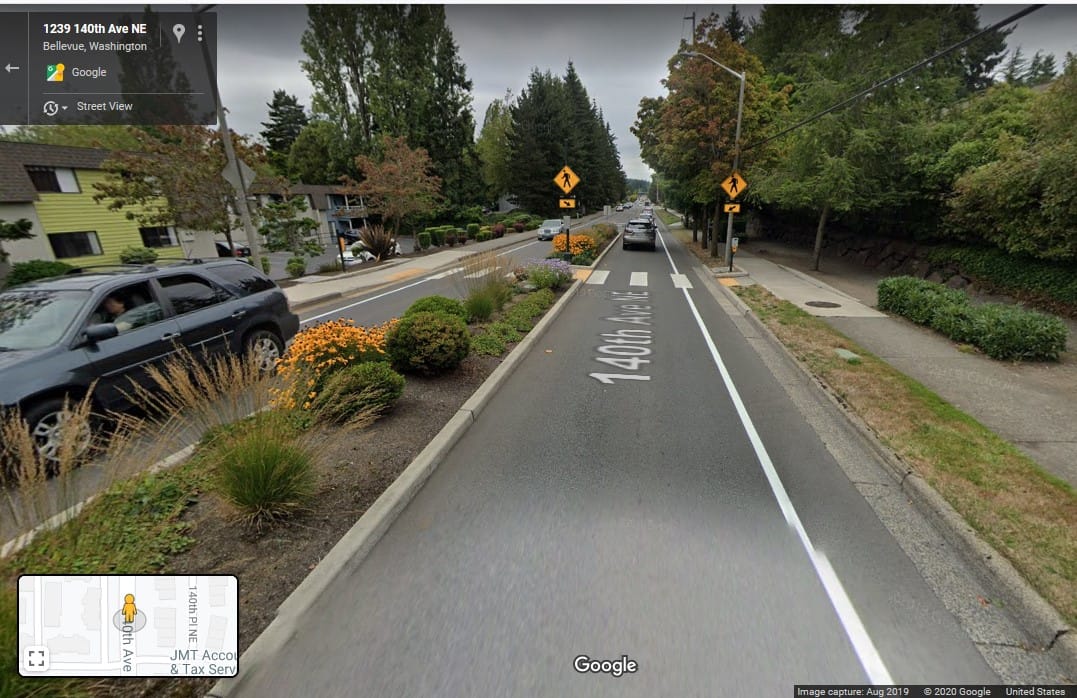
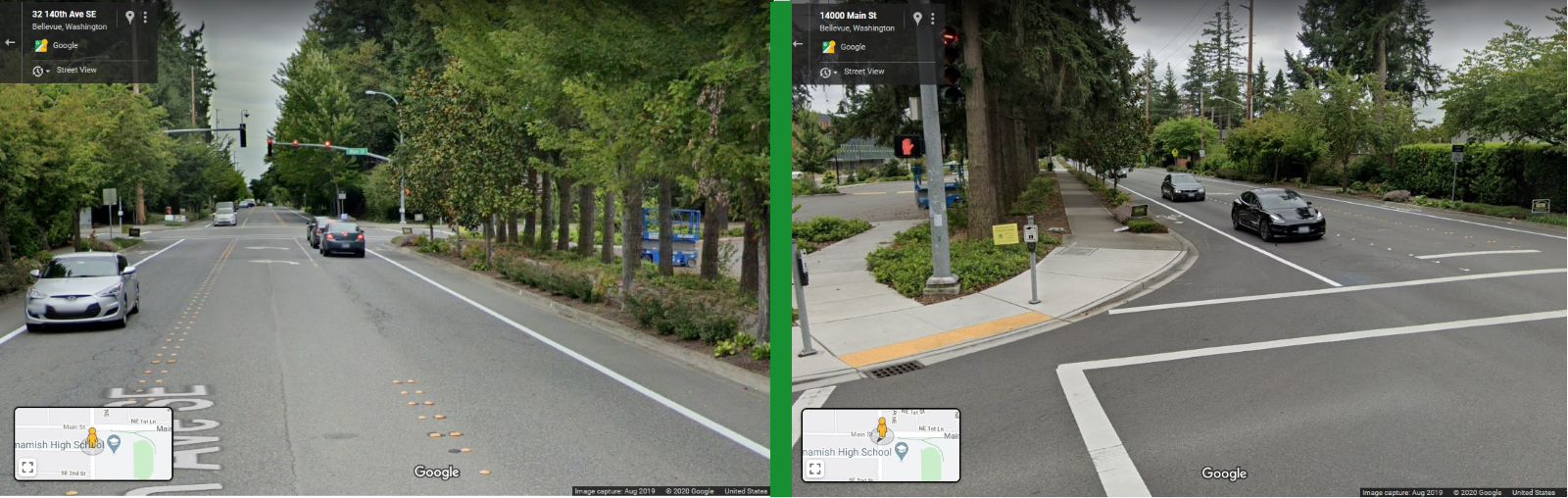
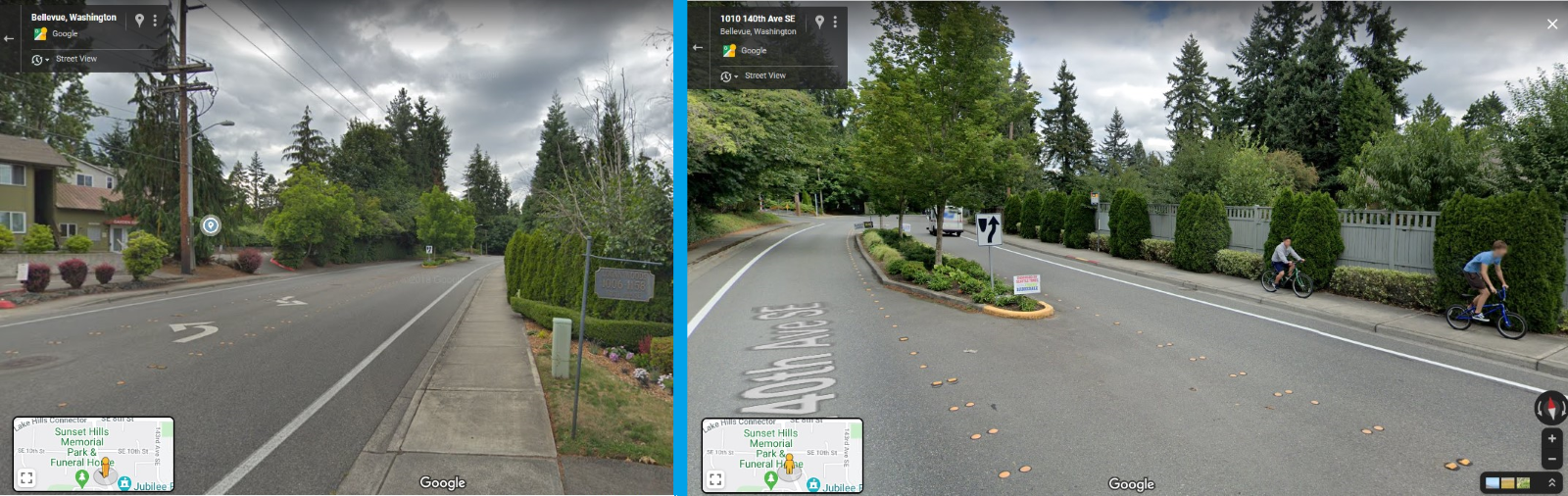
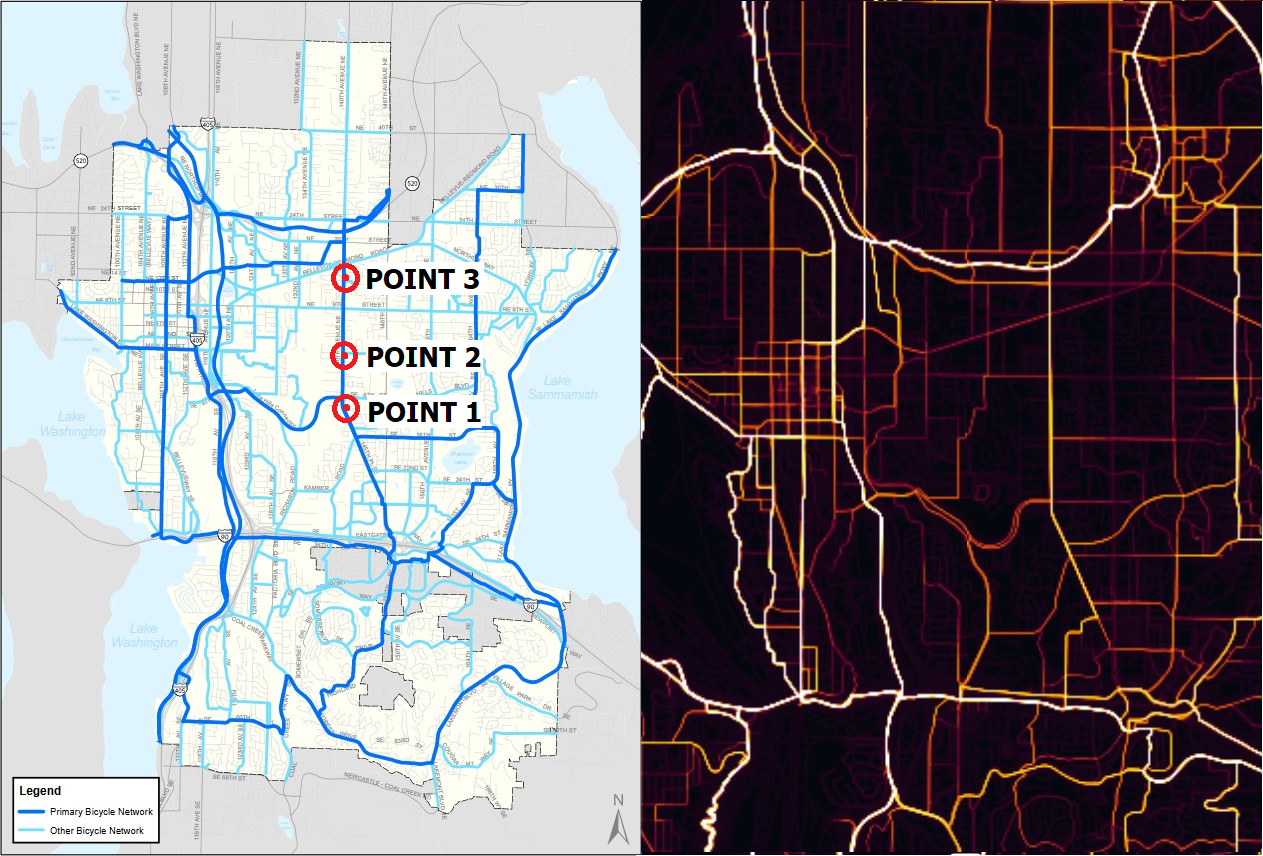
To do so, I selected three sites on 140th Ave, a frequently-used cyclist corridor in east Bellevue. Although there are painted, intentional bicycle lanes along nearly the entire corridor, there are no buffers, barriers, or other mechanisms to ensure cyclist separation and protection from drivers. I therefore assessed driver behavior at the above three points by noting how far (if at all) they crossed over the paint line demarcating vehicle and bicycle separation. Points 1 and 3 (see above map) represented a curved and straight point, respectively, where road width is constricted by a median, so I measured how many feet drivers were away from the paint line as their vehicles passed.
At Point 1 in particular, the northbound bike facilities fall on the inner edge of the curve, so I have often observed drivers that will cut into the facilities to make the turn more tightly and thus maintain their speed. Similarly, Point 2 represents an intersection with a large corner radius, which enables drivers to more easily maintain their speed as they turn if they cut into the bike lane to do so. Here, I measured how far behind the intersection vehicles crossed into the bike lane as they conducted their right turn. For more detailed site descriptions and methods, please read the Author’s Note at the end of the article.
How Drivers Did
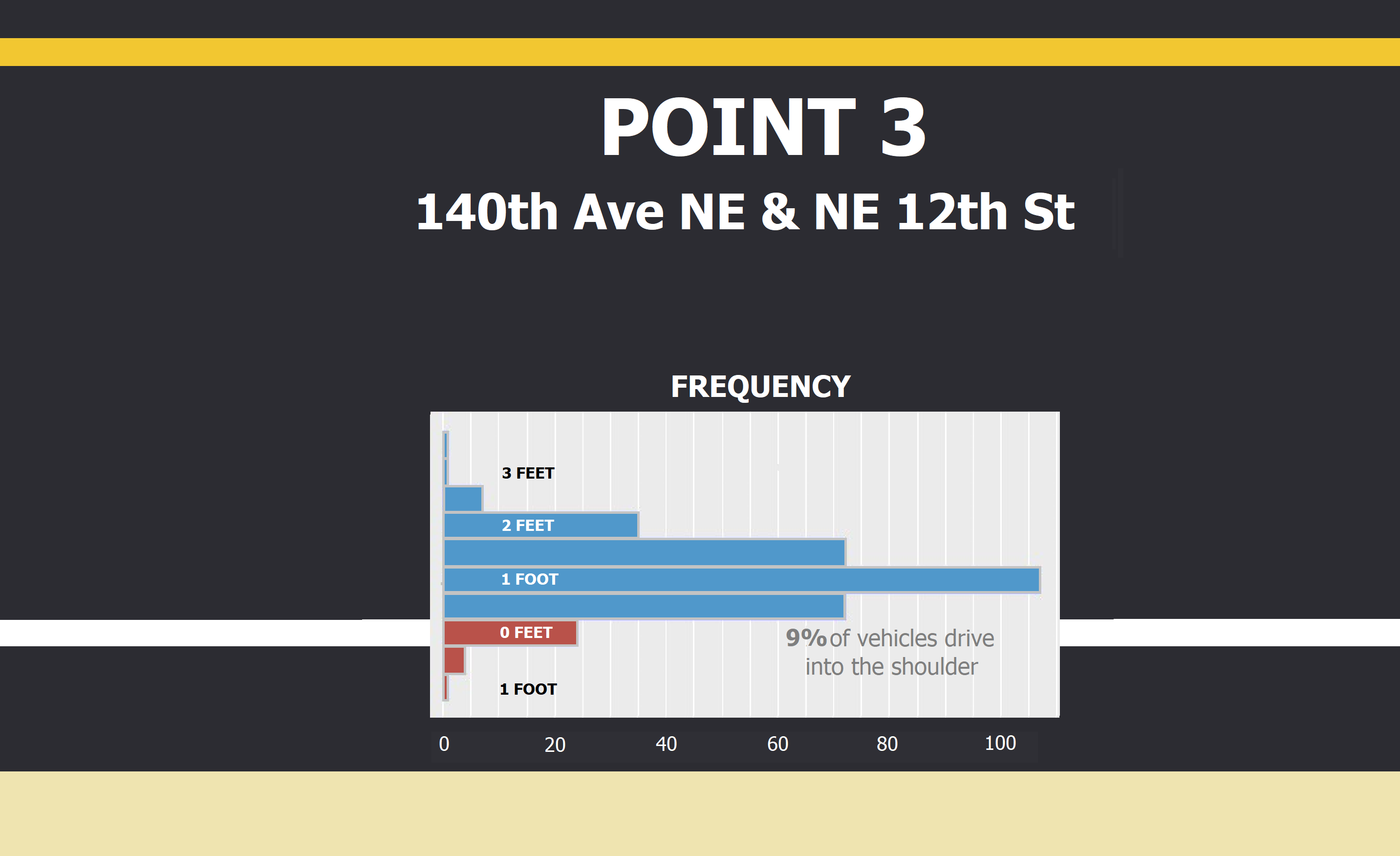
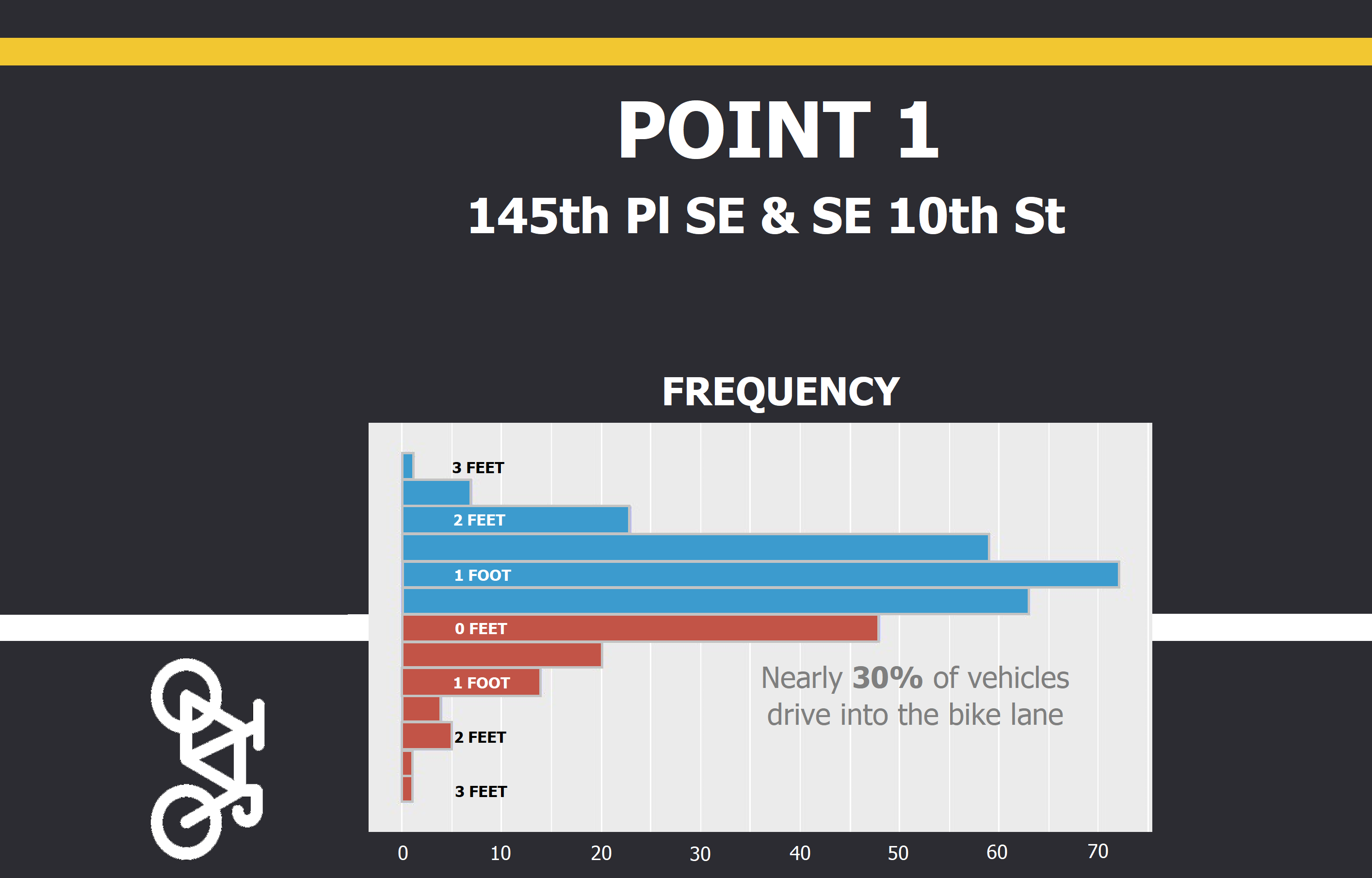
At Points 1 and 3, more than 300 vehicles passed by each site during an hour’s worth of data collection, and there were indeed marked differences in how far away drivers were from bicycle facilities as they passed. On average, drivers at Point 1 were less than 7 inches away from the bike lane, in contrast to the full foot (13 inches actually) of distance allotted on the straight road. This data was enough to show that cars do pass significantly closer to cycle lanes on curved roads than straight ones (p < 0.0001, for those that care about p-values). Although those six inches may sound minimal, it’s important to also look at the data’s distribution to understand the whole story.As seen in the figures above, drivers passing one foot away from the lane comprised the largest category at both points, but significantly more drivers went onto or into the bicycle facilities at Point 1. This further emphasizes that drivers are not hesitant to behave in a way that maximizes their speed and mobility while potentially sacrificing the safety of people on bikes. Also note that the facilities at Point 3 are half a foot narrower than those at Point 1; therefore, if bike riders are the same distance from the curb at both points, a vehicle separation of 1 foot at Point 3 is only equivalent to a separation of 0.5 feet at Point 1. This illustrates the necessity of a comprehensive view of both lane widths and the facilities present to best understand cyclist safety.
Even more egregious was the driver behavior I observed at Point 2, where I measured how far back cars would cross into a bike lane to make a right turn. Across the 65 vehicles I observed, drivers entered bike facilities an average of 21 feet behind the crosswalk. One driver even entered the lane almost 40 feet before the intersection, and, as detailed in the Author’s Note, most vehicles actually entered at a point that exceeded my ability to accurately measure. It should be noted that it’s not as if it is presently impossible for vehicles to complete the curve without prematurely crossing into the bike lane. Although it was a motorcyclist who crossed the paint line 3 feet behind the intersection and thus represented the “best” in driver behavior, the other vehicles who had values less than 10 feet were all normal SUVs and sedans. In fact, a student driver correctly pulled up to the intersection, slowed down, and only crossed the bike lane 6 feet from the crosswalk after they had confirmed there were no cyclists behind them. This suggests motorists have the innate ability to understand the rules of the road, be aware of their surroundings, and drive around curves more responsibly–but they may sometimes forget to take such care after they’ve passed theirdriver’s tests.But why have we designed our roads in a way where the only thing ensuring drivers show that care is a line of paint on the ground?
Why all this matters
Perhaps the most glaring limitation of these results is that, except for a few times where a cyclist actually was present while a car drove by, they do not capture actual behavior as drivers pass a cyclist. However, in a city that has committed to a Vision Zero pledge of zero traffic deaths on its streets by 2030, a city whose councilmembers unanimously backed a systems-oriented approach to Vision Zero, I do not believe that matters. Fundamental to the idea of Vision Zero is that “to err is human,” and people make mistakes. Drivers can be distracted for even a second and run over pedestrians in a marked crosswalk. Drivers can be blinded by the sun as they make a left turn on an early summer morning and collide with a cyclist. Drivers can fail to move over for cyclists and then make the malicious choice to continue on their way after a collision.
The key to actually seeing zero annual deaths on our roads by 2030 isn’t to rely on education and correcting human behavior–it’s to design our street networks in ways that make it impossible for such deaths to occur in spite of human behavior. By this logic, the takeaway from this data isn’t that most drivers are bad and their behavior needs to be corrected–it’s that there is a problem in the way this street is designed, and we need to change it to ensure that this behavior cannot occur.