Last week, the Washington State Department of Transportation (WSDOT) released a report (PDF) laying out a framework to advance Cascadia’s high-speed rail hopes. “Rather than relying on congested highways or increasing air traffic, UHSGT [ultra-high-speed ground transportation] offers sustainable alternative to traveling greater distances quickly and reliably,” the executive summary states.
While a plan to design a plan isn’t exactly riveting stuff, the show of support from regional leaders was impressive, and it’s another hurdle cleared on the long path to high-speed rail.
“We are living in unprecedented times that call on us to envision our future in new ways. Transformative infrastructure projects like this one could help us rebuild our economy in the short term and provide us with a strong competitive advantage in the future,” Washington Governor Jay Inslee said. “Imagine fast, frequent and reliable travel with the potential for zero emissions and the opportunity to better compete in a global economy. It could transform the Pacific Northwest.”
Cascadia Rail, an advocacy group formed to promote high-speed rail in the corridor, was pleased with the news.
“The holidays came early this year with the delivery of the latest WSDOT report outlining actionable steps forward into making high-speed rail a reality in the Pacific Northwest,” said Paige Malott, Chair of Cascadia Rail. “We were delighted to see the values that Cascadia Rail has been championing on equity, meeting climate goals, and alternatives to air travel were included on the first page of the executive summary. Our region’s values of prioritizing equity and accessibility for all are highlighting this project as a national example for other high-speed rail systems in development around the country.
British Columbia Premier John Horgan said the report provided a path forward for collaboration.
“Improving connectivity in the Pacific Northwest region through ultra high-speed rail presents enormous potential for job and economic growth on both sides of the border,” Premier Horgan said. “This study provides a path forward for British Columbians and gives us a clearer vision of what can be achieved when we all work together.”
Oregon Governor Kate Brown emphasized the climate benefits.
“Bringing high-speed rail to the Pacific Northwest would bolster our economies while contributing to our efforts to combat climate change,” Governor Brown said. “This study affirms that a regional high-speed rail system would yield an equitable and modern transportation infrastructure that benefits people, the environment, and the economy. This type of bold investment would help position our region for the future.”
Microsoft president Brad Smith also contributed a quote for the executive summary and emphasized the time people would save.
“High-speed rail will shrink travel times throughout the Cascadia Corridor, providing a strong transportation core for our region,” Smith said. “This report provides a valuable roadmap for making this international project a reality.”
Malott suggested Microsoft’s leadership could inspire more businesses to pitch in: “Microsoft has been a visionary supporter since the beginning of this project, and we look forward to more business partners and community organizations getting involved and making Cascadia high-speed rail part of our ‘New Normal.'”
The recipe for high-speed rail
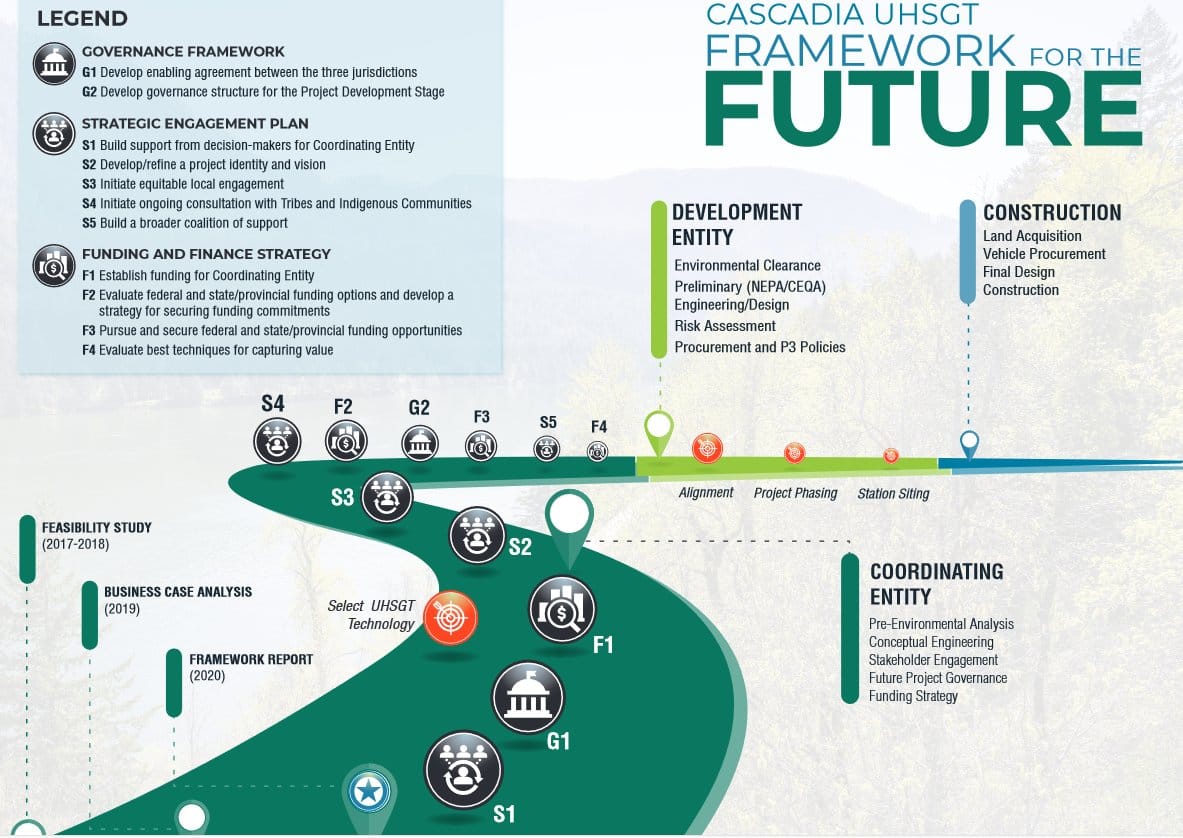
So what exactly is the roadmap to a plan? The report suggests the next big hurdle is setting up a coordinating entity to work across state and national lines and advance pre-environmental analysis, conceptual engineering, stakeholder engagement, future project governance, and funding strategy. The immediate next step is to “initiate equitable local engagement,” which may shows goals like reducing displacement of residents is important and lead to refining the scope to include social housing and upzones near the stations.
The vision from the Cascadia Innovation Corridor, a business-led advocacy group spearheaded by former Washington Governor Chris Gregoire, has been a little different; a recent “Cascadia Vision 2050” report claimed that hub cities of 300,000 residents or more in rural areas are the key to accommodating growth and maximizing high-speed rail’s effectiveness. We at The Urbanist are skeptical (here’s why) and would prefer to grow and invest in existing cities rather than pave over more farmland and forests.
The official study from WSDOT didn’t wade into that controversy and was much more focused on the nuts and bolts. Developing an enabling agreement between the three jurisdictions is one of the more immediate tasks. That enabling agreement will also need to come with funding to support the coordinating entity as it conducts all the needed stakeholder engagement and planning. Consulting tribal governments and indigenous communities is listed as a step, which is crucial since the line is likely to cross several reservations and may open up old wounds stemming from the first wave of intensive White colonization in the Northwest fueled by transcontinental railroad construction and the dubious land grabs and treaties signed and ignored along the way.
Each of the three state and provincial jurisdictions (plus Microsoft) has chipped in to conduct the planning so far, but the sums are sure to increase significantly as planning progresses, making federal matching funds more instrumental–and the report offers three funding scenarios with one even suggesting federal dollars could cover the majority of planning costs.