Update: Since this article was initially published, Councilmember Kshama Sawant has formally submitted a resolution calling on the City to “support community demands to fund quality affordable social housing to prevent and reverse displacement” and “urge the Office of Housing to fund the affordable housing project proposed by New Hope Community Development Institute.”
Last summer when Councilmember Kshama Sawant stood on the steps of New Hope Missionary Baptist Church in Seattle’s Central District, she called on the City to fund 1,000 new affordable housing units over three years for “historic residents and those displaced” from the neighborhood, which for decades was home to the largest Black community in the Pacific Northwest.
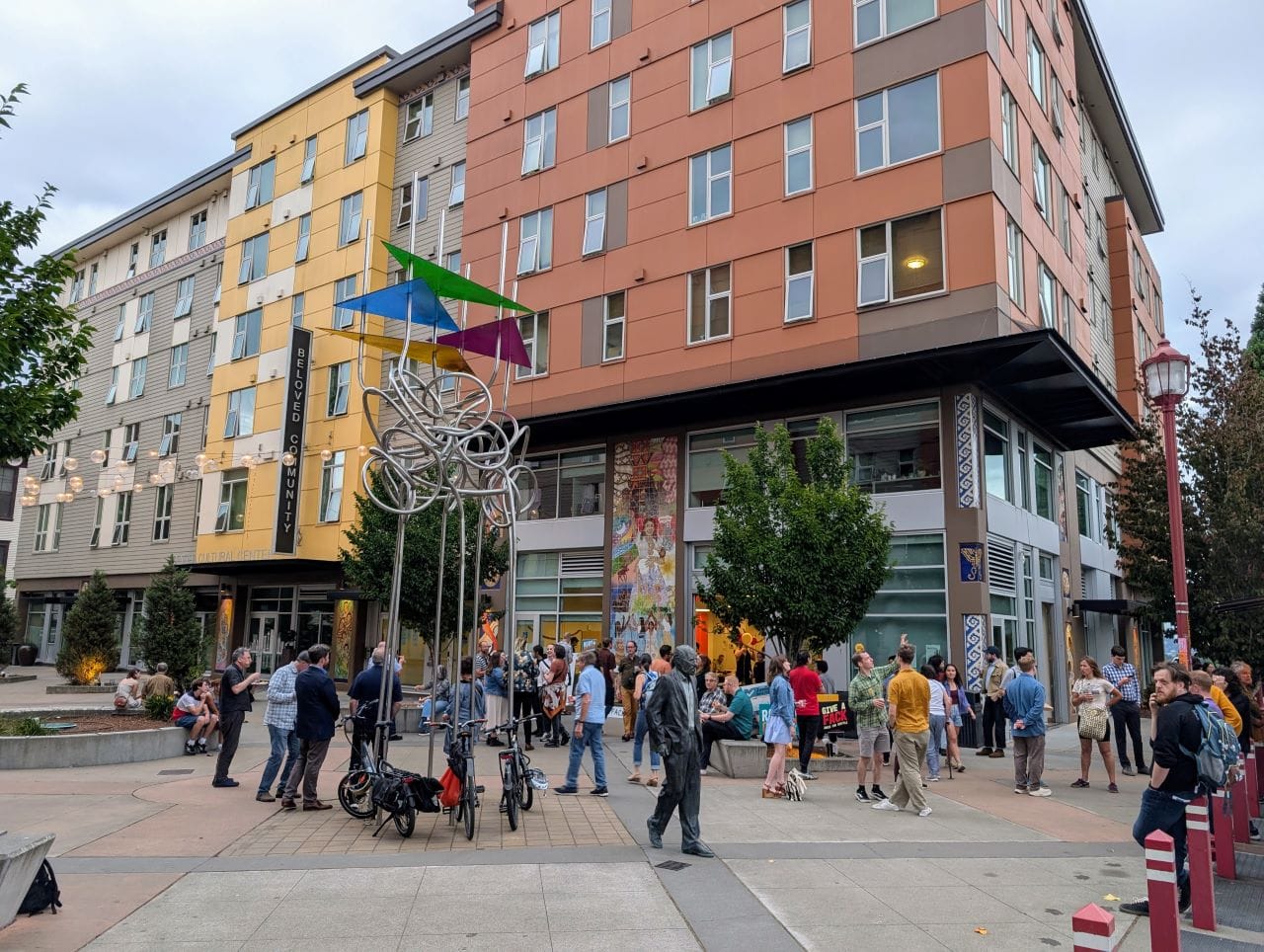
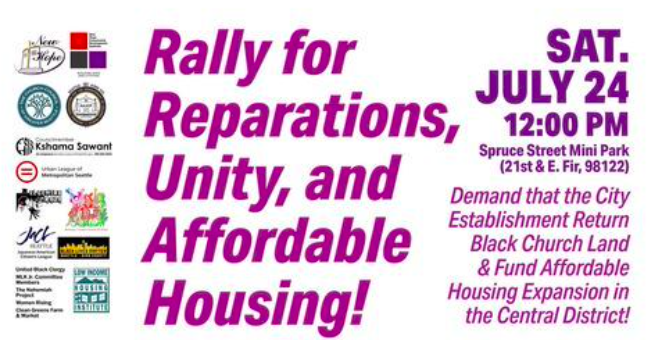
At that time Councilmember Sawant and advocates from the community stopped short of explicitly calling for reparations for Black Seattleites, who statistically have largely been left out of the economic growth accompanying the city’s most recent period of population expansion. Now a year later, the demands have shifted. On a sunny Saturday afternoon, Sawant and an expansive coalition of nonprofit organizations, faith-based institutions, and affordable housing providers held a rally for “reparations, unity, and affordable housing” held near the same site. The rally included live music and impassioned speakers.
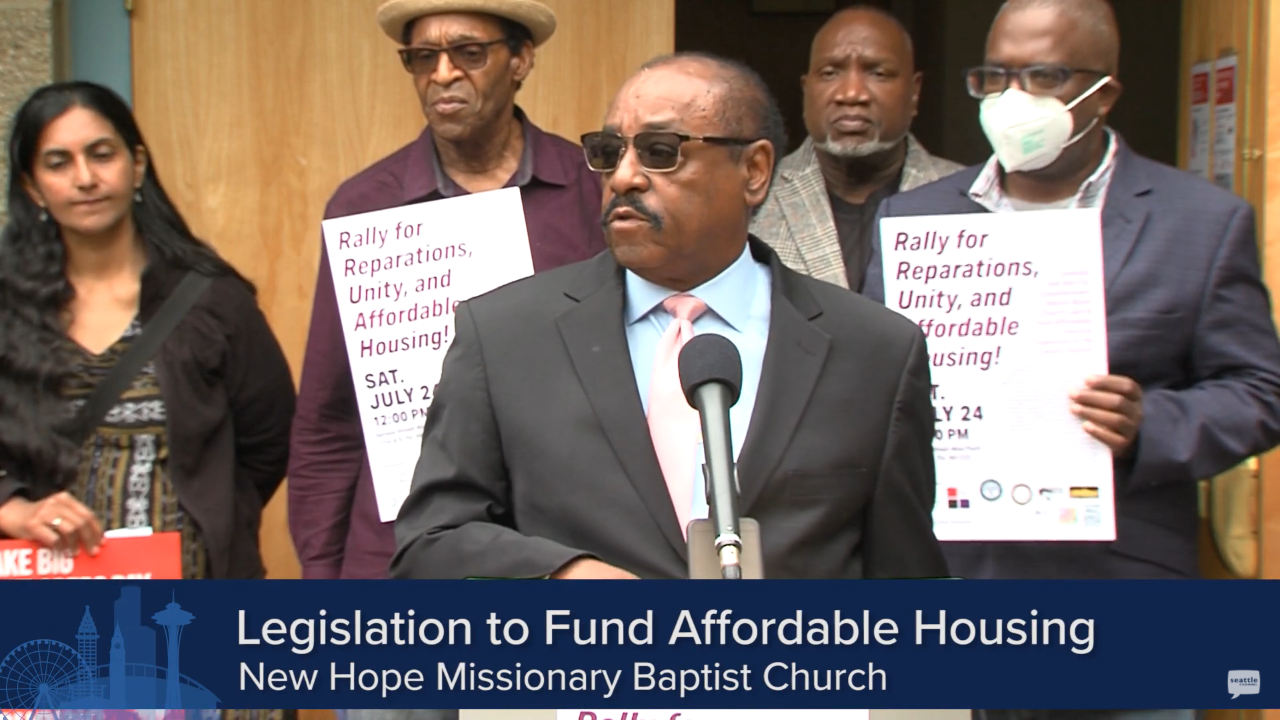
“We are asking you, we are pleading for you to give reparations back, to give back what’s been stolen and taken,” said Pastor Lawrence Willis of True Vine of Holiness Missionary Baptist Church at a press conference Wednesday promoting the rally and cause.
Reparations, which are defined in the dictionary as “the making of amends for a wrong one has done, by paying money to or otherwise helping those who have been wronged,” have been a sensitive topic in the U.S. ever since the American government failed to pay reparations to freed slaves after the end of the Civil War. The idea to redistribute some 400,000 acres of Confederate land among the 3.9 million newly liberated slaves was developed by a group of twenty Black leaders in Savannah, Georgia, eleven of whom had been born free in slave states and thus would not have benefited from the action — though they faced racism and prejudice throughout their lives. Their petitioning resulted in Special Order #15, which was signed into law by President Abraham Lincoln. Sadly, the act was overturned after Lincoln’s death by Andrew Johnson, setting into motion a pattern of ignoring or breaking promises made to Black Americans and advancing discriminatory policies favoring wealthy, mostly White landowners, some of which like exclusionary zoning and the mortgage interest tax deduction persist to this day.
After decades of stagnation in the Federal government, could cities lead the way for reparations for Black Americans?
As gentrification continues to tighten its grip on Seattle, it is unsurprising that Black residents and allies are stepping up calls for reparations for harms that have been done, but the evolution in rhetoric can also be linked to changes in national discourse around reparations. This spring the U.S. House of Representatives voted out of committee for the first time ever HB 40, a bill requiring the Federal government to study how it could undertake reparations for descendants of enslaved Americans.
At around the same time, Evanston, Illinois attracted national headlines when it passed its Local Reparations Restorative Housing Program granting qualifying households up to $25,000 for housing down payments or home repairs. According to the City of Evanston, in order to be eligible for the program, individuals must have lived in Evanston between 1919 and 1969 or be a direct descendant of someone harmed by discriminatory housing policies or practices during this time period. People who have lived in Evanston after 1969 and can demonstrate discriminatory housing practices by the City may also be eligible.
Seattle also has a history of discriminatory housing policies harming residents who are Black, Indigenous, and people of color (BIPOC). The recently rally for “reparations, unity, and affordable housing” was spurred by an op-ed published in the Seattle Times by Reverend Robert Jeffrey Sr. of New Hope Missionary Baptist Church.
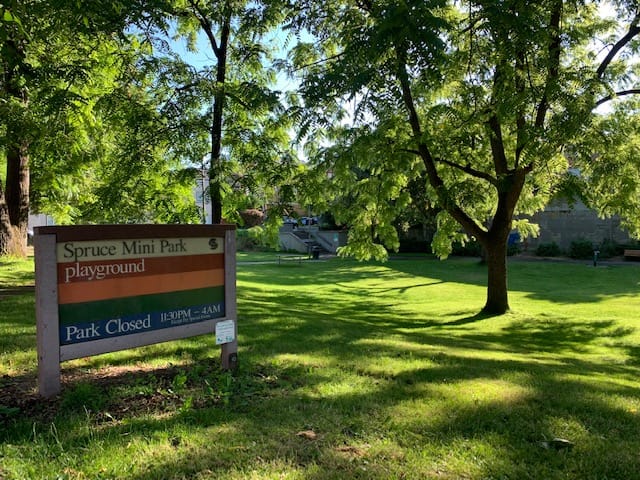
The op-ed makes the accusation that in 1969 the City of Seattle “forcibly took ownership” of two church properties “under the threat eminent domain and condemnation” to create Spruce Mini Park. Other Black property owners sold their land to create the park as well. Rev. Jeffrey is now calling for the City to return the land to the church or pay reparations for what was taken. In addition, he is demanding that City commit to $10.7 million of funding for the New Hope Family Housing Project, an 87 unit affordable housing development planned on land held by the church that is intended to provide housing to former residents of the Central District who has been displaced. Should the city opt not to return the land itself to the church, Jeffrey is currently pursuing an appraisal of the park’s land value for compensation.
“Why shouldn’t we quantify the pain?” Rev. Jeffrey asked. “We are tired of people estimating our pain and then throwing chump change at us.”
Councilmember Sawant has promised to put legislation in front of the City Council naming both of New Hope Missionary Baptist Church’s demands for reparations and additionally committing the City to paying compensation to “others who suffered under the racist urban renewal programs of the 1950’s, 60’s and 70’s.”