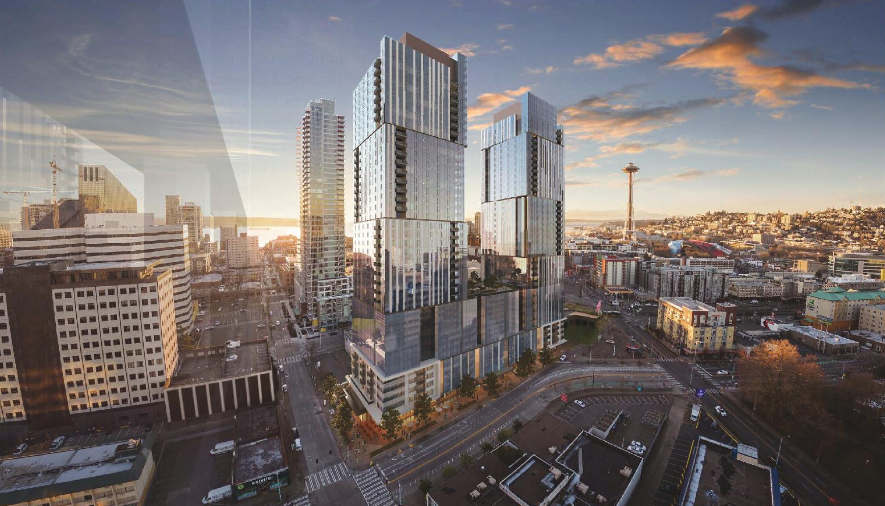
Seattle recently rezoned large swaths of Downtown and South Lake Union and the University District in the hopes of increasing development capacity for new development and delivering affordable housing. The rezones were paired with Mandatory Housing Affordability (MHA) requirements giving a choice to developers to build affordable units or pay the City a fee to create affordable housing units instead. The MHA program applies to most new multi-family residential and commercial development, though the rates differ by zone and use.
Before passing the Downtown and South Lake Union rezones, Councilmember Rob Johnson (District 4, Northeast Seattle) sponsored a provision (referred to as the “opt-in provision”) allowing developers with vested development projects to revise their project proposals so as to use added development capacity from the rezone changes if they choose to voluntarily participate in the MHA program. In other words, developers could benefit from the zoning changes without having to restart the permitting process while generating affordable housing that may not otherwise be realized. Some developers already appear poised to do just that.
Yesterday, Councilmember Johnson held a press conference at a windswept parking lot of a former gas station in the University District to highlight how the Downtown and South Lake Union opt-in provision is already generating serious interest amongst developers and how one developer in the University District is canceling his building permits to take advantage of the recent neighborhood rezone.
Councilmember Johnson reported that developers of seven projects in Downtown and South Lake Union have expressed interest in modifying their projects to use the opt-in provision. According to analysis by the Seattle Department of Construction and Inspections (SDCI), those seven projects are estimated to deliver $25 million for affordable housing using the in lieu fee payment option available under the MHA program. The SDCI estimate also suggests that approximately 320 affordable housing units could be produced using a mix of the in lieu fee payments and leveraging other sources, such as federal tax credits geared toward affordable housing developments. While the fee in lieu payments mean that affordable housing will not be provided on-site, City analysis shows that more affordable housing will be created in absolute terms due to the financing arrangements and design of the MHA program. Where affordable units are located by the City is through specific criteria, such as proximity to where the fees were derived, proximity to high quality transit, and proximity to an urban village or urban center.

Under the MHA framework, any units created through the fee lieu payment option are required to be rented to households with incomes at or below 60% of the area median income for at least 50 years or sold as ownership units to households with incomes at or below 80% of the area median income for a minimum period of 50 years. The United States Department of Housing and Urban Development (HUD) modifies area median income limits by households annually. For a single individual, an income of $43,680 would constitute 60% of the area median income whereas a family of four making an income of $57,600 would.