Seattle City Council district boundaries must be adjusted to rebalance population levels ahead of 2023 elections, and just how to accomplish that is proving quite controversial. The Seattle Redistricting Commission first joint map proposed to send part of Magnolia to District 6 — a move intended to bring down the population of District 7, the most overpopulated district by far following the 2020 Census.
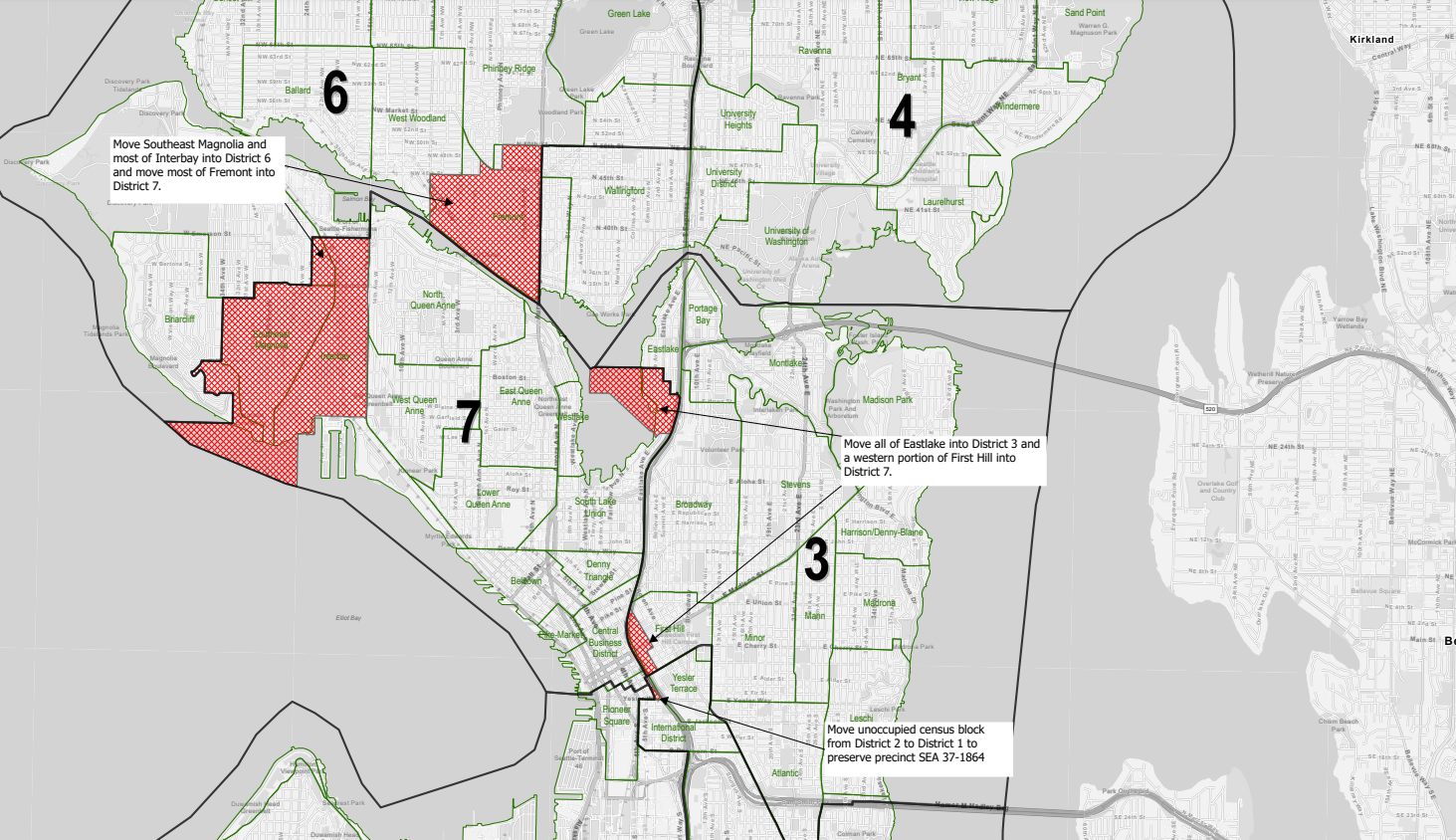
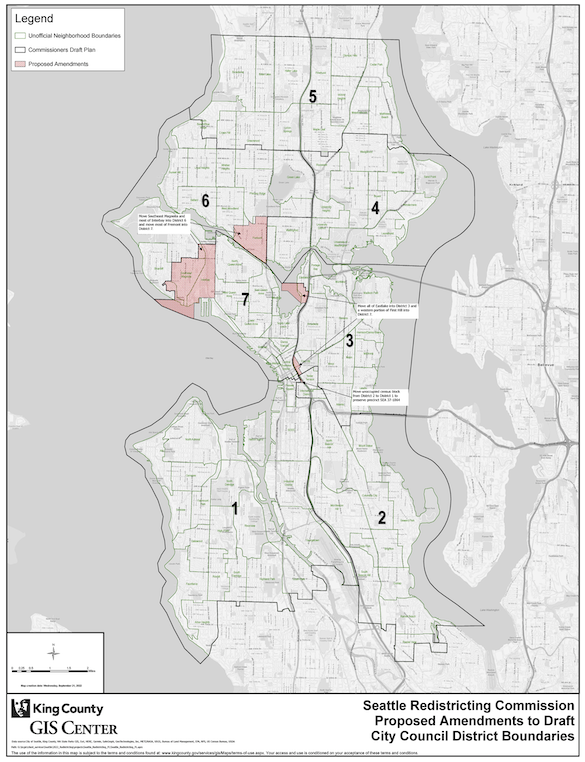
Splitting Magnolia between D6 and D7 earned the ire of a vocal contingent of neighborhood residents, and that backlash pushed Commissioner Rory O’Sullivan to propose a map moving all of Magnolia and Interbay into District 6 and sending most of Fremont and a slice of First Hill to D7 to balance population levels. It also consolidated the Eastlake neighborhood in D3. The O’Sullivan’s amendment earned the support of his colleagues yesterday in a 4-1 vote, with only Commissioner EJ Juárez opposed.
“I’m uncomfortable moving forward and voting on a proposal that a community has not had adequate time to provide input, especially when we’re splitting a neighborhood [Fremont] into three districts, which something we don’t do in any other place in this map,” Juárez said ahead of the vote. “I’m struggling with why we are choosing to split one neighborhood again with no real reason. I don’t understand the introduction of a Fremont split… I have not heard a compelling reason.”
Juárez also pointed out that this was a significant departure from the Redistricting Justice for Washington Seattle maps that had the most positive comments throughout the process, which is why the commission’s initial proposal had largely been based on that map. O’Sullivan had contended that the racial justice focused organization hadn’t lodged any specific complaints against the revision in public comments to start the meeting, but Juárez countered that wasn’t the same as consent or favoring this revision to their map.
“While we didn’t hear anything today, I think it would be a shame for us to throw out the months of activism, the month of engagement from those folks, who had a very concrete map that is incongruous with the lines proposed here,” Juárez added.
While the move may have placated Magnolia activists, it could also kick up a fresh round of backlash from new quarters. The Fremont neighborhood will be divided between D7, D4, and D6 in the new map, since a handful of blocks considered to be part of northern Fremont remain in D6. The strip of the neighborhood east of Aurora Avenue, which is currently in D4, was not included in the swap, and remains in D4. In effect, Commissioners are saying Magnolia’s unity is more important than Fremont’s. Adding a small D7 beachhead north of the ship canal also appears to clash with City Charter’s guidance that “to the extent feasible, new boundaries shall follow recognized waterways and geographic boundaries.”
Granted no map is going to make everyone happy or keep every community wholly together. But it is interesting to see who exactly is sacrificed to expediency and who succeeds in getting united in a single district to amplify their political voice.
While offering some criticism of D7 crossing the ship canal, Commissioner Greg Nickels (a former Seattle Mayor) appeared to flatten the local differences saying that all neighborhoods are diverse and contain both single family and multifamily housing. Magnolia is about 88% White and predominantly zoned for single family housing. It also one of the larger areas of Seattle without a designated urban village growth center, a vestige of earlier neighborhood activism in the 1990’s. A big chunk of Fremont, on the other hand, is within an urban village, and a relatively fast-growing one, which is split across two districts.