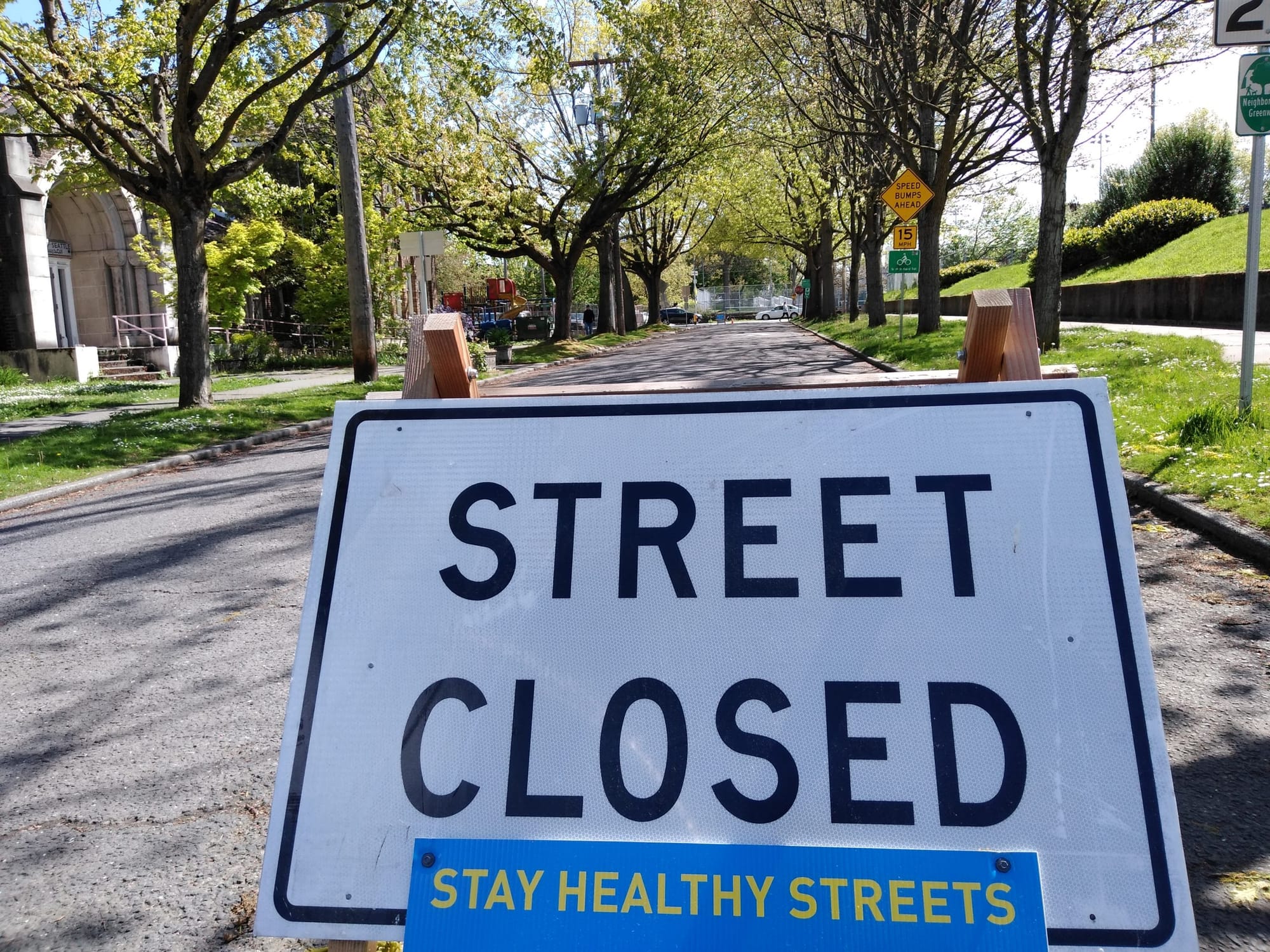
On Friday, when the Seattle Department of Transportation (SDOT) announced its third set of streets open to people walking and rolling, calming them for people on bicycles as well, the list did not include any streets inside Seattle’s densest neighborhoods. Downtown, Belltown, South Lake Union, First Hill, the University District, and Northgate all fall into the category of an “urban center” neighborhood and no plans have been announced for the residents in those neighborhoods to more safely use the city’s street space to get around without a car.
Seattle’s streets are serving two vital functions right now: allowing people to exercise, either on the streets themselves or in nearby parks, and to access essential services. The sidewalks aren’t up to this task, particularly in dense areas, nor in neighborhoods that lack them. Seattle’s dense urban centers and urban villages are also some of the most open space-scarce neighborhoods. Fewer than 3% of the land inside urban centers is devoted to parks or open space–contrast that with over 12% of the land outside the urban centers entirely, in Seattle’s single-family neighborhoods.
What urban centers do have is a massive amount of street right-of-way. Over 1,300 acres in urban centers are streets–more than two square miles. That’s over one in three acres devoted to travel and parking lanes. They are currently frozen in amber, an unneeded street system that’s wildly under capacity, encouraging dangerous driving. Sidewalks outside critical neighborhood businesses like grocery stores remain mostly as they existed before a COVID-19 world, despite the intense pressure that is being placed on these spaces. Over a month into the stay-at-home order, we need to act more nimbly to adapt our public spaces to our current needs. This is true absolutely everywhere, but it is felt most acutely in neighborhoods that have the most people living closely together.