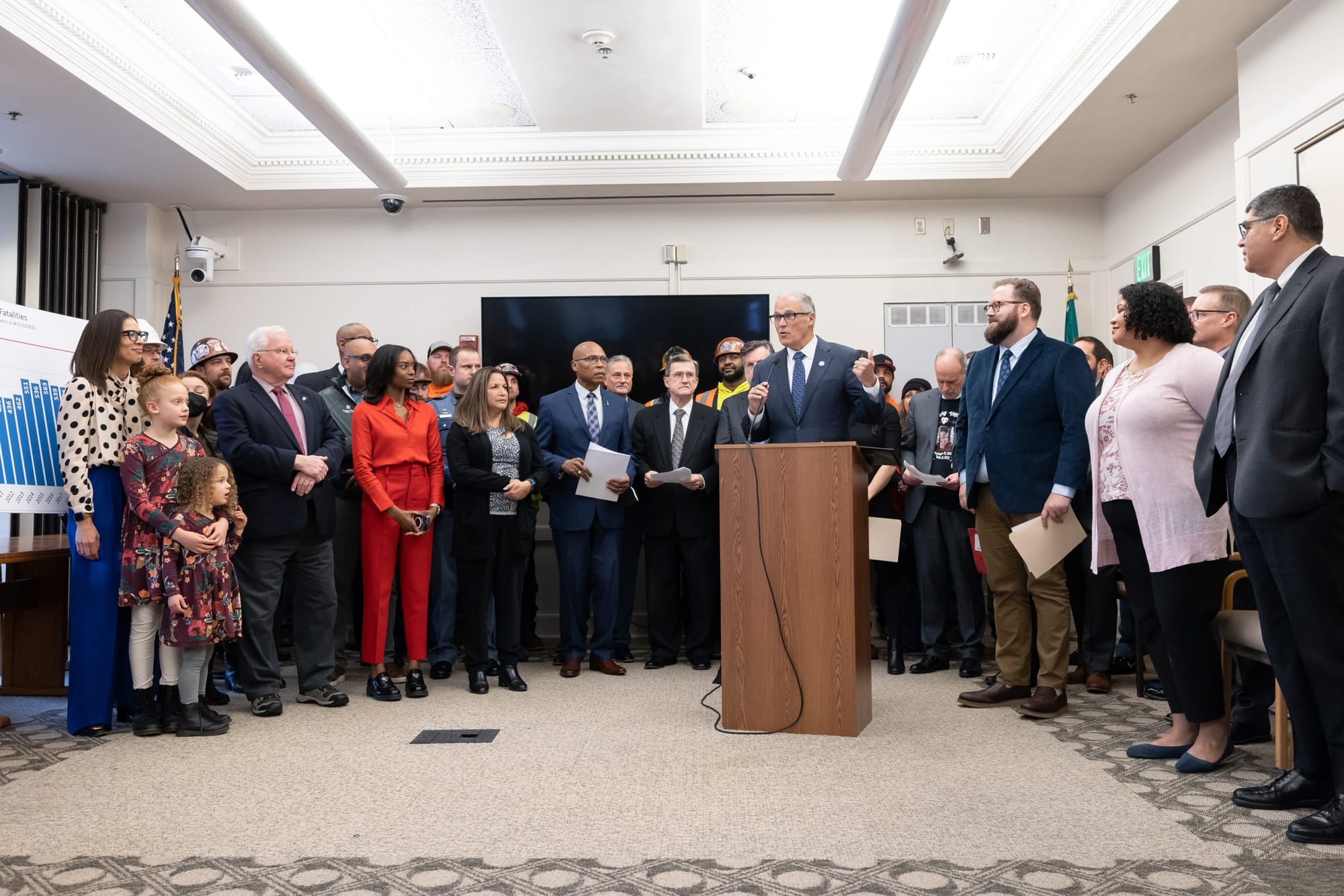
On Thursday, a bipartisan group of leaders held a press conference addressing a new focus on traffic safety during this legislative session. Sen. Marko Liias (D – Edmonds) and Governor Jay Inslee led the way in stressing the need for better education, stricter safety laws, and tighter enforcement of those laws.
The push to improve traffic safety follows news that Washington saw the biggest jump in road fatalities in the country, with 745 people losing their life in 2022 according to the Washington Traffic Safety Commission. That death toll is the highest since 1990 and headed in the wrong direction despite the state’s Target Zero pledge to end road deaths by 2030. Over the past three years, state highways are leading the way with 41% of traffic deaths happening on state routes, which the state government has the authority to redesign.
Dangerous roads and the risk of enforcement
In Inslee’s remarks, he said that impairment was involved in over half of the fatalities, and an emphasis on the danger of speeding ran throughout the press conference. Leaders claimed that addressing behavior could turn the tide of road deaths. However, the absence of funding priority and urgency around fundamentally redesigning our streets suggests their effort will come up short.
Overall, the focus of this bipartisan group of lawmakers and the governor on road safety is gratifying — with a goal of making the roads both be safe and feel safe for all users. However, the emphasis on law enforcement with the attendant risk of unequal treatment based on race and socioeconomics and after a major infrastructure spending bill containing numerous road expansion projects whose underlying goal is car speed and throughput, both key aspects of road design that make them unsafe and undermines spending on safety in the bill.
Safety advocates have been asking for design interventions to slow car speeds and improve sustainable alternatives for a long time. Among them is Paulo Nunes-Ueno, who is transportation and land use policy lead at Front and Centered Coalition.
“The traffic safety epidemic stems from a lack of investment in sidewalks, biking, and transit and from roadways engineered for speed instead of safety,” Nunes-Ueno said in an email.
The inequitable impact of policing is another hurdle to enforcement-centered approaches.
“As we see in cases like the death of Tyre Nichols in Memphis, the culture of policing often results in horrible outcomes for people of color, and it’s unclear whether more enforcement will make a difference in safety outcomes,” Nunes-Ueno added. “Solutions that don’t address the root cause (systemic disinvestment in transit, sidewalks, and bike facilities) are doomed to fail.”
Pulling the lever of more cops to tackle a whole host of disparate issues is a frequent move for Washington’s legislature. Nonetheless, we must be honest that police are also a source of hazards on the road, especially when it comes to police chases, which frequently lead to collisions with bystanders. Incongruously, Sen. John Lovick (a former state trooper) has caved to police lobbying and proposed a bill rolling back reform limiting the use of police chases even as he spoke to the need for safer roads at the press conference.
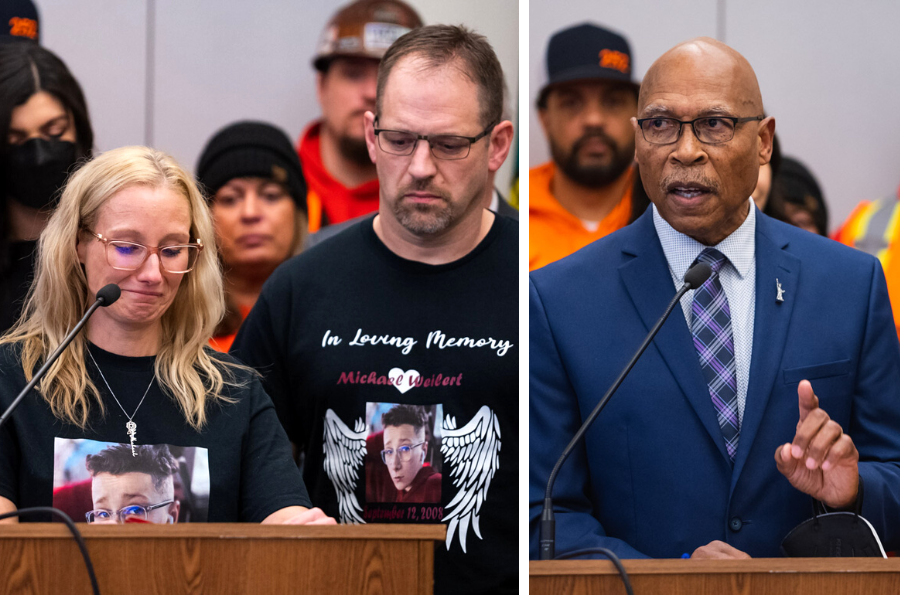
After passing the 17-billion-dollar Move Ahead Washington infrastructure package last session, this session’s effort is primarily focused on behavioral changes to improve safety on Washington’s roads. To a question regarding whether this new focus on safety would impact the priority of Move Ahead spending, Sen. Liias said that safety remains a top priority, while admitting the infrastructure bill had to balance many goals. Thus far there’s no indication additional funds will be shifted toward a fundamental redesign of Washington’s deadliest streets.
Leading cities for traffic safety around the globe have achieved zero fatalities and won this hard-fought victory through dramatically redesigning roads to be safer and more forgiving to human mistakes. They often pair these changes with education and laws less permissive to traffic violence. But street design is the cornerstone.
State lawmakers have many safety-themed bills lined up, but most proposals either avoid street design questions or only put money forward that is sufficient for small-scale pilot programs. The road safety crisis is too dire to slow-walk solutions.
Proposed legislation
While the work to propose and pass bills focused on traffic safety is in progress, some of the ideas highlighted were: lowering the legal blood alcohol content to 0.05%, increasing state trooper presence (including signing bonuses of $10,000 and $15,000) to enforce laws (particularly speeding), speed cameras for work sites, reexamination of drivers licenses for people breaking laws, and a “young/old” law that would extend the age to skip drivers education from 18 to 25 and may increase the frequency of evaluation for older drivers.