The Washington Supreme Court ruled this morning that Initiative 976 violated the state constitution–twice, in fact–and struck it down accordingly. As a result, transportation agencies across the state will keep a key funding source: motor vehicle license fees and excise taxes–or car tabs, for short.
Implementation of I-976 had been on hold due to an injunction from a lower court, which determined appellants were likely to prevail on the merits. Had the state supreme court ultimately gone the other way, however, transportation agencies would be grappling with colossal budget shortfalls on top of the enormous strain the Covid pandemic and recession has already placed them. We’d be looking at even more massive cuts than we already are due a projected $4.2 billion hit I-976 would inflicted in the next six years.
Luckily, local huckster Tim Eyman is not very good at drafting ballot measures, despite the enormous quantity in output–and only 2 of 11 he’s passed have survived completely intact. The court ruled I-976 violated both the single-subject rule and the accurate-title rule:
Under our constitution, “[n]o bill shall embrace more than one subject, and that shall be expressed in the title.” WASH. CONST. art. II, § 19. Initiative Measure 976 (I-976) contains more than one subject, and its subject is not accurately expressed in its title. Accordingly, it is unconstitutional.
Washington Supreme Court
The ballot title rule was violated in part because I-976, if enacted, would have only lowered car tab fees to $43.25, not the $30 that Eyman–like a shady used car salesman–advertised. Another issue was the “except voter-approved charges” language was confusing and may have unfairly tilted the scales in favor of passage, since voters may have not fully understood what they were approving.
The average informed lay voter would not think that “[t]his measure would . . . limit annual motor-vehicle-license fees to $30, except voter-approved charges” would mean charges previously approved by voters would be eliminated. As the League of Women Voters notes, many voters have voted on such measures in the past, and “the average-informed voter encountering the phrase ‘except voterapproved charges’ would expect that these earlier votes were the reason for the ‘except’ clause [and] would have no reason to anticipate that I-976 would implicitly repeal their votes while telling them that ‘voter-approved charges’ were ‘except[ed].’”
Washington State Supreme Court
The court opinion noted that while I-976 narrowly passed statewide, in some jurisdictions it was soundly rejected, particularly those that heavily relied on car tab funding to maintain their transportation systems. “The initiative passed statewide with about 53% of the vote, though it was rejected by about 53% of the voters in the Sound Transit region, about 60% of King County voters, and about 70% of San Juan voters, who depend heavily on ferries funded by motor vehicle excise taxes,” the opinion states.
“The court’s decision to overturn Eyman’s I-976 is a win for transit riders and for everyone in Washington state who benefits from a functional transportation system–and that’s all of us,” said Katie Wilson, general secretary of the Transit Riders Union. “It’s also a win for democracy, affirming the rights of voters in cities and transportation districts around the state to make their own decisions about how to fund transportation improvements and public transit. Now it’s time to get to work. Fully funding an equitable, sustainable transportation system will be essential to our state’s economic recovery from the Covid-19 recession.”
How did we get here?
This isn’t the first time Tim Eyman has tried to impose a $30 car tab fee limit across the state. In 1999, he ran and the state passed a similar measure: I-695. Again, Eyman tripped up the single-subject rule by including a provision in I-695 that required voter approval for all new taxes. The state supreme court struck that down but allowed the $30 car tabs to remain–though the state legislature had already enacted the $30 cap by that point.
Incidentally, state Democratic leaders have been willing co-conspirators in Eyman’s crusade against car tab fees. While the court was considering I-695, Governor Gary Locke (a Democrat) called a special session to pass $30 car tabs through the state legislature, and Attorney General Chris Gregoire (a Democrat) defended $30 car tabs in court, just as Attorney General Bob Ferguson (a Democrat) did this time around with unfortunate gusto. Gregoire went on to become governor herself and steamrolled Seattle to build a massively expensive new SR-99 tunnel through Downtown despite a more visionary plan from Cary Moon and the People’s Waterfront Coalition to rely on transit and a multimodal surface boulevard instead. These are the decisions you make when you prioritize cars above all else.
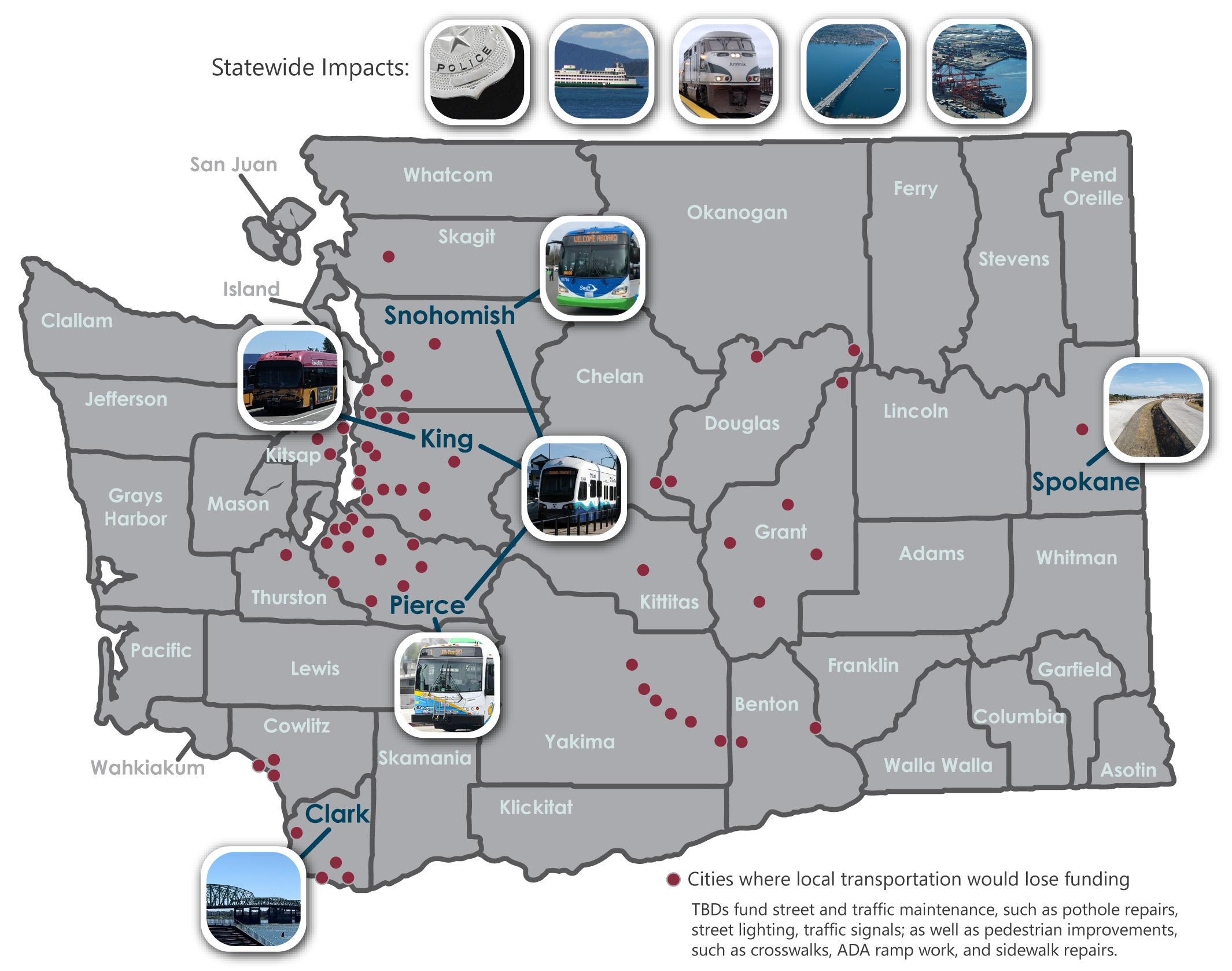
While car tab fees were set at $30 in the aftermath of I-695, local jurisdictions were able to raise them back up with ballot measures, often via transportation benefit districts. Hence by 2019, 62 different jurisdictions across the state relied on car tab fees to fund basic transportation and transit service. And knowing Eyman was lurking, the savvy one secured those fees with bonds.
Eyman attempts to checkmate Sound Transit
Eyman attempted to make a broader impact with I-976 than I-695, and that’s part of what tripped up the measure. Section 12 of the measure seeks to require Sound Transit to retire its bonds as soon as possible so that it can wind down the fees that back it, but the court ruled this is definitely a second subject. Eyman sought to add this provision in order to get around the state constitution protection of bondholders. Since Sound Transit has already bonded off future motor vehicle excise tax revenue, the agency constitutionally would not be able to lower its fees until those bonds are repaid.