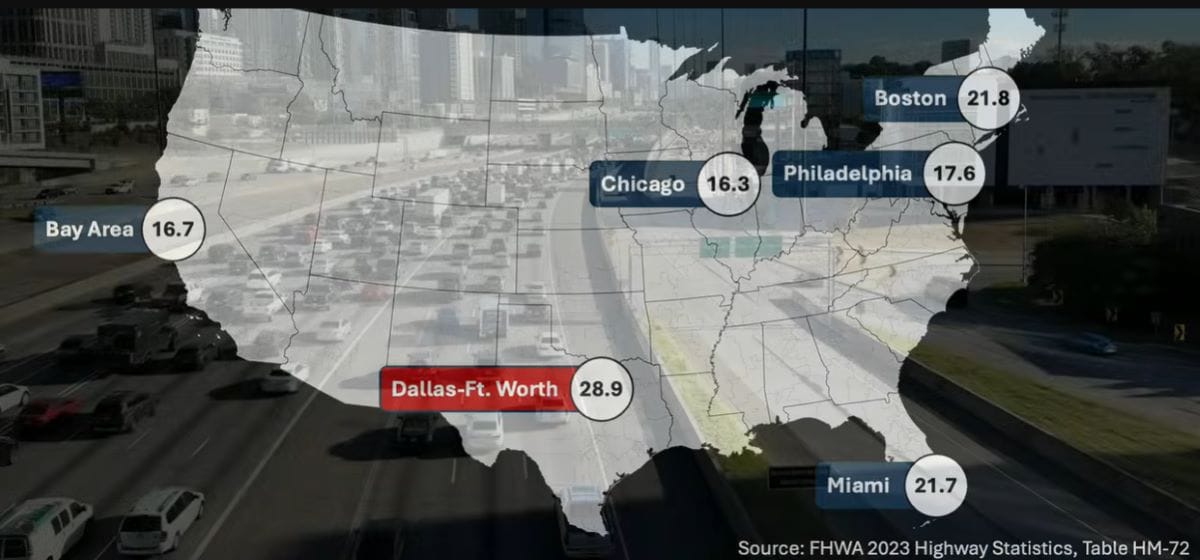
Ray Delahanty of CityNerd recently rebutted Conor Dougherty’s New York Times recent pro-sprawl op-ed. In a video titled “Density vs. Sprawl: A Spicy Top 10 List,” Delahanty shows how density generates high-amenity, livable neighborhoods that are far less car dependent than the sprawling suburbs that Dougherty celebrates in his hot take. Sprawling areas that seem affordable largely achieve that by requiring a lot of driving, which spikes transportation costs for residents, largely off-setting their housing savings while driving up climate pollution.
CityNerd’s top ten list shows a variety of housing affordability outcomes. A high-density cross-section of San Francisco or Los Angeles do have high housing prices (as does sprawl in those metro areas), but similarly dense cross-sections of Chicago and Philadelphia are relatively affordable. And Delahanty notes that suburbs obtain the appearance of affordability only temporarily and in mirage fashion: they do not have a dense enough tax base to cover maintenance needs over the long term, which leads Strong Towns leader Chuck Marohn to call sprawling suburbs a Ponzi scheme.
I wrote about how we need more sprawl and the word itself is sorely misunderstood. It took me a while to get here, but I got here. Find your hate-read here: www.nytimes.com/2025/04/10/m…
— Conor Dougherty (@conordougherty.bsky.social) April 10, 2025 at 7:47 AM
[image or embed]
Seattle did not make the top ten population density list for U.S. cities. The densest three-kilometer radius circle of Seattle had a population just over 152,000 in Ray’s analysis. That’s less than half the density of the densest sections of LA and San Fran and a fourth the density of New York City’s densest cross-sections. In fact, Seattle’s figure was modest enough to be beat out by the densest section of Las Vegas. Clearly, Seattle has some work to do.