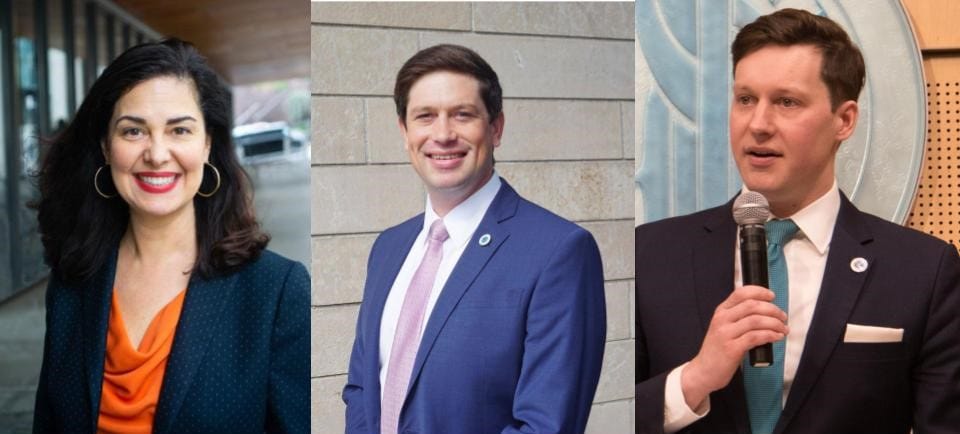
Seven seats on the Seattle City Council are up for grabs this year and the races are starting to firm up ahead of the May 19th candidate filing deadline.
Four sitting councilmembers — Lisa Herbold (District 1), Kshama Sawant (District 3), Alex Pedersen (District 4), and Debora Juarez (District 5) — have declined to run for re-election. The open seat left in their respective districts has led to some crowded races, which The Urbanist will pick apart in subsequent articles. (Part 2 on Districts 1 and 3 is here.)
For now, let’s look at the three races with incumbents (click to jump to the race):
- District 2: South Seattle
- District 6: Ballard, Fremont and Magnolia
- District 7: Downtown and Queen Anne
But first, a word about the dynamics of the race. Much has been made about the unpopularity of Seattle City Council, especially by groups who’d love to shift the Council in a more conservative direction. Polling does suggest high levels of voter frustration that has continued to be directed at the Council more so than the Mayor — even if Seattle’s strong mayor system gives the executive far more control over issues like homelessness and crime over which voters are particularly frustrated.
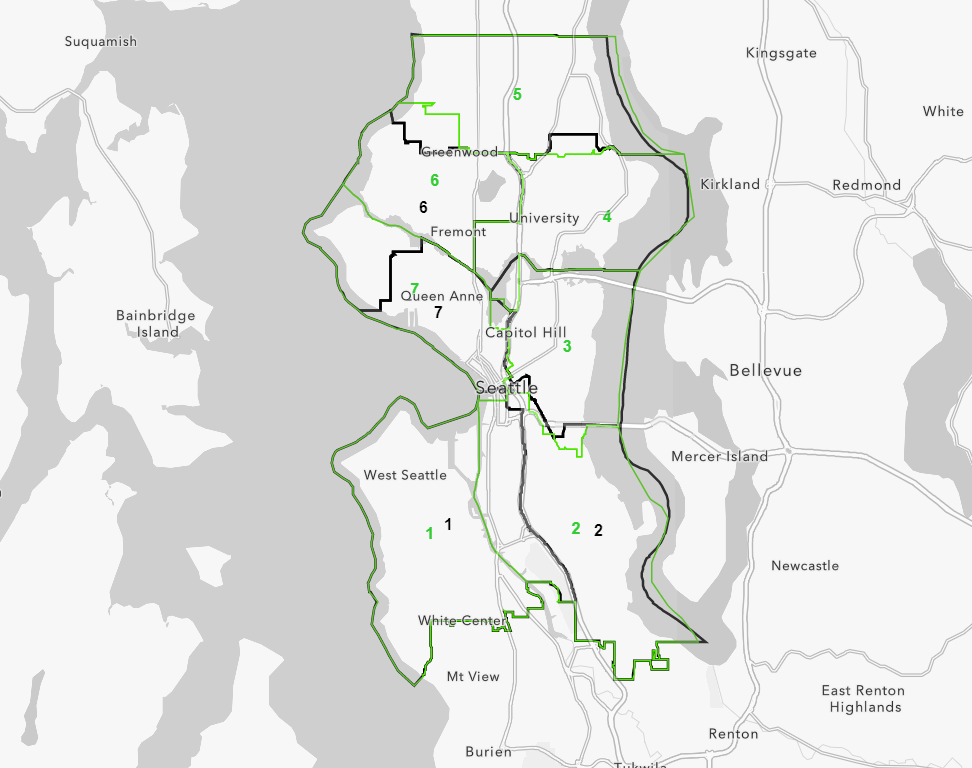
Nonetheless, the three incumbents in question seem pretty well positioned to win in their races. The exception could be Dan Strauss since his district’s voting patterns have shifted to the right following redistricting that added much of Magnolia to District 6. As we’ll see below, Strauss’s stiffest challenge is coming from the right, and could be well-resourced.
We will be touching on the fundraising numbers since successfully running for office takes resources, but Seattle is also lucky to have publicly-funded campaigns via its Democracy Vouchers program. Each registered Seattle voter gets four $25 vouchers to give to the municipal candidates of their choice. Spend them while you can, because once the $5.25 million available to fund campaigns this year is spent, remaining vouchers lose their value. The voucher program has helped expand the field of candidates, encouraging more people of color and working class Seattleites without personal fortunes to run.
In order to qualify to accept Democracy Vouchers in district-based council races, candidates must gather 150 qualifying contributions of at least $10 and signatures, with at least 75 contributions and signatures coming from within the candidate’s district. The other part of qualifying is to accept spending limits in the race, which are fairly strict at $93,750 for the primary and the same amount for the general (assuming they advance by finishing in the top two).
Ironically, those strict spending caps have magnified the impact of independent expenditure campaigns from political action committees (PACs), as Michael Charles and Michael Fertakis of progressive-leaning political consulting firm Upper Left Strategies argued in a recent op-ed. In the 2019 City Council elections, PAC’s spent nearly $4 million on independent expenditures, which was a fourfold increase from 2017, they noted. The Citizen United Supreme Court ruling enshrines the right of PACs to raise unlimited amounts of money to influence elections. As a result, outside spending may end up exceeding that spent directly by campaigns, with the aid of the Democracy Voucher program.
The biggest players in the independent expenditure game are typically PACs aligned with big business and real estate interests, but labor unions usually make significant investments as well. That promise of investments is why certain endorsements carry such weight.
The two endorsements that carry the biggest weight in local elections are the Seattle Times endorsement on the centrist (homeowner) side and The Stranger endorsement on the progressive side. The vast majority of races see the two candidates with those respective endorsements advancing, although there is the occasional exception. (Of course, The Urbanist is partial to our own endorsements and hope they will carry an increasing sway as well.)
Labor endorsements are also important given the resources they entail, including not just PAC money but also get-out-the-vote operations. And business group endorsements can signal a wave of PAC spending is coming. After their 2019 Amazon money bomb debacle, the Seattle Metropolitan Chamber of Commerce said it won’t do endorsements and no longer has its own aligned PAC, but usually other PACs arise to channel corporate and megarich money to similar purposes. Former Councilmember Tim Burgess’s People for Seattle PAC was an example of this in recent cycles. Burgess is now Director of Strategic Initiative in the Harrell Administration after helping elect him with his fundraising efforts.
But that’s enough table-setting now onto the three council races with incumbents running.
District 2: South Seattle
Tammy Morales is running for a second term and she appears well-positioned to win it. She has qualified for democracy vouchers and also has a big fundraising lead.
Tanya Woo appears to be her primary competition. A Rainier Beach resident well-connected in the Chinatown-International District community, Woo was a vocal opponent of the homeless shelter expansion at the southern edge of Chinatown, arguing too many homelessness services were being concentrated in the neighborhood and that the community hadn’t been sufficiently consulted. Woo’s family owns the Louisa Hotel in Chinatown and she grew up in Beacon Hill.
King County Executive Dow Constantine ended up canceling the shelter expansion and pivoting to backing a proposal to add a light rail station on the site via his alternate proposal to site a new light rail line on either side of Chinatown rather than in the neighborhood. Woo was neutral on the station siting decision, but Morales came out in favor of studying that late-breaking “North and South of CID” alternative backed by Constantine and Mayor Bruce Harrell.
Also running are Isaiah Willoughby and Dawn Marie Lucas, but have reported zero fundraising to the PDC thus far.