This week’s Transpo Notes roundup touches on a mix of bus, train, and driving stories, including:
- The hiring of Sound Transit’s next CEO;
- Naming of the forthcoming Link stations;
- Free transit passes for University of Washington employees;
- Noisy escalators and cracking tiles at new Link stations;
- Park-and-ride demand remains low;
- New Sounder service agreements with BNSF; and
- Minor adjustment to Route 79 in Roosevelt.
Julie Timm named new Sound Transit CEO

The Sound Transit Board hired Julie Timm last week as the agency next CEO. Timm is expected to take the helm on September 26th and serve in the role until at least December 31, 2025. A one-year extension of the contract with Timm under the same terms is possible. There are high hopes that Timm will steady the ship at Sound Transit as it moves forward with vast transit expansions and tackles piling up rider experience issues.
Timm is currently the CEO of the Greater Richmond Transit Company in Virginia. Though the agency is considerably smaller than Sound Transit, it does operate a bus rapid transit line under the Pulse brand with potential future expansion. Timm has been in the role since 2019 and served in other administrative transit roles over the past decade, including as chief development officer for WeGo Public Transit in Nashville, Tennessee from 2016 to 2019. She’s highly regarded as a transit executive, so that should come as welcome news to Puget Sound transit riders.
During the meeting on Thursday, Timm said, “I am humbled and grateful to be part of this team — it’s an amazing team — that’s leading a legacy of generational investments in the region that will lead the country.” She also added somewhat jokingly, “The first and hardest decision that I’m going to have, as I’ve talked with many of you, is where to live and that might be one of my first controversial decisions moving forward.”
Timm’s compensation is very competitive with traditional benefits, a fully subsidized ORCA transit pass, $375,000 annual salary, and raises of 3.5% or more per year.
Sound Transit names Federal Way and Downtown Redmond Link stations
At last week’s Sound Transit Board meeting, officials settled on permanent station names for the Federal Way and Downtown Redmond Link Extensions. Most station names had consensus before the meeting, but there was disagreement on what should be the name for station in the West Hill area of Kent that was tentatively known as “Kent/Des Moines.”
For the Kent/Des Moines station, King County Councilmembers Dave Upthegrove and Joe McDermott supported naming the station “Highline College” over objections from Kent Mayor Dana Ralph. Upthegrove’s rationale was that it better described its location near Highline College, a known landmark in the area much like the University of Washington at UW Station in Seattle. Another set of benefits from the college name was that it would avoid confusion with the existing Kent Station several miles to the east and highway named “Kent-Des Moines Road” to the north.
An amendment sponsored by Upthegrove to name the station “Highline College” failed. Instead, the adopted motion settled with “Kent/Des Moines Station” along with “Star Lake Station” and “Federal Way Downtown Station” for the Federal Way Link Extension.
Conversely, King County Councilmember Claudia Balducci was successful in getting the Redmond Marymoor station altered in committee earlier in the month despite staff recommending the simple “Marymoor Station” name. Balducci lobbied for “Marymoor Village Station” since it would better set a place name for a growing urban district and remove ambiguity of its location (the station doesn’t fall within Marymoor Park). The other station name approved for the Downtown Redmond Link Extension was “Downtown Redmond Station.”
One oddity between the two station naming efforts is the inconsistency in the “Downtown” syntax: compare “Downtown Redmond Station” versus “Federal Way Downtown Station.” Going forward, Sound Transit may need to do some cleanup work on how station names include “downtown” and “city center” identifiers appear in place names.
University of Washington staff gets free transit passes
On July 1st, all employees of the University of Washington will finally benefit from unlimited, fully subsidized transit passes. University employees who were not already covered by union agreements will automatically have a U-PASS loaded onto their Husky Cards at no charge, allowing free travel across regional transit providers, such as Sound Transit, King County Metro, Kitsap Transit, and Seattle Monorail (the pass does not cover Washington State Ferries). The victory for staff has been a hard fight effort for many years following subsidized transit pass agreements with unions as well as pressure from the City of Seattle, environmental groups, and Seattle Transit Riders Union.
In March, the university’s board of regents finally approved the measure, granting the employee benefit to non-union professional staff and faculty. That means over 10,000 additional university employees will be able to take advantage of the transit benefit, saving workers potentially thousands of dollars in annual transportation costs (e.g., parking fees, gas, and maintenance) right as gas prices are soaring.
This benefit extends to all university staff at the University of Washington’s three campuses in the U District, Bothell, and Tacoma as well as Harborview Medical Center and UW Medicine facilities. As one of the largest employers in Seattle and Puget Sound, the impact of this policy will undoubtedly be substantial in further tilting the scales toward transit use among employees for work and personal trips. Transit commute rates among university employees is already relatively high with 48% of staff and 36% of faculty riding buses and trains, but the cost of the pass had left many on the sidelines.
Staff that were paying for a U-PASS add-on will automatically have payments stop on June 30th.
Sound Transit escalator noises and tile cracks in new stations
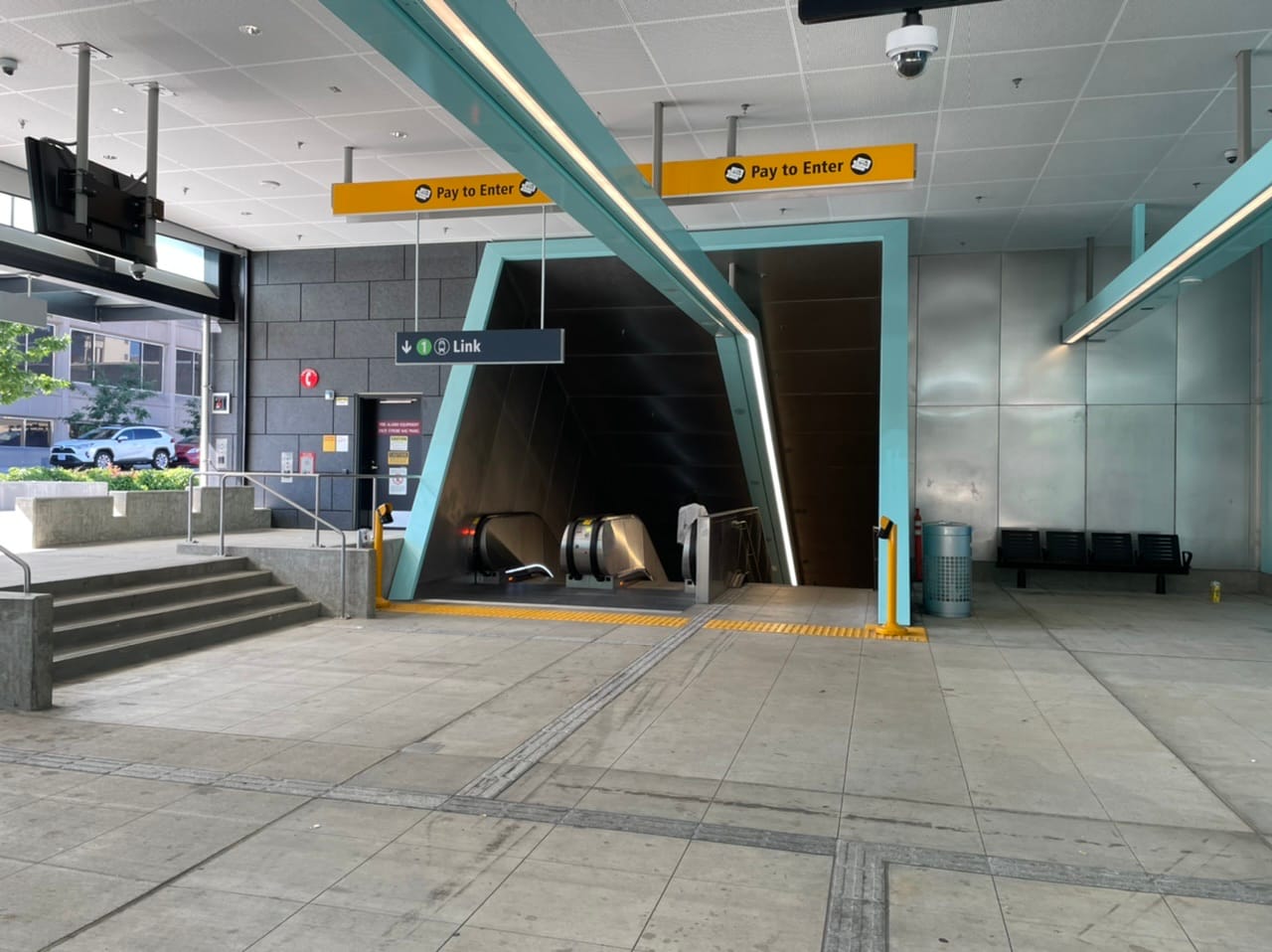
Sound Transit’s new Link stations seem to be struggling in their first year. Escalators are making very squeaky sounds and cracks have started to form in tiles on platforms and other station areas. We checked in with Sound Transit to find out if they are things to be concerned about.
John Gallagher, an agency spokesperson, said that noises coming from escalators generally shouldn’t be a concern. “Typically, when you hear some type of screeching, it is generally a step grinding across the skirt brush and typically requires a simple adjustment and is not a major repair,” he said when reached by email. “As always, we encourage passengers to alert Sound Transit of any inoperable vertical conveyance units or concerns regarding these assets.”