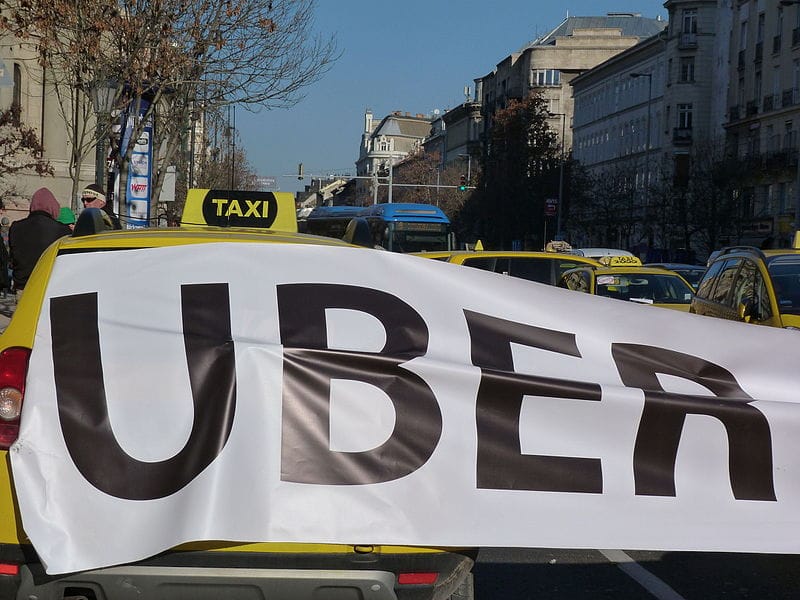
Uber has been in the news lately for offering cities a smidgen of their data on traffic patterns. Like so many things with Uber, the company insists what it’s doing is truly and utterly revolutionary. Traffic data management seems to be another scheme in Uber’s overarching plot to worm its way into being an indispensable part of the transportation system while effectively monopolizing the taxi market.
Uber also seems to insinuate it could replace mass transit–although perhaps not rail transit–and do a better job than cities in delivering it, which is ludicrous. Several issues exist with Uber’s whole enterprise and should make cities leery of promoting it and counting on it for their transportation needs.
- Uber is losing massive amounts of money, including a $2.2 billion loss in a nine-month stretch last year.
- Uber seems to be gambling everything on autonomous cars. Specifically, Uber must introduce autonomous cars soon (say within a decade) and ahead of their competitors or their business model may collapse. By rolling out a driverless car network first, a competitor could eat Uber’s lunch.
- Introducing an Uber driverless fleet would cost hundreds of thousands of jobs.
- Uber drivers aren’t going to be thrilled about being replaced by machines, which would likely be a public relations nightmare if and when it does happen.
- Uber is seeking a monopoly on taxi service. Anti-trust laws are a thing, even if conservatives and neoliberals alike have weakened or neglected to enforce them.
- If Uber were to achieve a monopoly, it could easily raise prices. Monopolies are associated with price gouging rather than a healthy capitalist market where competition drives down prices and fuels innovation.
- Uber derives part of its competitive advantage from tax dodging schemes, including insisting it’s a transportation network company, not a plain old taxi company like it is, thus avoiding expensive taxi medallions or insurance. Once cities inevitably re-calibrate the tax code, that advantage will diminish.
- Statistically, Uber service discriminates against African-Americans leading to 35% longer wait times.
- Uber does not lower drunk driving death rates according to the most credible study despite Uber loudly proclaiming itself a drunk driving solution.
- It’s a spiffy app though.
A Monopoly You Say?
In a The Week article titled “How Uber could become a nightmarish monopoly“, Ryan Cooper suggested Uber achieving a taxi monopoly would allow the company to implement far-reaching price discrimination, a form of price gouging furthered by the massive amounts of data it constantly collects on its users.
With traditional cab companies collapsing and most cities reticent to tackle ride-sharing apps head on, Uber would have a chance to dominate the American taxi market to an unprecedented degree. And because any such nationwide taxi monopoly would also have powerful high-tech tools at its disposal, it could be the first company in history to be able to attempt perfect price discrimination — adjusting individual prices so that every taxi customer pays as much as she can afford.
That scenario may sound paranoid but it’s hard to explain investor behavior–namely flushing billions of dollars into a money-losing enterprise–without monopoly-seeking. Cooper explained:
It’s pretty clear Uber is banking on total domination. The company has raked in at least $15 billion in outside investment — including a massive $3.5 billion in a single shot from Saudi Arabia. Some quick arithmetic done by an analyst at Naked Capitalism demonstrates that Uber’s fares only cover about 40 percent of its costs — the rest being subsidized out of investor cash. That, plus the fact that the entire American taxi market has yearly revenues of only $11 billion, suggests one of two things. Either investors are fooling themselves, or they “are assuming this will be a monopoly service,” says Frank Pasquale, law professor at the University of Maryland. The strategy would be to undercut competition with investor-subsidized fares, and then when everyone else is driven out of business, jack prices through the roof and collect monopoly profits. Indeed, the firm claims it already controls over 80 percent of the taxi app market.
Uber’s Fraught Relationship With Unions
Another reason Uber has been in the news in 2017 is the brouhaha erupted over perceived strikebreaking at John F. Kennedy International Airport. New York City taxi drivers staged the work stoppage and protest at JFK in response to President Trump’s Muslim ban, and by opting not to join and in fact turning off surge pricing, Uber was perceived to be breaking the strike. Uber CEO Travis Kalanick had joined an advisory business council to the president, adding to the sense Uber was siding with Trump.
At first, Kalanick tried to push back against the Delete Uber campaign that started in protest: “We’ll partner with anyone in the world as long they’re about making transportation in cities better, creating job opportunities, making it easier to get around, getting pollution out of the air and traffic off the streets,” Salon reported Kalanick told employees. By the way, the anti-pollution collaboration was hard to envision since the new administration has made climate change denial and dismantling the Environmental Protection Agency a central to its platform. Ultimately, after mounting pressure Kalanick ended up quitting Trump’s business council, perhaps to slow the trend of customers deleting Uber from their phones.
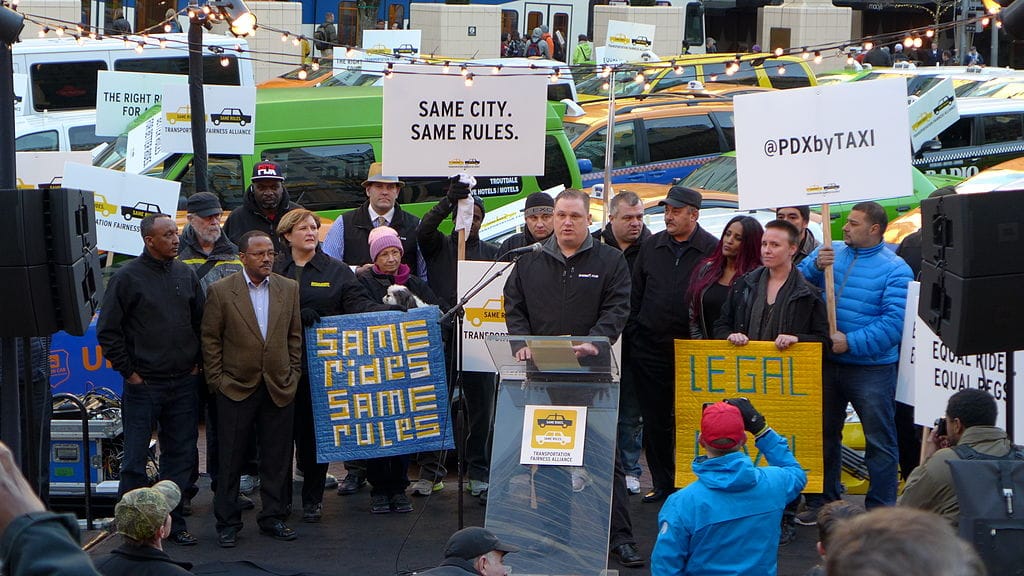
Taking a step back though, Uber’s relationship with unions has been strained for a long time. Kalanick likes to frame Uber as taking on the “Big Taxi Cartel” and it’s clear who’s winning. Uber has helped drive a number of taxi companies to file for bankruptcy, such as San Francisco‘s largest, traditional taxi company last year. The largest taxi company in the world is now Uber; so, it’s hard to see them as the underdog taking on “Big Taxi.” Uber is Big Taxi.
And drivers expecting the Democratic Party to intervene on their behalf in Congress should remember Barack Obama’s campaign manager and former Senior Adviser David Plouffe is closely tied to Uber, working as an executive starting in 2014 and later as a senior strategist. (In January, Plouffe was hired away by Facebook CEO Mark Zuckerberg’s social advocacy outfit, where he also may be helping Zuck plot a presidential run.) Uber likely thought they were buying some lobbying power when they dropped millions of dollars hiring him. Plouffe made a lobbying trip to the Seattle in December 2015 and told Seattle Times reporter Daniel Beekman that Uber drivers didn’t need a union, and, by virtue of being independent contractors, they had no legal right to engage in collective bargaining, anyway.
Seattle’s Uber Driver Union Push
In 2014, Seattle Uber drivers began a push to unionize. Uber management pushed back and questioned their motives. The drivers’ complaints were many, including being suspended with little explanation and an authoritarian attitude and lack of respect from managerial staff. The Uber app interface also makes it difficult and less likely customers will tip their drivers, which ends up further driving down drivers’ income. In December of 2015, the Seattle City Council passed a first-of-its-kind law explicitly allowing Uber and Lyft drivers to unionize. Momentum was still slow and Uber ramped up advertising using scare tactics to paint unionization as bad for drivers, including a Superbowl ad. Uber followed that up with a lawsuit against the City of Seattle last month. It’s hard for local unions to match the resources of a global behemoth, but perhaps Seattle Uber drivers will succeed in their unionization efforts.
Wage Wars
For many drivers, it doesn’t seem Uber pays particularly well, perhaps less than minimum wage in some cases–although granted that’s legal since Uber classifies its drivers as independent contractors. Uber slashing fares last year cut into driver wages and the “guaranteed hourly” program it implemented (for qualifying full time drivers in some markets) to compensate didn’t prove very beneficial and actually ate into the boost drivers formerly got from surge pricing. And of course, after factoring in expenses like gas and vehicle depreciation, some drivers report barely turning a profit (see video below). Some Uber drivers even sleep in their cars to clock more hours or avoid long commutes to neighboring cities where they reside.