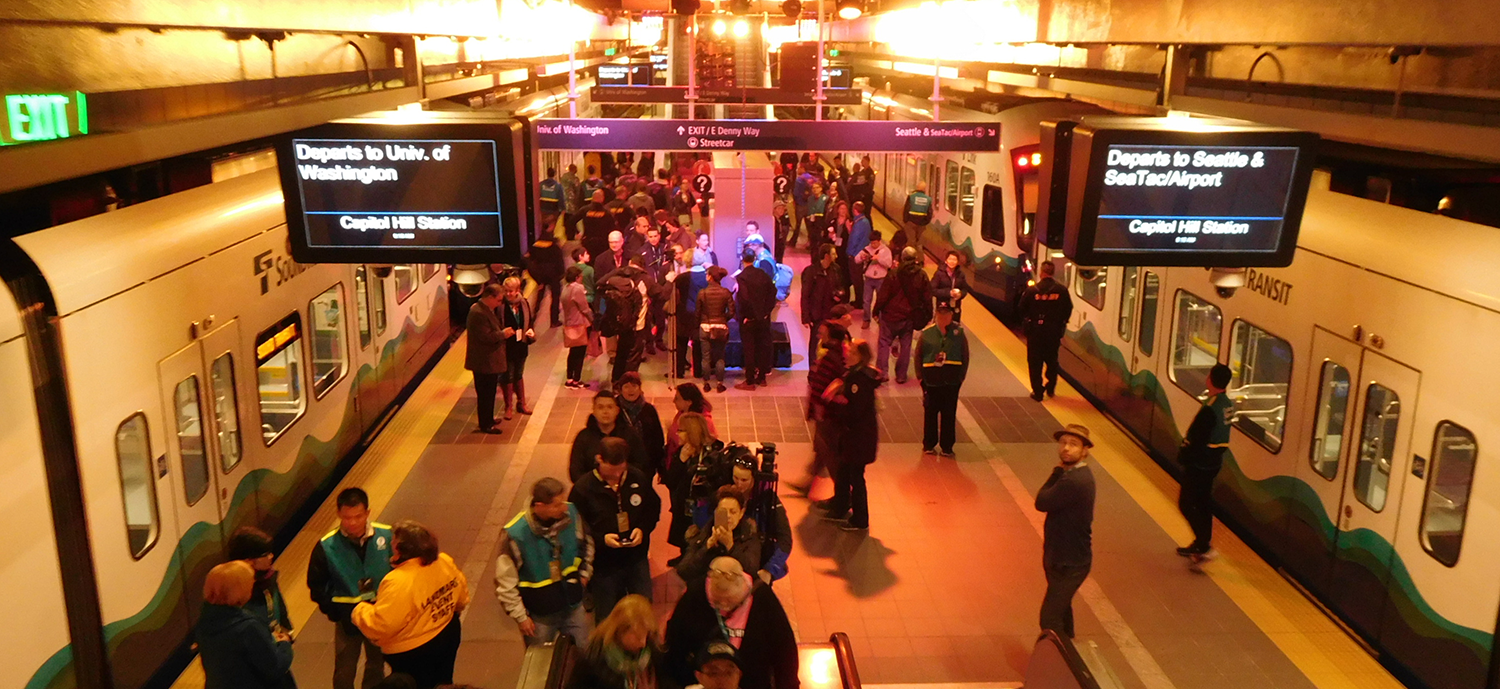
Twenty years ago, when voters first approved Sound Move, the idea of rapid rail transit in Seattle was only a fuzzy concept. It was something that had been declined by 1960s voters and only the oldest residents might have recalled the city once had a sprawling network of streetcars. But finally, in 2009, the central portion of Link light rail opened between Downtown and the airport and opened up a new realm of transportation. Seattle’s transit world grew again with the next two stations that opened Saturday.
Sound Transit’s purpose is to provide mass transit connections between the central Puget Sound’s urban centers. It originated out of the 1996 Sound Move ballot measure approved by voters in the urbanized areas of King, Pierce, and Snohomish counties. The measure was a $3.9 billion transit package, including $1.7 billion for a 25 mile light rail system, that also funded intercity express bus lines, the Sounder commuter rail service between Everett and Lakewood, and the Tacoma streetcar. The measure also funded infrastructure like HOV lanes, transit centers, and park-and-rides.
As part of this package Central Link was originally supposed to reach the University District. However, in the late 1990s Sound Transit’s ambitions exceeded its fiscal realities and federal grants dried up. The agency came under fire for its poor planning and financial mismanagement. New leadership in the early 2000s achieved a clean audit and the agency was awarded federal funding for Central Link, but by then the line couldn’t be extended to its original terminus and ended in central Downtown Seattle. A stop in First Hill was also cut, resulting in Sound Transit funding the First Hill streetcar to connect that neighborhood with other light rail stops.
By the end of 2009 the 15 mile Central line was operating between SeaTac airport and Westlake Station. Stops in-between include Tukwila, the Rainer Valley in southern Seattle, Beacon Hill, Sodo, and three other stops in the core of Downtown. Average weekday passenger counts have increased year over year, peaking above 40,000 last year.

University Link is a northward 3.15 mile underground extension of the original line using twin-bored tunnels. At their deepest point beneath Volunteer Park the tunnels are 300 feet below ground. Sound Transit says the $1.9 billion project was completed six months ahead of schedule, $200 million under budget, and without any major construction injuries. The addition of the two stations is expected to add 71,000 average weekday riders to the system by 2030.
University of Washington (UW) Station
The University Link extension nearly fulfills the original vision to reach the U-District. The neighborhood hosts 45,000 students at the University of Washington’s main Seattle campus. Link’s new northern terminus, UW Station, is on the southernmost edge of the campus next to Husky Stadium and the monolithic UW Medical Center. As part of the next project, called Northgate Link, an actual U-District station at the corner of Brooklyn Avenue and NE 43rd Street is currently under construction and planned for opening in 2021, along with stations in the Roosevelt neighborhood at NE 65th Street and at the Northgate Mall at NE 103rd Street.

UW Station is poorly located. Husky Stadium hosts only six home football games per year, and the station itself is surrounded by a massive asphalt parking lot and six lanes of pedestrian-hostile Montlake Boulevard. The station is essentially a compromise between a location in the heart of the campus proper, which short-sighted university officials opposed, and the Montlake Freeway Station at SR-520 that provides access to Eastside job centers like Redmond, Bellevue, and Kirkland. Instead, both students and Eastside bus riders who want to transfer have a minimum ten minute walk to and from the station’s awkward location. There are also zero commercial services within sight of the station, not so much as a coffee stand, and there is no chance for transit-oriented development like apartments or even student housing.
That said, Sound Transit made the best of the situation by building a generous pedestrian and bicycle bridge over Montlake Boulevard and a land bridge across NE Pacific Place, allowing people to reach the station from campus without crossing roadways. There are also new connections to the regional Burke-Gilman Trail, a popular bicycle commuting route that stretches westward to Ballard and northward to neighborhoods along the shores of Lake Washington. A new plaza, furniture, lighting, wayfinding signs, bicycle parking, and an abundance of trees help improve the otherwise desolate locale. The station will also be convenient for the 4,300 employees at the UW Medical Center, and certainly it is still close enough to the UW campus to spark a paradigm shift in how U-District workers and residents will get around. Sound Transit projects the station will see 25,000 daily passengers by 2030.

Part of that shift will also come with significant changes in King County Metro’s bus network. Next Saturday, March 26, northeastern Seattle will see new and consolidated routes with higher frequency than ever before. Much of the changes are designed to deliver far-flung riders to UW Station to provide a more reliable trip to Downtown and beyond, whereas before the workhorse routes 71/72/73 alternated between the Interstate 5 express lanes and slogging through surface street traffic. I was part of the Sounding Board that oversaw the restructure and made a series of posts on the process.
Capitol Hill Station
The bus network isn’t changing nearly as much in central Seattle, but Capitol Hill Station promises to make an even bigger change in lifestyles and commutes. The station is smack in the middle of Seattle’s most densely populated neighborhood (nearly 50 people per acre) and surrounded by bars, restaurants, shops, parks, and other attractions of all types. As such, the neighborhood is highly walkable and has existing bus service to and from the station. The First Hill streetcar’s northernmost stop is also directly outside one of the station entries. The streetcar connects to several hospitals and Seattle University, which enrolls 7,000 students, and the station itself is within a stone’s throw of Seattle Central College’s 16,000 students. Sound Transit projects daily ridership of 14,000 passengers by 2030.
Two of the station entries currently stand amid bare pavement on a 2.6 acre site. Sound Transit has partnered with a developer to construct a mixed-use development on top of the station, with construction slated to begin this year. Up to five six-story buildings will contain retail space and 418 apartments; 38 percent of the apartments will be required to rent below market rates for 12 years, and 20 percent will be permanently rent below market rates. A third of the units will have at least two bedrooms. The site will also have a daycare and a new plaza space for the Capitol Hill Farmer’s Market and other community events. A post on Capitol Hill Seattle Blog documented the mix of buildings which used to stand on the site, none of which were taller than three stories.
First impressions
Among about a thousand other people I was lucky enough to win a “golden ticket” for the first public ride between the two new stations. The ceremonies began with an activation of UW Station, shown in all its glory in the video below.