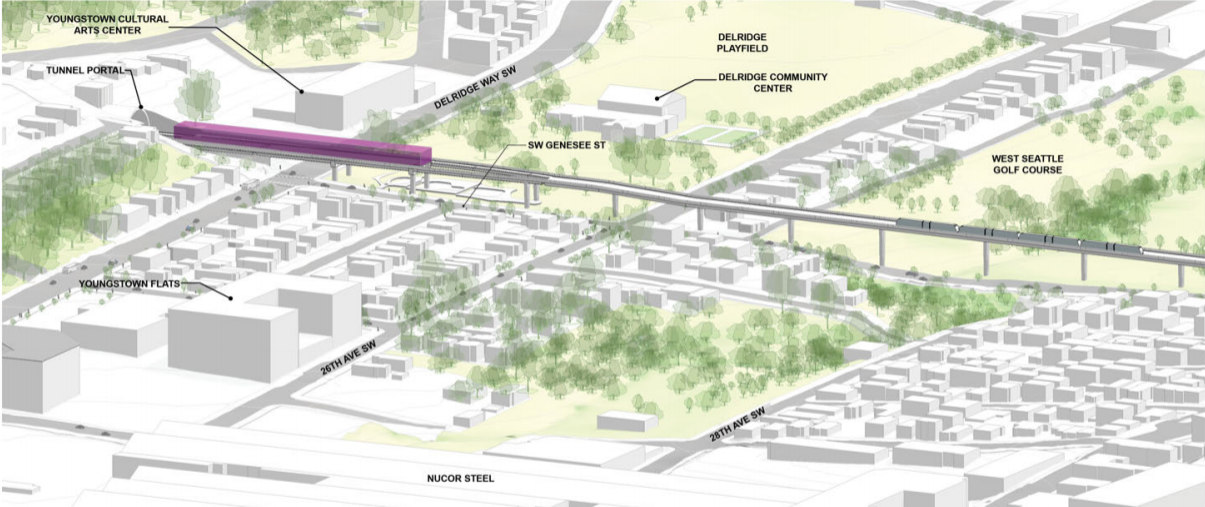
Some political leaders are in full court press to add a West Seattle tunnel to the Sound Transit 3 (ST3) package. Apart from adding at least $700 million in costs, Sound Transit can discern minimal operational benefits to such a decision. Projected ridership would only increase by 1,000 to 2,000 daily boardings. Transit times would be the same. It’s time to put the idea to bed.
But we should not walk away from the idea of investing more in transit using third party funding. Instead of simply burying the light rail line we are already building, there are a whole range of options to provide access across the city. Primarily, more neighborhoods could be served with the ST3 facilities. Think of how many better ways we have to spend $700 million!
- Light rail extensions. Extend Ballard Link northward and West Seattle Link southward.
- Speed up bus, bike, and pedestrian upgrades Move Seattle promised. Deliver RapidRide upgrades, sidewalks additions, and new protected bike lanes on a faster timeline and avert cuts that are being planned in the face of a $96 million shortfall.
- Rapid rollout of bus-only lanes. The Move All Seattle Sustainably (MASS) coalition is pushing dedicated bus lanes as a way to deal with the gridlocked transportation system we are experiencing with the Seattle Squeeze.
- Pedestrianize streets. Streets like Pike Place, Pine Street, Bell Street, Ballard Avenue, and University Way (“The Ave”) should be pedestrianized.
Onward to White Center: Extending West Seattle Link
Sound Transit estimated extending West Seattle Link south to Burien would cost $2.8 billion (in 2014 dollars). The catch is that the estimate is predicated on elevated rail. A subway option wouldn’t just be way more expensive to build to Alaska Junction, it would also be more costly to extend further south. Easier expandability is a key argument for choosing the elevated option to Alaska Junction. And while $700 million wouldn’t get us all the way to Burien, it might get us to High Point. Do we want to serve the racially diverse High Point neighborhood as soon as possible or just provide a tunnel for the purposes of optics at Alaska Junction?
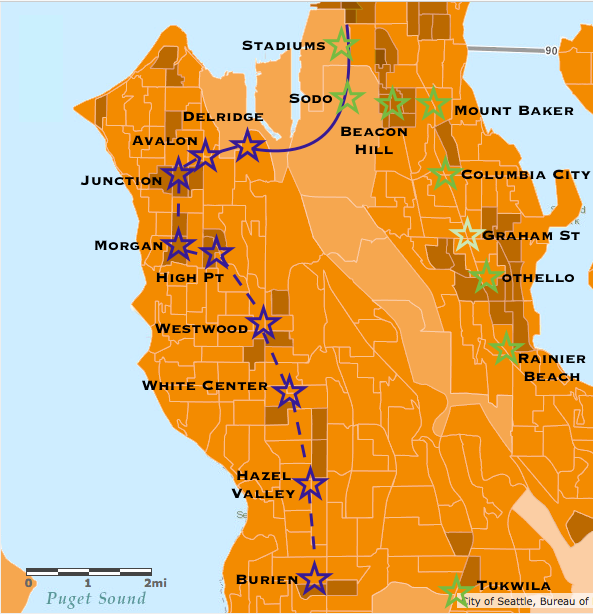
Another problem for West Seattle’s tunnel alignment is that it appears to require the bridge to be north of the existing West Seattle bridge, exactly where the Port of Seattle doesn’t want it. The Port makes a pretty good case too since the north side of the bridge is loaded with industrial infrastructure, including the primary fuel facility for Washington State Ferries, as well as Terminal 5, which the Port just spent $300 million supersizing for the new mega class of container ships.
Yet another problem is that the tunnel is a failure under the equity lens. A tunnel is popular on top of the hill, but Delridge generally doesn’t like it because it focuses the property takings and disruption at the bottom of the hill instead and also forces the station to be at a less convenient location for Delridge residents. The top of the hill is relatively white and wealthy while Delridge is more racially diverse and less wealthy.
It wasn’t too long ago that Seattleites repeatedly voted for the monorail, which promised to bring elevated trains to West Seattle, some in cutesy “iris” configurations. There seems to be a bit of selective amnesia toward history now going. The truth is that elevated rail lines can be harmonious features of the urban environment. One does not have to look far to for a good case study of this with SkyTrain in Vancouver, British Columbia. But there are ample others in New York City, Chicago, London, and Busan.
But if Alaska Junction residents are so committed to the cause of building an expensive and lavish tunnel, they should foot the bill, perhaps by forming their own Local Improvement District to tax themselves for the luxury of a non-essential tunnel. This should not fall on the rest of Seattle as our deficit of transportation needs is large and growing.
Crown Hill or Better: Extending Ballard Link
Likewise in Ballard, an elevated option would likely be cheaper to extend. Sound Transit estimated it would take about $360 million to extend Ballard Link to Ballard High School at N 65th St. Going farther north wasn’t on the ST3 menu, but it’d make sense to connect Crown Hill, Greenwood, and Aurora-Licton Springs, too. Reaching Aurora Avenue and N 105th St would only take another 3.5 miles. A station at NW 65th St would finally put Ballard’s rail transit where it would have been if Forward Thrust had passed in 1970.
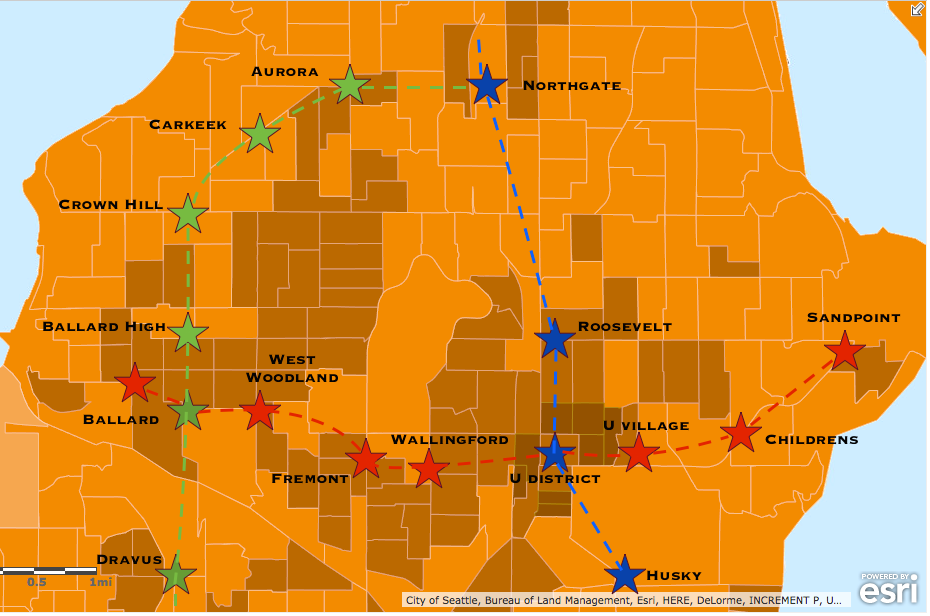
Plus, stretching Ballard Link all the way to Northgate (another three-quarters of a mile) could open up a world of transfer possibilities and balance loads on our light rail network. Stations could be designed for convenient connections to Route 45 on NW/N 85th St, Routes 5 and 28 (straddling Greenwood Ave N and 3rd Ave NW), and RapidRide E on Aurora Avenue. Seattle Subway has proposed such an alignment on their latest map.
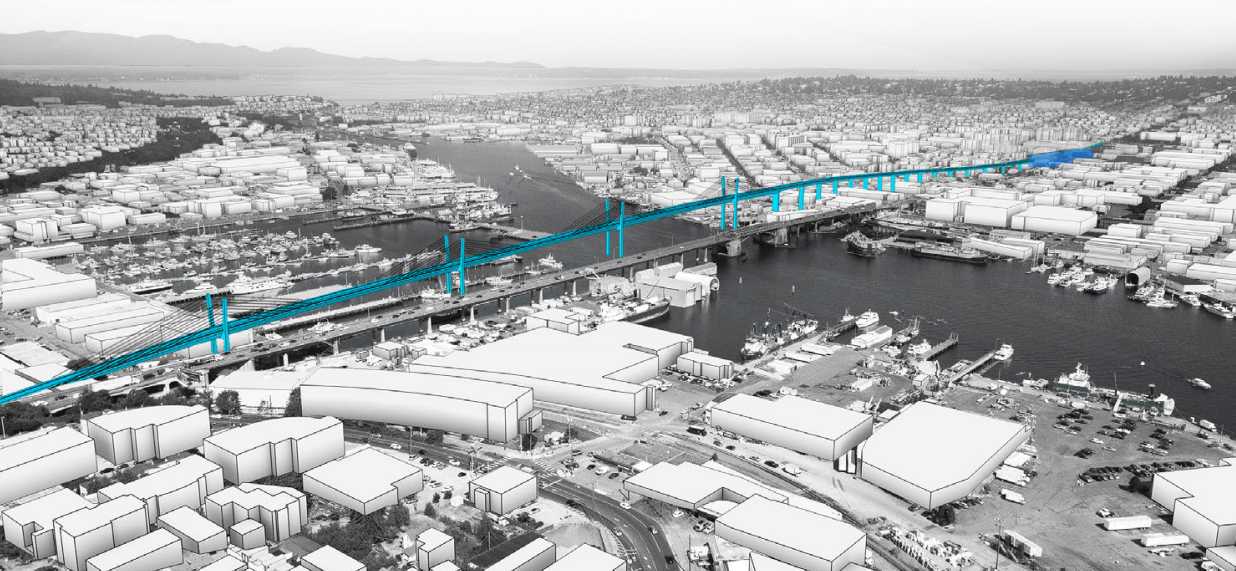
On the other hand, Seattle Subway has been critical of Sound Transit’s proposed movable bridge option for Ballard. In its place, Seattle Subway has been adamant that the Salmon Bay crossing must be an underground tunnel or a fixed high bridge to ensure reliability in the network. Moreover, they’ve insisted Ballard’s station should be at 15th Ave NW rather than 14th Ave NW for better connections.
Unfortunately, the alternatives process, lead by the elected leadership group, has already unceremoniously eliminated the 15th Ave NW high bridge option, leaving only the 14th Ave NW option and an expensive tunnel. This puts transit backers in a tough spot to advocate for future riders.