Yesterday, Challenge Seattle hosted a conference that demonstrated widespread support for high-speed rail among political and business leaders in Cascadia. And then there was Peter DeFazio, the Democrat who has represented Oregon’s 4th Congressional District since 1987. During the “Federal Partnership” session, Representative DeFazio came out as a hyperloop enthusiast and high-speed rail skeptic.
The Southwest Oregon legislator emphasized the high-speed rail’s cost and suggested that a hyperloop would be much much cheaper–despite little evidence for that other than dubious promises of erratic billionaires like Elon Musk. No pressurized vacuum tube mass transit system (i.e., hyperloop) operates anywhere in the world beyond small-scale experiments, and there have been broken promises for gullible cities like Los Angeles.
Rep. DeFazio’s skepticism wouldn’t matter much except that he chairs the U.S. House transportation committee, making him one of the most powerful transportation policymakers at the federal level. If Cascadia high-speed rail is to get significant support from the federal government, it will have to go through Chair DeFazio–at least until the next round of committee shakeups or his retirement. Rep. DeFazio is 72.
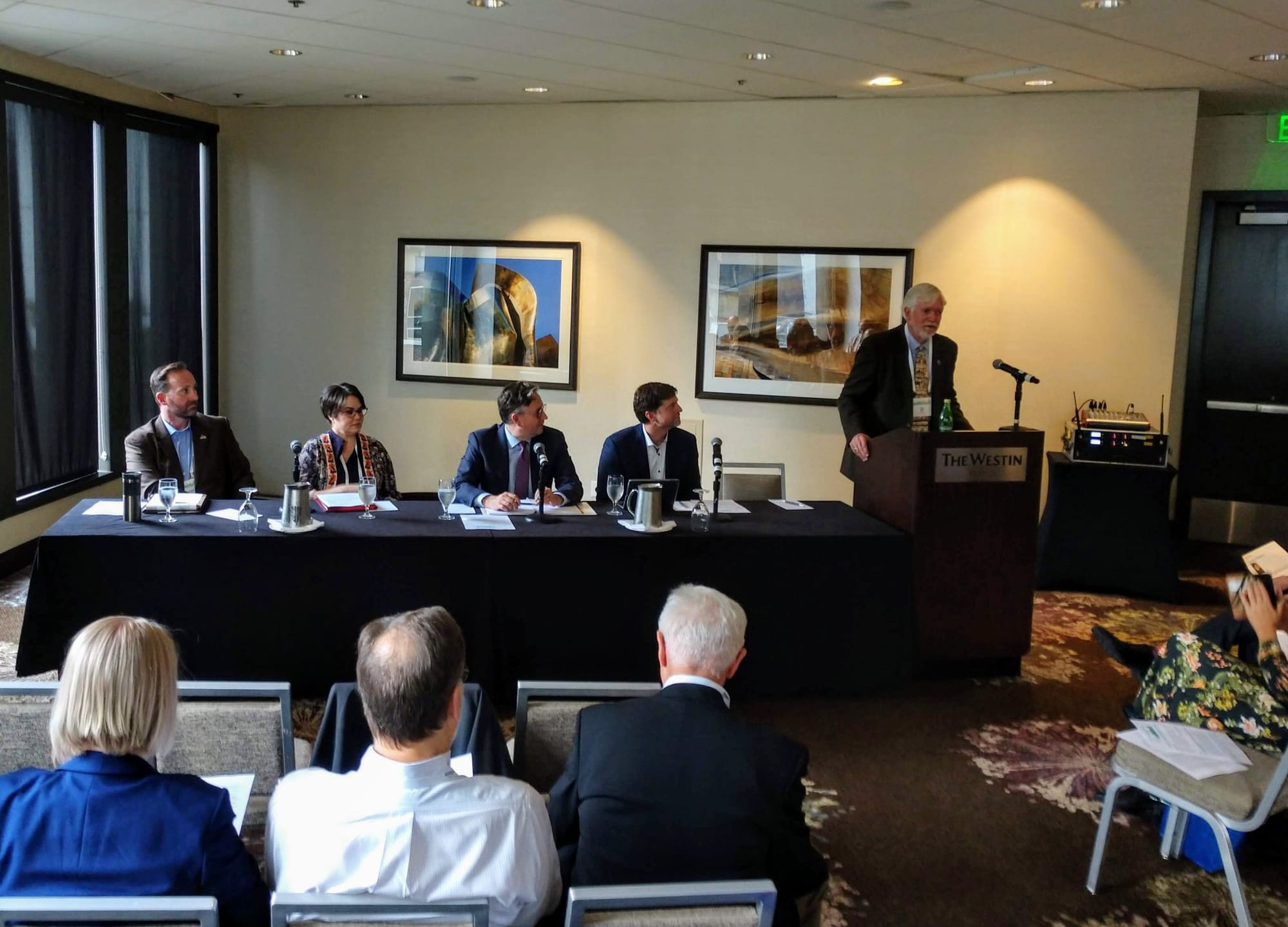
Business and governmental leaders from Oregon to British Columbia convened at the Westin in Seattle for the “Connect Cascadia” conference to explore how to foster stronger collaboration in the Cascadia region. The biggest course on the menu was high-speed rail from Vancouver, B.C. to Portland, and potentially on to Eugene. With Rep. DeFazio’s notable exception, most speakers at the Cascadia Innovation Corridor conference seemed bullish about the prospects for high-speed rail along the I-5 corridor.
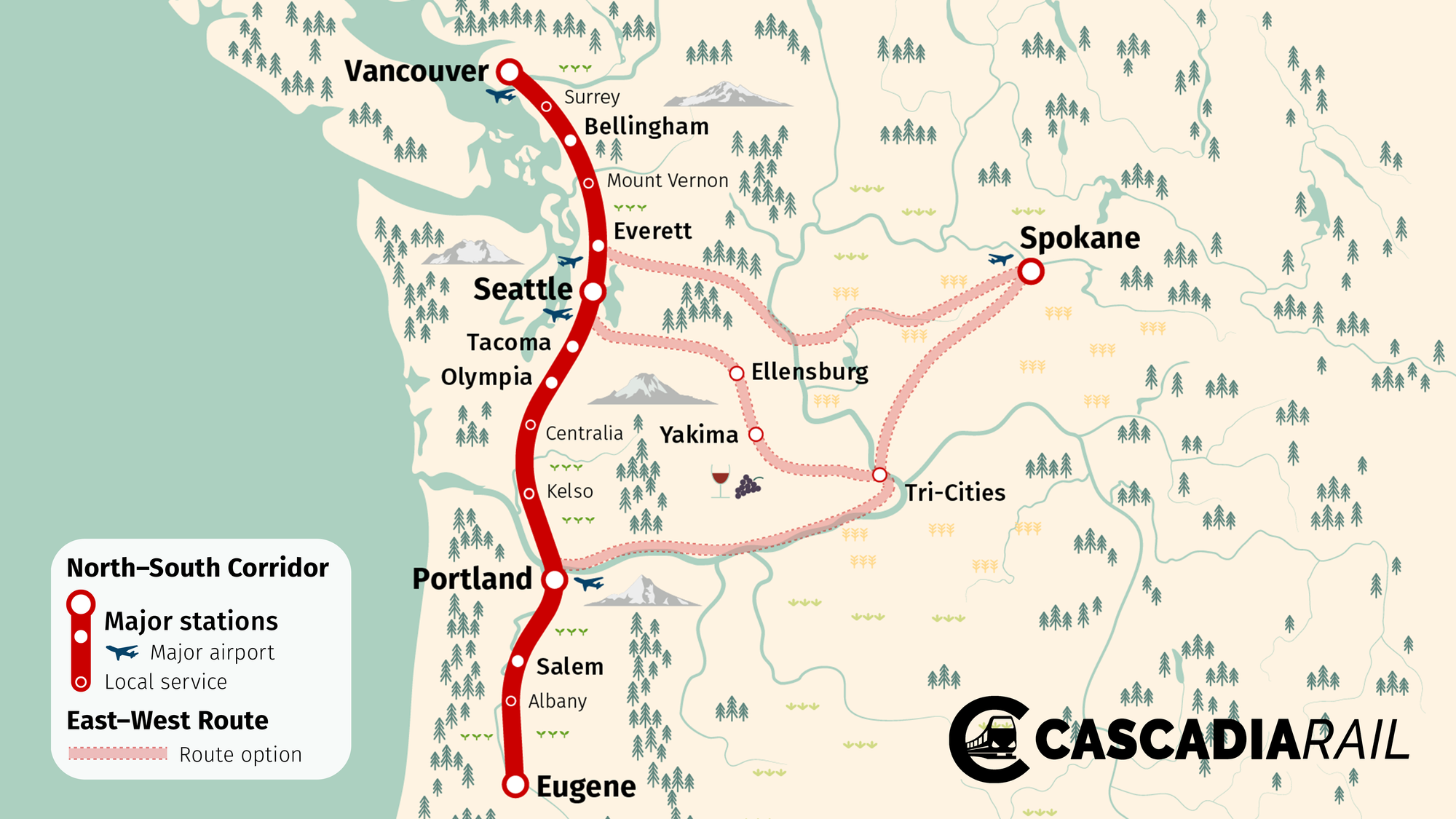
Governor Jay Inslee and British Columbia Premier John Horgan shared the stage and announced a new shared 100% clean energy grid pact between their jurisdictions. They both talked up high-speed rail as a means to to unite the region, drive down carbon emissions, and overcome congestion on I-5, which is hindering economic growth and mental well-being of many a traveler in the region.
$115 billion for I-5 widening or high-speed rail for a third the price?
In a transportation-focused breakout session, Washington State Department of Transportation (WSDOT) Secretary Roger Millar delivered an update on the “ultra-high-speed ground transportation” study–and the alternative of widening I-5. Adding one freeway lane in each direction from Canadian border to the Oregonian border would cost $110 billion, Millar said, “and the lanes would be full as soon as they open.”
“So why spend money on ultra-high-speed rail with all this going on?” Millar said. “We need to look out 165 years. We need to look out 50 years. We need to think about what kind of population are we going to have, what’s the land they’re going to live on, and how are they going to get around.”
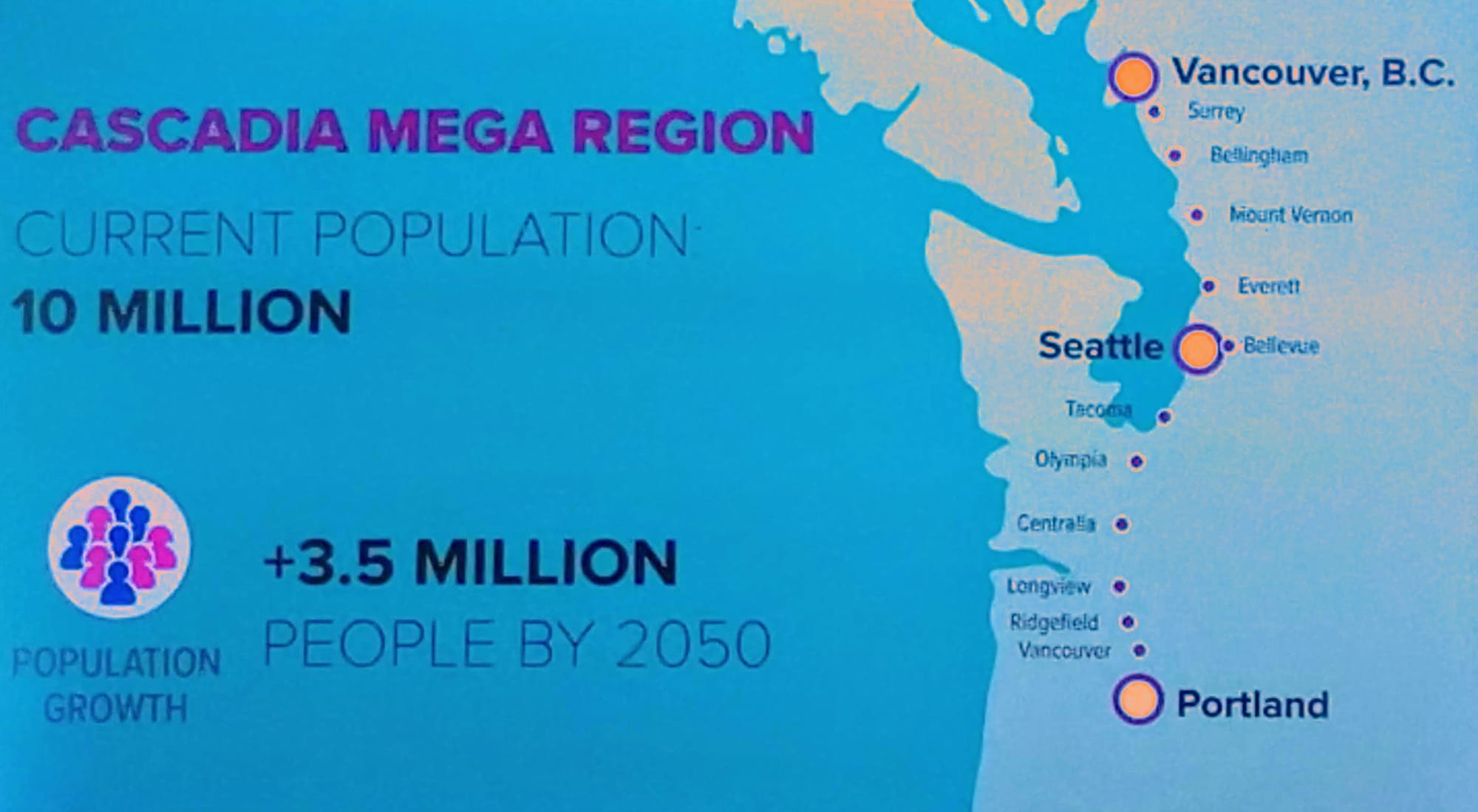
“We looked at what would it take so that everybody can drive 60 miles per hour whenever they want. It’s $115 billion dollars. If we built that on gas tax and bonded it on the gas tax, we would only need to raise our gas tax $2.50 to do it,” Secretary Millar said. “And that’s only the people here today. It doesn’t account for growth. And it doesn’t account for growth in city roads and county roads that would be connected to this glorious transportation system where you can drive 60 miles per hour any time you wanted.”