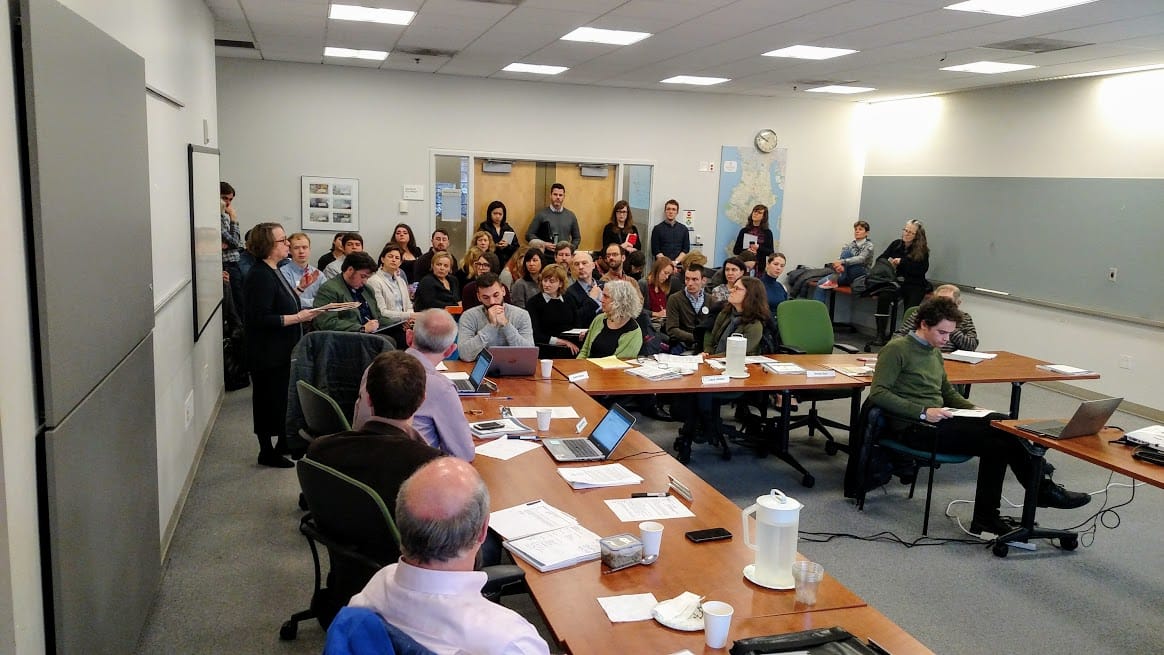
Yesterday both the City of Seattle and Community Package Coalition told the planners of the Washington State Convention Center (WSCC) Addition that the public benefit package was too small for the 1.5 million square foot project that is still holding out hope to break ground this year. The WSCC received this feedback at the Seattle Design Commission’s first hearing on public benefits.
“We’ve come together today to speak with one voice asking the design commission to ensure that the initial proposal offers benefits commensurate with the enormous scale of this project,” Community Package Coalition representative Alex Hudson said. “This is a $1.6 billion project and it’s the singe largest real estate development project in the history of Seattle. The project’s size, central location, public ownership and extensive requests for public right of way compels the Washington State Convention Center to also offer accordingly large investment in our communities.”
The Community Package Coalition is composed of nine different non-profits and advocacy groups including the First Hill Improvement Association, which Hudson leads as Director.
“Simply put, the size of the public benefits package being proposed is nowhere near fair or commensurate with what the developer is asking the public to give up or the permanent impact,” Hudson added.
Community Package Coalition strategy of speaking with one voice seemed to impress the commission. “This is the most impressive community proposal we’ve seen–very helpful,” Seattle Design Commissioner John Salvo said.
Following public comment, the members of the Seattle Design Commission also grappled with what is commensurate public benefit for the project. The commissioners couldn’t settle on a number or scope, but they seemed supportive of a large public benefits package, generally.
Ultimately, one outcome of the hearing was the Lid I-5 study moved forward, while the proof-of-concept prototype Pine-Boren Lid Park got rejected at this point.
Chair Shannon Loew asked, "What is commensurate?" Answer: "It's not clear" but they compared to benefits of similarly-sized Amazon project.
— The Urbanist (@UrbanistOrg) February 16, 2017