The Terrible No-good Very Bad Use Table
Over this series of articles, I am laying out an argument that Seattle should mix industrial uses in our residential and commercial neighborhoods. A long history of exclusion keeps interesting and useful things out of our communities, an absolute loss for building a vibrant and vital city. Now is the time to change this because the lines have disappeared between the places we work, create, build, and live. Right now, every neighborhood is mixed use.
Read part one of the series here. And read part two of the series here.
After last week’s tour of zoning history, this is going to be a slightly different type of article. First, it’s shorter (waits for cheers). Second, we’re going to focus on a very specific part of the zoning ordinance–the use table (waits for groans).
The use table is a chunk of the zoning ordinance that has a long list of permitted, prohibited, and conditional uses running along the left side, and the list of zones along the top. Find the use you want–say animal shelter–and the zone your property is in–say Industrial General (IG). Where the two axis meet, there is an X for prohibited, P for permitted, or some mix of cryptic notes describing the conditions that allow you to open. For animal shelters in the IG zone, you’re good, permitted outright.
There are only two traditional use tables in Seattle’s zoning code. Industrial and commercial zones maintain lists of 130 or so uses with designations that each is allowed or not. With the exception of multifamily zones, the rest of the zones (there’s 23 others) don’t have use tables. They just have the list of permitted uses and prohibited uses.
And here is a taste of the use table for Seattle’s industrial and commercial zones. The entire combined grid is linked here and also attached at the bottom of this article for your perusal.
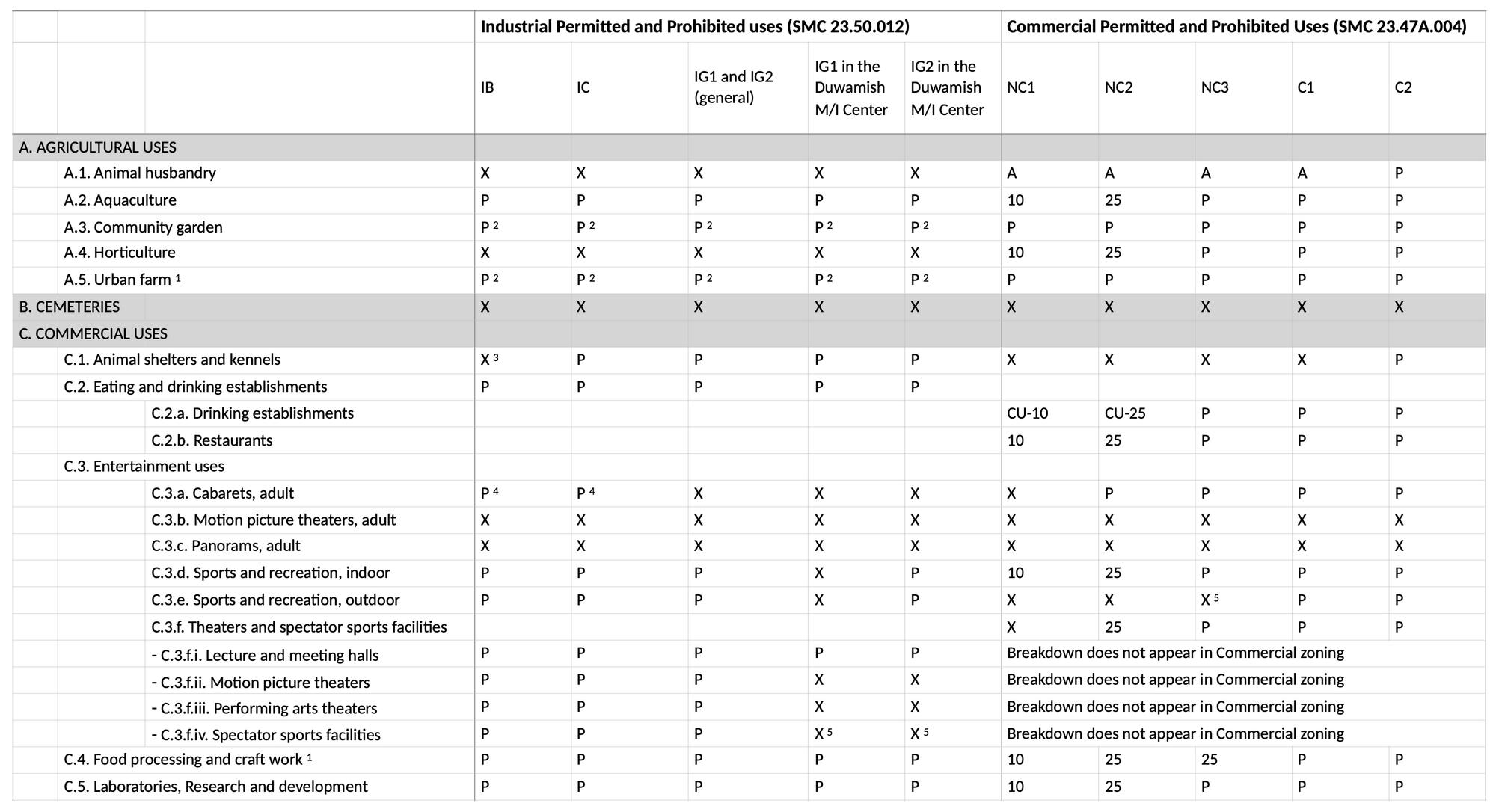
Three takeaways
First, the table is not about rules. It’s about exceptions. For clarity, the text of footnotes are omitted from this table, but available in commercial and industrial parts of the code. Between industrial and commercial zoning, there are 43 footnotes that change the meaning of 136 individual uses.
Some footnotes are ridiculously specific, like footnote 12 in industrial zones. “Major institution uses are permitted only in a building existing on October 7, 1987, except that such uses are permitted on properties located outside of the Ballard/Interbay/Northend Manufacturing and Industrial Center that are located in an area south of the Lake Washington Ship Canal, east of 8th Avenue West, north of West Nickerson Street, and west of 3rd Avenue West regardless of whether the use is located in a building existing on October 7, 1987.” Or industrial footnote 13 “On IC zoned parcels within the Ballard Hub Urban Village and abutting Market Street, museums are allowed in new buildings or structures.”
Second, for over half of the listed uses, the Industrial General zone and the Commercial 1 and Commercial 2 zones agree. Where they depart, it is most often the commercial zone that is more permissive than the industrial zone. Industrial zones do not allow residences, elementary schools, or religious facilities. Commercial zones do.
For commercial uses like sales, the general industrial and commercial zones agree. They’re permitted across the board. Retail sales and services in general, and specifically for marine goods, automobiles, and heavy equipment specifically, are allowed in all of the industrial zones and all of the general commercial zones. Mini-storage (listed as “mini-warehouses”) are allowed in all of the industrial zones and commercial zones. This is the spot that sets up the competition between industrial uses and grocery stores for space in industrial zones.
For the big three industrial uses–heavy industry, heavy manufacturing, and utilities like power plants and landfills–commercial and industrial zones also agree. In most cases, they are not allowed. It’s only with conditional approval from the city council or the Seattle Department of Construction and Inspections that these uses are permitted in Industrial General zoning.
The code requires these conditional permits be based on management plans, definitions found in the National Electrical Code and the National Building Code, and consultations with Puget Sound Clean Air Agency and Public Health of Seattle & King County.
Take for example Nucor Steel, located just next to the currently inert West Seattle Bridge. Running electric furnaces on Seattle City Light’s hydroelectric power and outputting only steam, it is nothing like the smoking steel foundries of the last century. And it is surrounded by the Youngstown neighborhood it helped build. Zoning did not forbid this, nor does it mitigate the impacts of this high intensity use. Instead, Nucor files regular permits with state agencies. We rely on a network of regulatory and agency review–not zoning– to manage or clean up industrial uses.